Working memory in the fly brain: a gate that writes a goal
A Nature study published on 7 October 2026 shows how a fruit fly saves a direction the instant a smell arrives: one set of neurons holds what to remember, another decides when, and an inhibitory gate sits between them. It is one of the clearest pictures yet of a memory write operation in a real brain.
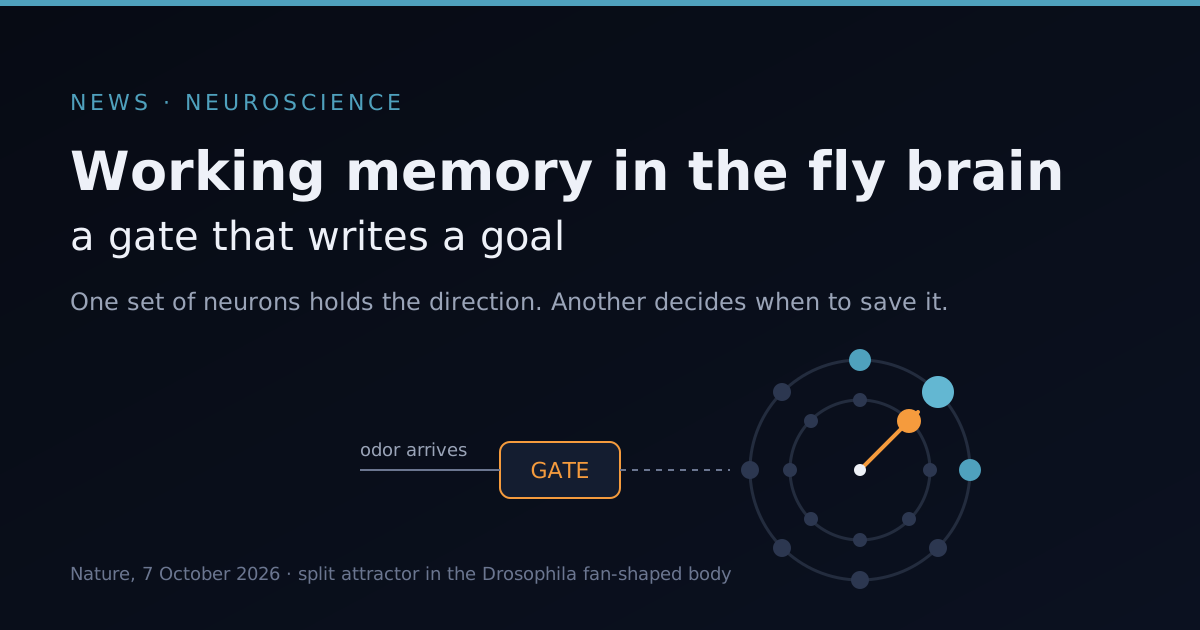
A fruit fly walking in the dark catches a whiff of apple cider vinegar. It turns toward the source. Then the smell is switched off, and the fly keeps walking along the same heading for several seconds, as if it had written the direction down. On 7 October 2026, a team led by Katherine Nagel at NYU Grossman School of Medicine, with the mathematician Bard Ermentrout at the University of Pittsburgh, published in Nature the circuit that does the writing. Its design is the news: the neurons that hold the remembered direction are not the neurons that decide when to store it, and an inhibitory gate sits between the two.
That split answers a question that has been open for decades. Neuroscience has a good theory of how a brain holds a value for a few seconds. It has had a much weaker account of how a brain decides, in a fraction of a second, that this value, now, is the one to keep.
Holding a value is the easy half
Short-term memory of this kind, the ability to keep a number, a location or a direction in mind for seconds after the cue is gone, is called working memory. The leading explanation for it is the attractor network: a group of neurons wired to excite each other so strongly that, once a pattern of activity starts, it sustains itself without any further input. The pattern is the memory. It persists because the network keeps feeding it.
The fly is the best place in biology to see one. In 2015, Johannes Seelig and Vivek Jayaraman imaged a ring-shaped structure in the fly’s central brain and found a single bump of activity that moved around the ring as the animal turned, like the needle of a compass. In darkness, with no landmarks and no motion, the bump stayed put. That is an attractor holding a heading, and it matched what theorists had predicted for years.
But a self-sustaining memory has an awkward property: it does not want to change. A network that keeps its pattern against noise will also keep it against new information. Any working memory therefore needs a second mechanism that lets it be overwritten at the right moment and protects it the rest of the time. In models, this is usually a parameter the theorist turns by hand. In a brain, somebody has to turn it.
Content in one place, timing in another
The new study works in the fan-shaped body, a region downstream of the compass that holds the fly’s goals rather than its current heading. It focuses on two cell types. PFG neurons receive the compass signal: they carry the content, which direction the fly is facing. hΔK neurons (read “h-delta-K”) are connected back to the PFG neurons in a loop that can sustain a bump of activity, but in normal conditions they are held silent by inhibition.
When the attractive odor arrives, that inhibition is released. This is disinhibition, switching something on by switching off the thing that was suppressing it. With the gate open, the loop closes: hΔK and PFG activity lock onto each other and capture whatever heading the compass reports at that moment. When the odor goes, the bump persists, and the fly keeps steering along the stored direction.
The authors call this a split attractor: the self-sustaining loop is divided across two populations, one carrying content and one carrying timing, joined by a gate that opens only when information needs to be kept. They support it with recordings of the neurons during behavior, the fly’s complete wiring diagram (its connectome, the map of every synapse, which is now available for the whole fly brain), and a computational model. In that model, about thirty hΔK units and eighteen PFG units with a single shared inhibitory unit are enough to reproduce the write and the hold.
Two further details explain why the design is robust. The excitation inside the loop is slow, which lets the bump settle and stay stable even when individual connection strengths vary from cell to cell. The inhibition is fast, which gives the gate precise timing. Slow to hold, fast to switch: the two speeds do two different jobs.
Why the split matters beyond flies
Anyone who has looked inside a computer will recognize the pattern. A memory register has data lines, which carry the value, and a separate write-enable line, which decides whether the register takes the new value or keeps the old one. The value and the permission are separate signals, and the permission is cheap and fast.
Machine learning arrived at the same idea in 1997, when gated recurrent networks such as the LSTM added explicit “write” and “forget” gates to neural networks so they could keep information across long sequences without having it smeared by every new input. The fly circuit is not an LSTM, and the resemblance is a convergence of logic, not of mechanism. But it is a strong hint that any system, evolved or engineered, that must hold a value against noise and still update it on demand ends up separating what from when.
For neuroscience, the result matters because the “when” has been the missing half. Theories of working memory in mammals, especially in the prefrontal cortex, the region behind the forehead associated with planning, have long assumed some gating signal without being able to point to the cells that produce it. In the fly, the cells now have names, a wiring diagram and a measured behavior attached to them.
What the study does not show
The memory lasts seconds. That is working memory in the strict sense, and the paper does not address how, or whether, such a trace is passed to longer-lasting storage.
The trigger studied is a single, simple cue: an attractive odor. Real navigation involves competing goals, aversive cues and changing internal states. How several possible “write” signals are arbitrated, or how the fly chooses between two remembered directions, is outside this work. A separate theoretical preprint this summer argued that the fan-shaped body holds a single goal by normalizing activity rather than selecting among candidates; how that fits with the gated write mechanism remains to be worked out.
The step to humans is the weakest link. NYU’s press release says the findings offer a baseline for understanding how executive circuits falter in conditions such as ADHD, schizophrenia and dementia. That is a reasonable research motivation, not a result. Nothing in the paper tests a mammalian circuit, and the fly brain has roughly a hundred and forty thousand neurons, against tens of billions in a human cortex. The principle may travel. The cells do not.
Finally, a model that reproduces the data shows the proposed mechanism is sufficient, not that it is the only one. The strength of this study is that it combines the model with recordings and anatomy. The next test is perturbation at scale: silencing or forcing the gate during behavior and checking that the stored heading appears, vanishes or shifts exactly as the split attractor predicts.
Further reading
- A split attractor design for rapidly writing a navigational goal, the paper, Nature, 2026.
- Fruit fly study reveals mechanics of working memory, NYU Langone announcement.
- Neural dynamics for landmark orientation and angular path integration, Seelig and Jayaraman, the 2015 discovery of the fly’s compass ring.
- In fruit fly brain, a ring for navigation, an accessible account of the ring attractor.