Why a mind needs a body
A machine beat the world chess champion in 1997, yet no robot folds a towel as well as a six-year-old. That inversion has a name, Moravec's paradox, and it explains why AI is finally climbing down into a physical body.
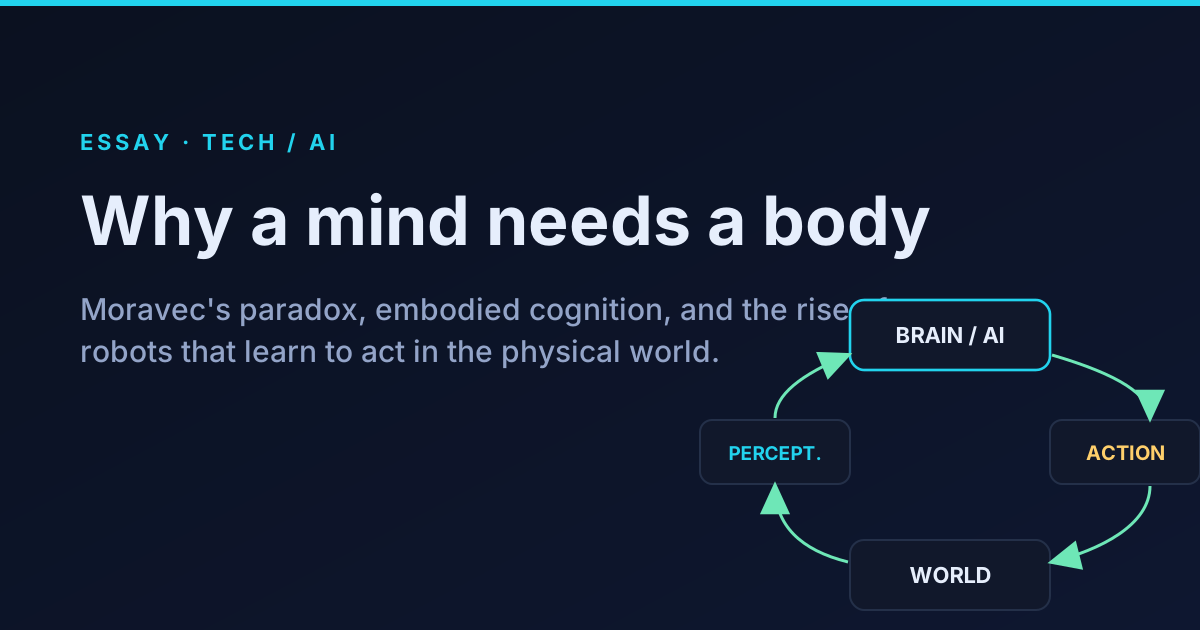
Start with a fact that should seem absurd. In 1997, a machine beat Garry Kasparov at chess, the supposed summit of human intelligence. Nearly thirty years later, no robot folds a bath towel as quickly and neatly as a six-year-old child. Beating the best player in the world: done. Tidying a messy kitchen: still an open research problem. This inversion has a name, Moravec’s paradox, and it is the doorway into one of the most consequential shifts in AI: why “pure”, disembodied intelligence stalls on what a body does without thinking, and how AI is now climbing down into a body to get past that wall.
What is easy for us is hard for machines
Hans Moravec’s observation, around 1988, fits in one sentence: what is easy for us is hard for machines, and what feels hard to us is easy for them. Abstract reasoning (arithmetic, logic, chess) is recent on an evolutionary timescale: a few thousand years of culture. Perception and movement (seeing, grasping, walking, keeping balance) are the product of hundreds of millions of years of selection. That knowledge is so old, so deeply wired, that it runs below the threshold of awareness: you don’t know how you catch a falling glass, your body just does it. And anything unconscious feels simple to us, precisely because we have no access to its complexity. The mistake is an optical illusion: we underestimated movement because we never see it working.
Intelligence lives in the loop, not in the head alone
To understand why grasping is hard, you have to overturn an intuition. We picture intelligence as a brain-computer that thinks first and then commands a body-executor. The thesis of embodied cognition says the opposite: thinking, perceiving and acting are not three stacked layers, they are three beats of a single loop, inseparable. You don’t perceive the world and then act: you act in order to perceive (you turn your head, you touch, you move an object to see it better) and each action changes the next sensory input. The body is not a peripheral of the mind. It is inside the computation.
Why the body is a brutal computational problem
Make the difficulty concrete. In chess, on each turn you choose from a finite number of legal moves (around thirty on average), in a world whose rules are perfectly known, with no noise and no physical surprise. Catching a cup is the opposite on three fronts at once: the space of actions is continuous (your hand can take an infinity of positions), it is high-dimensional (a human hand has on the order of 27 degrees of freedom to coordinate simultaneously), and the world is uncertain: the cup may be slippery, heavier than it looks, badly lit. You are not searching for “the best move” in a list: you are steering, in real time, a system with dozens of dimensions under noisy sensory feedback. That is what a child does without thinking and a supercomputer struggles to do.
Roboticists summarise the gesture as a policy: the action is a function of the perceived state (what the cameras see plus the instruction received). The plain-language version matters more than the notation: a body is a function that turns “what I perceive” into “what I do”. The catch is that nobody wrote that function for you. You learned it, by falling, missing and catching thousands of times in childhood. The dream of embodied AI is exactly that: stop trying to program the function (impossible by hand for 27 uncertain dimensions) and instead let it be learned, from demonstration and trial, the way a child learns.
The 2024–2026 shift: speaking the language of actions
What recently unstuck the field is an idea with real elegance: treat an action as if it were language. Large language models learned to predict the next word from an ocean of text. The trick behind so-called Vision-Language-Action (VLA) models is to make them predict, instead, the next gesture: you give the model a camera image and a plain-language instruction (“put the blue cup in the sink”), and it directly produces a sequence of motor commands, as if it were “writing” the movement token by token. Vision, language and action in a single network: the model that understands the scene is also the one that moves the arm.
Two findings make this approach powerful. The first: you train the model on demonstrations from several different robot bodies: single arm, two-armed robot, mobile base, quadruped, humanoid. This is called cross-embodiment learning, and the result is counter-intuitive: a policy trained on several bodies works better on each individual body than a bespoke policy trained on that single body alone. As if knowing how to move an arm helped you move a leg. It says something deep: motor intelligence is not bolted to one specific body: it is a general skill that tunes itself to whatever body is available.
The second: these models inherit the “common sense” learned from web text and images. Tell a VLA to “clear the table” and it already knows, without being shown, that a cup goes in the sink and a cloth on the rail, because it read about the world before it ever touched it. Language and vision provide the meaning of the task; learning from demonstration provides the gesture. We are beginning to glue back together the two halves that Moravec’s paradox had pulled apart: abstract reasoning (easy for machines) and bodily dexterity (long impossible). That is, very precisely, the trajectory toward a mind that acts in the world.
Where this stands in 2026
The pace is real, but the claims deserve a cool eye. The most-watched line of work is the series of generalist robot policies from Physical Intelligence: after π0, its “first generalist policy”, the company announced π0.7 in April 2026, presented as a steerable robotic foundation model with a step in generalization and early signs of compositional generalization, recombining separately learned skills. “Steerable” and “generalization” are, here, vendor framing; the success rates depend heavily on the tasks and remain to be confirmed outside curated demos.
In parallel, Google DeepMind’s Gemini Robotics family (a generalist VLA built on Gemini 2.0, with 3D spatial perception and on-the-fly code generation) shipped an On-Device version in mid-2025 light enough to run locally on the robot itself, with no cloud dependency. And NVIDIA’s GR00T N1 then N1.5 (2025) are among the first open, customizable humanoid foundation models, pairing a Vision-Language backbone for reasoning with a Diffusion-Transformer action module for motor control. The common thread is unmistakable: the field is converging on reusable “motor brains” that can be pointed at many different bodies, open enough to be tinkered with, and increasingly able to run at the place where the action happens.
Further reading
- Physical Intelligence · “π0: Our First Generalist Policy”: the original post, with videos of the robot folding laundry and clearing a table. The best place to see what this essay describes, with no maths.
- “Vision-Language-Action (VLA) Models 2026”: a 2026 overview of the VLA landscape and the main players. For situating who does what and how the pieces fit.
- “Moravec’s Paradox”: a calm explanation of the paradox and its link to embodied cognition: why evolution made movement both easy and inexplicable.
- “Gemini Robotics: Bringing AI into the Physical World”: the technical reference paper; the architecture figures are worth the detour once the topic has hooked you.