Whose body is this? How the brain decides what counts as you
Owning a body is not a fact but a hypothesis the brain keeps rebuilding from vision, touch and proprioception. The rubber hand illusion hijacks it in three minutes, and the same mechanism lets us inhabit avatars and robotic bodies.
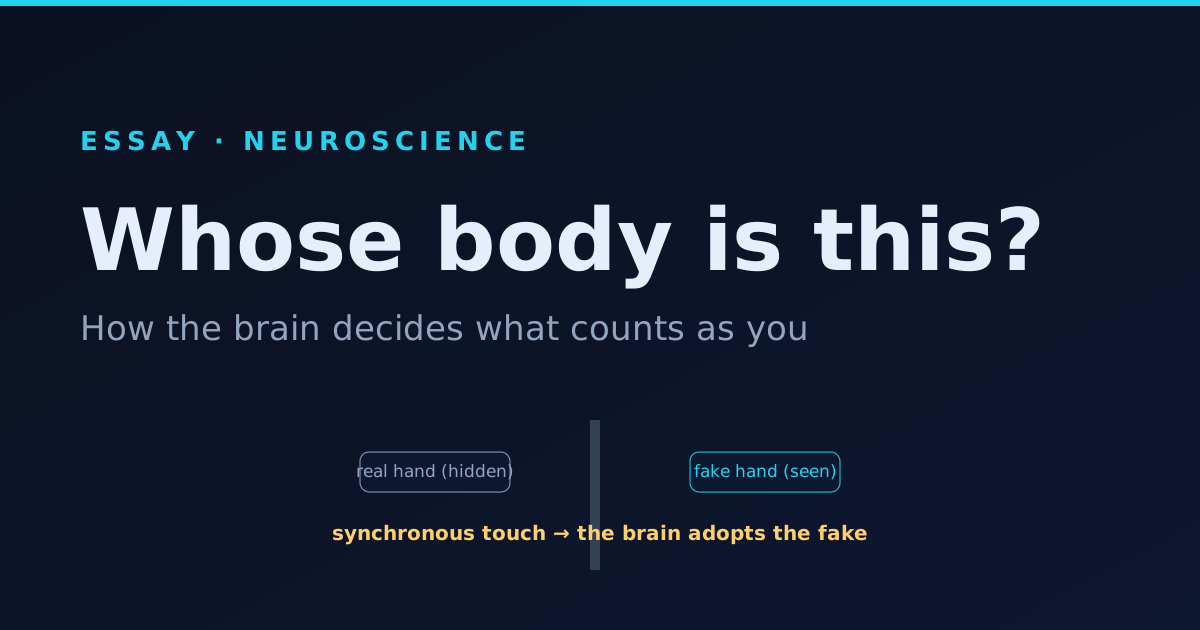
You are certain of one thing right now: the hand at the end of your arm is yours. That certainty is so obvious you never notice it, until a neuroscientist steals it from you in three minutes with two paintbrushes and a rubber hand. It is one of the most unsettling experiments of the last century on bodily awareness, and it reveals something vertiginous: your body is not a fact, it is a hypothesis your brain rebuilds continuously. And a hypothesis can be manipulated.
The rubber hand illusion
The setup, devised by Botvinick and Cohen in 1998, fits on a table. Your real hand is hidden behind a small screen; a rubber hand is placed in front of you, aligned with your shoulder. An experimenter then strokes your real hand (which you cannot see) and the fake hand (which you can) at the same time, in the same rhythm. After sixty to ninety seconds something flips: you begin to feel the strokes where you see them: on the rubber. The brain “adopts” the fake hand. The most striking proof: threaten the rubber hand with a hammer and you flinch, your skin sweats, as if your own flesh were in danger.
Your body as a best guess
Your brain never receives “your hand” directly. It receives three separate, slightly noisy streams of evidence: vision (I see a hand, there), touch (something is brushing skin), and proprioception, that quiet sixth sense, the position of your limbs reported continuously by muscles and joints, even with your eyes shut. From these three testimonies it must settle a single question: where is my body, and what is part of it? It does not have the answer; it makes the most probable bet.
And when two witnesses out of three (vision + touch) agree perfectly on a point in space, they win over the third (proprioception, which is blurrier). The brain concludes: “if I see a stroke here and feel it at the same instant, then my hand must be here.” It literally shifts the felt location of your hand toward the rubber. You can even measure it: afterward, asked with eyes closed to point to your real hand, you place it drifted toward the fake: the proprioceptive drift, the numerical signature that your body model has moved.
Here is the intuition without any equation. Imagine three slightly imprecise GPS units reporting your position. Two of them (vision, touch) point to the very same café; the third (proprioception), older and fuzzier, says “somewhere in the neighbourhood.” Your phone does not take a dumb average: it trusts the two that agree and are precise, and places you at the café. Your brain does the same with your body: it weights each sense by its reliability and sides with the sharpest coalition. Seeing and touching at the same instant is an unbeatable coalition, even against the reality of your actual hand.
From a fake hand to a whole body
The trick is not limited to a hand. In 2007, Ehrsson, Petkova and colleagues produced the full-body illusion and the body swap. With a headset fed by a camera placed on a mannequin, or on another person, you are given the first-person view of another body; add a few synchronous touches and your brain migrates: you feel the mannequin’s body as your own, and can even shake hands with your “former” body in front of you and find it a stranger. The sense of being somewhere, inside something (what researchers call presence and embodiment) is far more negotiable than it feels.
This is exactly the lever of modern virtual reality. In VR, two ingredients are enough to make you inhabit an avatar: visuomotor synchrony (the avatar moves when you move) and/or visuotactile synchrony (you are touched where you see yourself touched). The brain does not even require the body to be realistic: recent work shows that a cartoon or frankly robotic avatar can produce a sense of ownership that is equal, sometimes greater, than a photorealistic human one. What matters is not resemblance but the coherence of the signals in time and space. That is why “a mind in a robot body” is not soft science fiction: the brain is already equipped to adopt almost any body, provided it responds coherently to your intentions.
Where this stands in 2026
The frontier now is tuning that adoption precisely enough for engineered bodies. A 2026 study in Scientific Reports had people control a robotic forearm in VR that moved on its own, and varied its movement speed: too fast or too “robotic” and the sense of embodiment collapsed; at the right cadence, the autonomous limb was felt as part of the self and judged more usable; see the movement-speed study. Work on avatar appearance in Frontiers in Virtual Reality (2026) confirms that machine-like or stylised bodies can be embodied as well as photorealistic ones, so inhabiting a double or a robot body is about coherent responsiveness, not a perfect clone; see avatar appearance and embodiment. And for supernumerary limbs (extra robotic arms or tails grafted onto the body schema), a 2026 CHI paper explicitly bridges VR embodiment and wearable robotics: Augmented Body Parts.
The through-line is old and radical at once: the boundary of “me” is not fixed at the skin. It is a running inference, and coherent signals can move it: onto a rubber hand, into an avatar, out to the tip of a tool.
Further reading
- Human bodies in virtual worlds: a systematic review of implicit agency and ownership in immersive VR (Frontiers in Human Neuroscience, 2025): the current picture of how embodiment is measured objectively, beyond questionnaires.
- The effectiveness of body-ownership illusions in VR: review and meta-analysis (ACM TOCHI): what actually works to induce ownership of a virtual body, with the numbers.
- The rubber hand illusion in virtual reality and the real world: comparable but different (ACM VRST): what is preserved and what changes when the classic paradigm goes digital.