Wetware, and the computer you have to keep alive
Living neurons grown on electrode arrays are now sold as computers and rented over an API. The case for them is not energy, and the arithmetic on energy is worse than advertised. What the 2026 organoid learning results establish, and where the adaptation is actually happening.
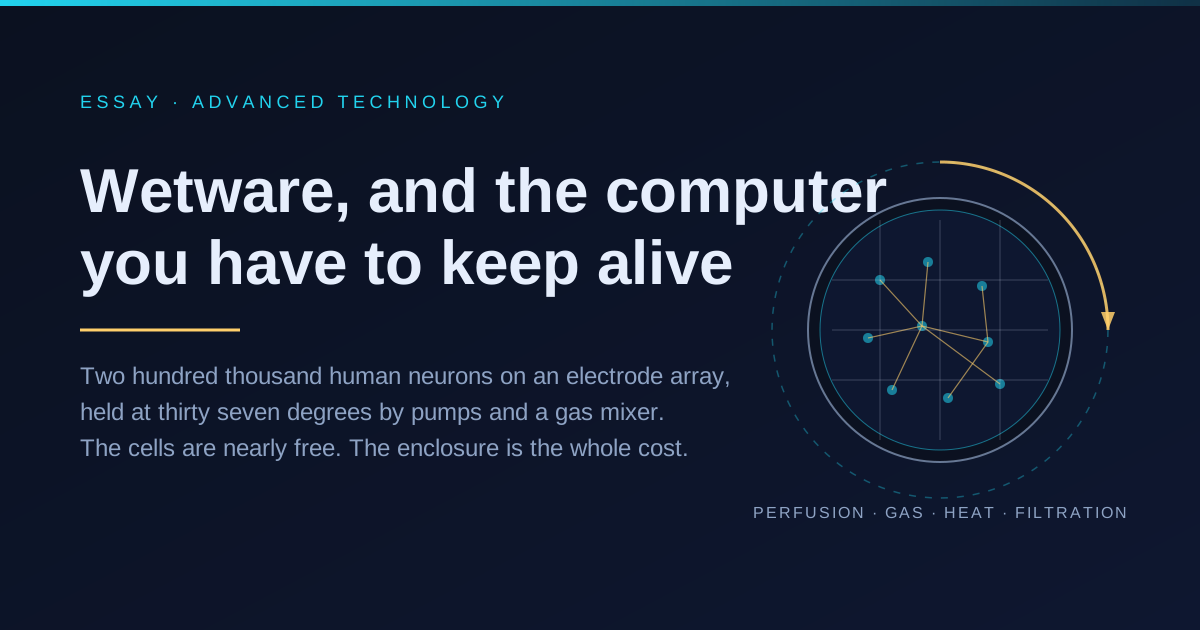
A rack in Melbourne holds a machine that would be unremarkable if it were not warm and wet. Inside a sealed enclosure sit pumps, a gas mixer, a heater, a filtration loop and a reservoir of culture medium, all working to hold one chip at thirty seven degrees in a controlled atmosphere. Grown on the surface of that chip, in direct contact with an array of electrodes, are roughly two hundred thousand human neurons derived from blood stem cells. Programs are deployed to them over an API. The unit sells for about thirty five thousand dollars, draws close to a kilowatt, and will need its cells replaced within months.
The pitch usually attached to this hardware is about energy. Brains do extraordinary things on twenty watts, data centres do less on megawatts, therefore compute with brains. That pitch is the weakest argument available, and the arithmetic collapses the moment the enclosure is included in the accounting. There is a real case for living neurons as a computational substrate, but it is a different case, and it is worth stating precisely.
What a synapse offers that a transistor does not
Three properties justify the trouble, and only three.
The first is that memory and computation occupy the same physical object. A transistor holds no record of its own history. In a modern accelerator the weights live in external memory and are hauled across a bus to meet the arithmetic units, and the hauling, not the arithmetic, is where most of the energy goes. A synapse has no such split. Its strength is the stored value, and reading it means using it. There is no fetch, because there is nowhere to fetch from.
The second is that the update rule is local. Spike timing dependent plasticity is the canonical form: if a presynaptic spike arrives a few milliseconds before the postsynaptic cell fires, the synapse strengthens, and if it arrives just after, it weakens, with the effect falling off over a window of roughly twenty milliseconds on either side. Written as a rule the synapse could execute by itself, the change depends only on the difference between the two spike times, and on nothing else in the network. In plain terms, each connection is asking a single question: did I help cause the spike that followed? No global error signal is computed, no gradient is propagated backwards, and no part of the network needs to know the state of any other part.
The third is that the substrate maintains itself. Homeostatic plasticity keeps average firing rates inside a working band by scaling excitability up or down over hours. A silicon network initialised into a dead or saturated regime stays there until something outside it intervenes. A culture drifts back toward a regime in which it can still signal, because staying signal capable is what the cells are doing anyway.
Set against this is everything a transistor does better. Neurons switch in milliseconds rather than fractions of a nanosecond. They are noisy, they fail to fire when they should, and they cannot be specified. You do not lay out a culture, you grow one, and what you get is a network with a topology nobody chose and nobody can read out.
So the honest summary of the substrate is not that it is fast or efficient. It is that it reorganises itself, for free, without anyone having to say how.
Embodiment is the whole experiment
That property is only visible if the culture has something to reorganise around. Neurons stimulated passively produce activity that looks broadly like noise with structure, and the structure is hard to interpret. The move that made the field tractable was to close the loop.
The setup is always the same. A high density multielectrode array sits under the cells. Some electrodes carry input, encoding the state of a simulated environment as patterns of stimulation. Others record, and the recorded spikes are decoded into an action inside that environment. The consequence of the action is then fed back as further stimulation. The culture is not solving a task in any sense it could recognise. It is sitting inside a feedback loop whose statistics depend on its own output.
The theoretical justification borrowed for this is the free energy principle, in its active inference form. The claim is that a self-organising system will act so as to reduce the unpredictability of its own sensory input. Translate that into a stimulation protocol and you get a simple asymmetry: when the culture produces the desired output, feed back a clean, predictable, structured stimulus, and when it does not, feed back unstructured noise. Nothing here is a reward in the psychological sense. The only currency is predictability.
The first widely noticed result on this design was the 2022 Neuron paper in which cortical cultures of human and rodent origin were placed inside a simulated version of Pong. The authors reported apparent learning within five minutes of real time gameplay, absent in control conditions where feedback was random or unstructured, and gave the phenomenon the name synthetic biological intelligence. The word sentience appeared in the title, which caused an argument that has not finished.
Where this stands in 2026
The substantive result of the year is a replication that tightens the controls. In February 2026, a group at UC Santa Cruz published goal-directed learning in cortical organoids in Cell Reports. Rather than Pong, they embodied mouse cortical organoids in a pole balancing task, the cartpole problem familiar from reinforcement learning benchmarks, using a closed loop electrophysiology framework and a high frequency training stimulus.
Three findings matter more than the headline. Adaptive training significantly outperformed both random stimulation and a null condition, which is the control the original work was criticised for underweighting. Performance was predicted by stimulus evoked causal connectivity, meaning the improvement tracked a measurable change in how activity propagated through the tissue rather than being inferred only from task score. And pharmacological blockade of glutamatergic transmission abolished the adaptation entirely, which is the closest thing the field has to a demonstration that the effect is synaptic rather than an artefact of the apparatus. The experimental data and code are public, which for a result this contested is not a detail.
The same work introduces the complication discussed below: a reinforcement learning algorithm selects which neurons receive the training signal, described by the group as an artificial coach.
Commercially, the field has moved from demonstration to product faster than the science warrants. Cortical Labs sells the CL1 as a code deployable biological computer, with an internal life support system rated to keep cells viable for around six months, and has announced two facilities intended to host such units at rack scale. A Swiss group runs the Neuroplatform, sixteen organoids totalling roughly 160,000 neurons, accessible remotely through an API, with microfluidic perfusion and a stated operating lifespan near one hundred days. Task demonstrations have crept beyond games: one 2025 preprint reports encoding tactile stimuli for braille recognition with organoid cultures.
What this does not prove
Start with the attribution problem, because it is the one that will not go away. In a closed loop system where a reinforcement learning controller chooses stimulation targets and adapts that choice, the loop as a whole improves. Some of that improvement is synaptic change in the tissue and some is the controller getting better at driving whatever tissue it has. The glutamatergic blockade experiment is the right way to cut this, and it establishes that the tissue contributes. It does not quantify how much. A system whose silicon half is itself a learner cannot be evaluated by looking at the score alone.
Then the task ceiling. Cartpole and Pong are low dimensional control problems whose decisions carry on the order of one bit. The Swiss group states a roadmap objective of raising information density from about one bit per organoid to ten or more, which is an honest way of saying where the field actually is. Nothing here is a step on a path to displacing an accelerator, and the twenty million fold power gap in the panel above is not closed by scaling, because it is dominated by the enclosure rather than the cells.
Then reproducibility, which is the deepest problem and the least discussed. Organoids are grown, not fabricated. No two have the same cell composition or the same connectivity, and neither is measurable in a living culture. There is no reset, no snapshot, no copy and no version control. A result obtained on one culture cannot be rerun on another and expected to match, and the culture that produced it will be dead in a few months. Whatever this is, it does not yet satisfy the ordinary meaning of the word computing, in which the same program on the same machine produces the same answer. Reviews of the field list the same barriers: long term viability, encoding and decoding, device integration and data management, with vascularisation the biological wall behind the lifespan figure, since without a blood supply an organoid past a few millimetres starves at its centre.
Finally the language. In November 2025, researchers who built the organoid field went public with the worry that inflated biocomputing claims could produce a backlash severe enough to damage the medical work that shares the same tissue, which is where organoids have actually delivered, in disease modelling and drug screening. Their objection is not squeamishness. Words like intelligence and sentience, applied to a few hundred thousand cells in a dish, mislead policymakers about what exists and simultaneously make the ethical questions harder to discuss seriously, since a term that has been spent on a pole balancing demo is not available when something genuinely warrants it.
What remains, stripped of the marketing, is still worth attention. A lump of cortical tissue with no body, no sensory organs and no evolutionary preparation for a cartpole will reorganise its own connectivity when its output is given consequences, within minutes, with no objective function anywhere inside it. That is a claim about what neural tissue does by default rather than a claim about computers. The enclosure, the pumps and the kilowatt are the price of watching it happen.
Further reading
- In vitro neurons learn and exhibit sentience when embodied in a simulated game world, the 2022 Neuron paper that started the closed loop line of work, contested title included.
- Goal-directed learning in cortical organoids, Cell Reports, February 2026, with the pharmacological control that the earlier work lacked.
- Brain organoid computing, an overview, a survey of substrates, interfaces and tasks for readers who want the full landscape.
- Brain organoid pioneers fear inflated claims about biocomputing could backfire, the argument from inside the field about what these systems should be called.