VO2max: the size of your aerobic engine
VO2max is the single number that best predicts how long an effort can last and, across large datasets, how long a life stays healthy. Here is what it actually measures, why the heart is usually the bottleneck, and the two dials that move it.
There is one number in physiology that carries more weight than almost any other, and most people who own a sports watch already have an estimate of it on their wrist without quite knowing what it means. It is VO2max: the maximum rate at which your body can take in oxygen, transport it, and burn it in your muscles, expressed in millilitres of O₂ per kilogram per minute. The key word is rate. VO2max is not a tank you draw down; it is the width of a pipe. It fixes the ceiling on any effort that lasts more than a couple of minutes. Below it, you hold. Above it, you fold. It is, quite literally, the displacement of your engine.
A relay race for oxygen
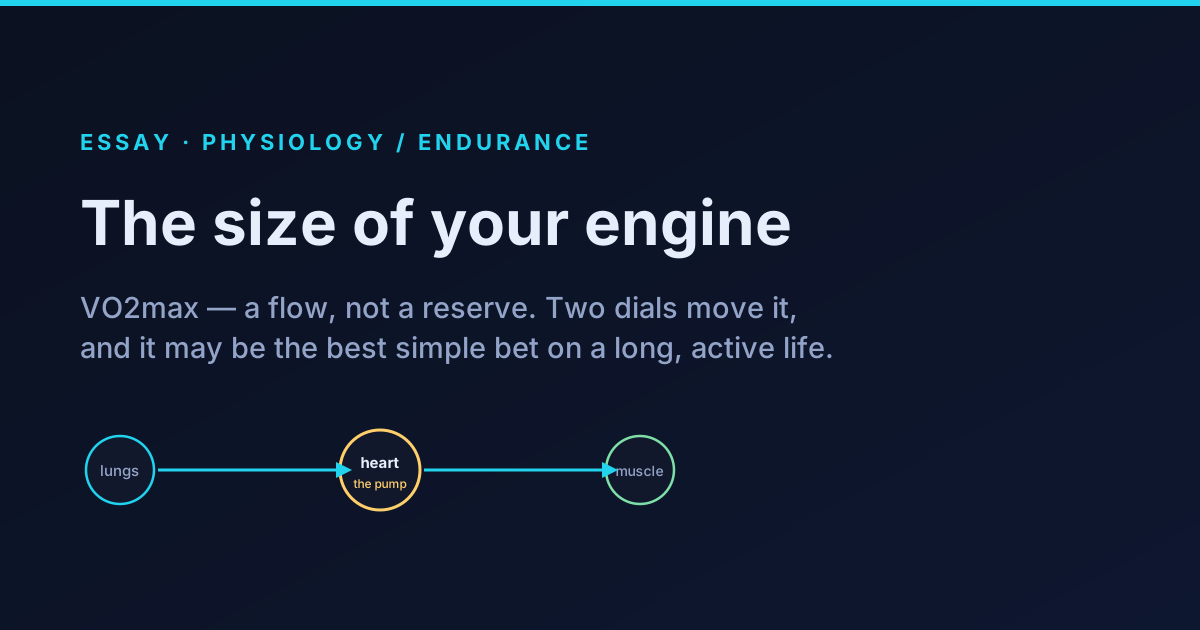
Everything else follows from one mental model: oxygen makes a relay journey from the air to your mitochondria, and the slowest leg caps the whole chain. There are five stages.
You can have flawless lungs and oxygen-hungry muscles, but if the heart cannot move enough blood, the whole convoy slows. That is why endurance training targets the heart first.
Two dials, not one
The entire chain collapses, since 1870, into one idea of rare elegance: the Fick principle, named after the physiologist Adolph Fick. It says your maximum oxygen flow is the product of how much blood your heart sends out and how much oxygen your muscles pull from it on the way past: VO2max = cardiac output × extraction, where cardiac output is itself heart rate × stroke volume.
Do not memorise the formula. Picture a fleet of oxygen delivery trucks. You can raise deliveries in only two ways. Dial one, a bigger truck: with each beat, a trained heart ejects more blood (stroke volume rises). Dial two, greedier customers: muscles laced with more capillaries and packed with more mitochondria extract a larger share of the oxygen that passes. Maximum heart rate, by contrast, barely changes with training, so the real levers are truck size and customer hunger.
And here is the good news that should reach anyone who has ever felt “unfit by nature”: both dials are trainable, with no ceiling in sight for non-elite athletes. The heart enlarges and grows more elastic; muscle builds fresh capillaries and mitochondria. A sedentary person who starts training commonly gains 5 to 20 percent of VO2max in eight to twelve weeks. This is not a fixed gift. It is an organ you remodel.
How you turn the dials: the 80/20 rule
There is a popular belief that you should do “everything in zone 2”, the easy pace where you can still hold a conversation. The better-supported picture is polarized: roughly 80 percent of your volume easy (zone 2, dial two, which builds the mitochondrial and capillary base without burning you out) and 20 percent very hard (near maximum, which forces the heart to eject more: dial one). Two honest intensities; you avoid the “grey zone” in the middle, too hard to recover from and too soft to drive progress.
Why four minutes? Too short and the heart never reaches its maximum output; too long and you cannot hold the intensity. About four minutes is the window in which the heart spends the most time at its maximum stroke volume, precisely the stimulus that pushes it to enlarge. You “touch the ceiling” four times, and the body answers by raising it.
Where this stands in 2026
Large cohorts keep converging on the same striking result: low cardiorespiratory fitness predicts all-cause mortality more strongly than smoking, diabetes or hypertension. This is an epidemiological association across populations, not a personal guarantee, but few health signals are this clean, and this one is directly trainable.
The Norwegian 4×4 protocol, developed at the Norwegian University of Science and Technology, reports VO2max gains of roughly 7 to 10 percent in eight weeks in moderately trained adults training three times a week: a bounded, measurable session of about 38 minutes. Meanwhile a 2025 Sports Medicine review has tempered the “all zone 2” enthusiasm: the slow base remains valuable, but without the hard 20 percent the ceiling barely moves. The practical synthesis is the polarized model above: build a wide easy base, then sharpen it with a little well-placed intensity.
Further reading
- The Norwegian Protocol: 4×4 Intervals: the NTNU group’s own explanation of the session.
- VO2 Max · Physiopedia: clean, sourced physiology (the oxygen chain and the Fick principle) with diagrams.
- Zone 2 Isn’t the Longevity Magic Bullet · The Honest Read: a measured counterpoint to the zone-2 hype.
- How to Improve VO2 Max: an evidence-based guide, moving from the “why” to a week-by-week “how”.