Uploading the mind: would a perfect copy of you still be you?
Copying a mind into a machine raises two questions people constantly confuse: is it technically possible, and would the copy be you? The connectome, whole-brain emulation, and the copy problem.
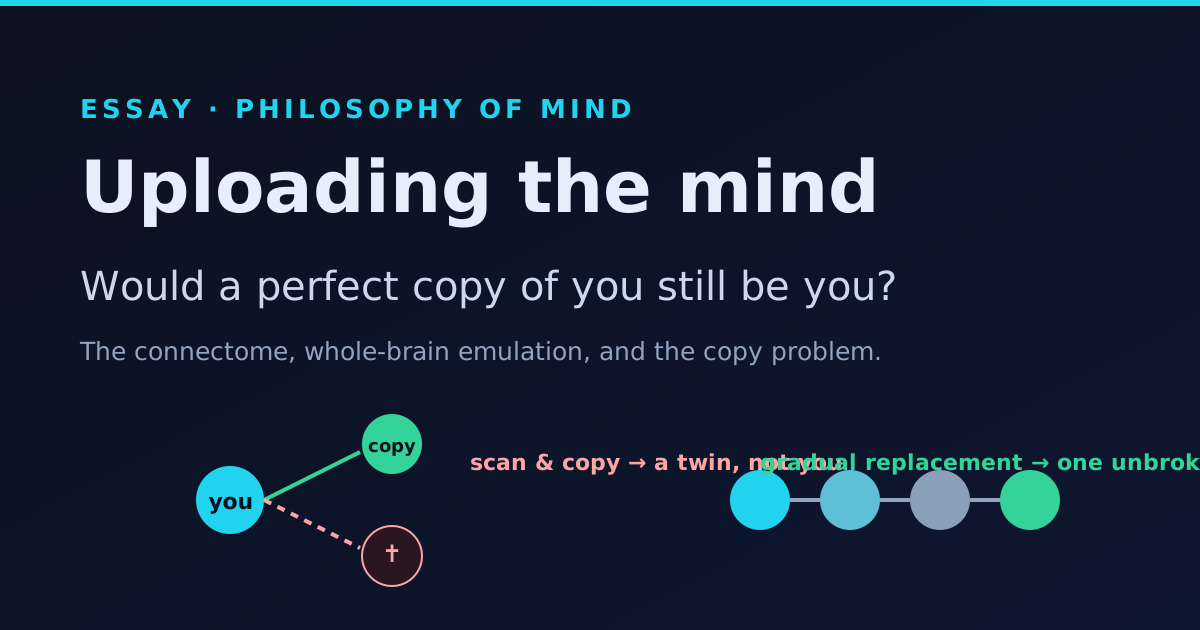
The most vertiginous version of the dream of a digital self is not a chatbot that talks like you. It is mind uploading: transferring a mind itself into a computer. The idea hides two questions that get confused all the time, and that must be kept strictly apart: (1) is it technically possible? and (2) even if it were, would the copy be you, or a twin that outlives you? The first is an engineering problem. The second is a knot that no amount of engineering can untie, and it is the one that bites.
Imitating is not emulating
Start with the essential distinction. There are two ways to build a digital “you,” and they have almost nothing in common.
The first is a copy of behaviour: take everything a person has written, said and chosen, and train a model to resemble them from the outside. Useful, sometimes uncanny, but it is a mask. Nothing inside it matches the person’s mental machinery. “It sounds like them” does not mean “it is them”; this is the old lesson of the Mechanical Turk in software form.
The second, radically different, is a copy of structure: reproduce the wiring of a brain, neuron by neuron, connection by connection, and then run it. You are no longer copying what someone says; you are copying the thing that makes them say it. This is uploading in the strong sense, and it rests on one precise object: the connectome.
The connectome: the map of the wiring
The connectome is the complete map of a brain’s connections: which neuron talks to which, and through which synapse. The intuition that drives the whole field (sometimes called connectionism about the self) fits in a sentence: “you are your connectome.” The claim is that your personality, memories and reflexes are not inside individual neurons but in the pattern of how they are wired together. Change the wiring, you change the person; reproduce the wiring exactly, and, perhaps, you reproduce the person.
This is no longer pure speculation. In October 2024 an international consortium (the FlyWire project) published in Nature the first complete connectome of an adult brain: that of the fruit fly. The number: 139,255 neurons linked by more than 50 million synapses, mapped from slices of brain imaged under an electron microscope and reconstructed in 3D. A complete road map of an entire brain. A first.
But the gap between a fly and a human is an abyss, and here an image serves better than a number. The fly has about 105 neurons: a small town of 140,000 inhabitants. A human brain has around 86 billion: roughly ten times the entire human population of Earth. Synapses? The fly: 50 million. A human: on the order of 100 trillion: a factor of about three million. Forget the numbers. Keep the picture: if the fly’s connectome is the street map of a village, yours is the road network of a whole, densely populated planet. We have just finished the village. That is why “a brain has been mapped” and “your brain will be uploaded” are separated by decades, not years.
And a map is not enough. A road map does not tell you when the lights turn green, how fast the traffic moves, which trucks carry what. The connectome gives the wiring; it still lacks the dynamics: the strength of each synapse, the neurotransmitters, the electrical rhythm. That is exactly the bottleneck experts point to: we cannot yet read all of that off a whole brain without destroying it.
And yet it already works, on a fly
Here is the result that shifts the ground. In March 2026 a team (the EON project) ran that fly connectome as a genuine emulated brain: the 140,000 simulated neurons receive sensory input, activity propagates through the network, motor commands come out, and they drive a virtual fly body inside a physics simulator. The result: the digital fly grooms, feeds and walks (three distinct behaviours) with, the team reports, 91% behavioural accuracy. (A figure announced by the team, to be watched over time.)
Take the measure of the moment: for the first time, a mind (tiny, but real) runs on a computer because its structure, not its behaviour, was copied. It is the closest proof of concept we have to the whole idea. But it is a fly, and the jump to a human is not a matter of degree: it is a change of kind (see the state of play below).
The copy problem: the knot that bites
Now suppose the technical problem solved. We scan a brain perfectly, run it, and out comes a digital being with all your memories, your inner voice, your habits. Question (2) returns, brutally: is it you?
The philosopher Derek Parfit built the thought experiment that traps everyone: the teleporter. A machine scans you atom by atom, puts you to sleep (destroys you), sends the blueprint to Mars, and there another machine rebuilds you exactly. The Mars-you has all your memories, believes itself to be you, swears the trip worked. But the Earth-you was disintegrated. So: did you travel, or did you die and leave behind a perfect replica?
The trap snaps shut with a variant: modify the machine so it does not destroy the original. Now there are two of you, each with the same memories, each claiming to be “the real one.” They cannot both be numerically you: identity is a one-to-one relation (one thing is identical to exactly one thing). A perfect copy therefore proves that a copy, however faithful, is not you: it is a twin that starts life with your memory.
Parfit draws a conclusion that defuses the vertigo: perhaps identity is not what matters. What connects you to “you-tomorrow” is not some magical spark of identity, but what he calls Relation R: psychological continuity, the unbroken chain of memories, intentions and character that link up over time. And you already live that continuity without thinking about it: the you of twenty years ago shares not a single atom with you now (the body has renewed everything), and yet you are “them”, because the thread was never cut, day after day. You are, in a sense, already a “gradual copy” of your earlier self.
That is what makes the right-hand road on the diagram so interesting. If your neurons were replaced one at a time by artificial equivalents, without ever being switched off, without ever duplicating the thread (like a biological ship of Theseus), there would never be a “second you,” never a death, never a branch. Just you, sliding slowly from carbon toward silicon. The philosopher David Chalmers has argued that as long as each replacement part does exactly the same job as the neuron it replaces, your consciousness could neither wink out abruptly nor “fade” without your noticing, so, in principle, it would survive the crossing. It is speculative, but it is the only route where the word “you” holds all the way through.
The lesson to keep is sharp: the real question of uploading is not “can a mind be copied?” but “how many threads, and which one is cut?” The fidelity of the copy settles nothing; it is the continuity of the thread that decides whether someone travels or someone dies leaving a lookalike behind.
Where this stands in 2026
The tangible progress is real and small. The EON result above (a fly connectome running an embodied brain at a reported 91% behavioural accuracy) is the first whole-brain emulation to act in a simulated body. It shows the principle works. It does not show it scales.
Against that, a broad State of Brain Emulation Report published in October 2025 concludes that emulating a human brain remains, at best, 30 to 40 years away. Three bottlenecks stay unsolved: we cannot capture a human brain’s activity at sufficient resolution while keeping it viable; molecular annotation of neurotransmitters and receptors does not scale to a whole brain; and the computation needed to simulate a human-scale network exceeds available hardware. Three locks, not a dial to turn.
And mapping the activity, not just the wiring, is beginning too: in September 2025 the International Brain Laboratory published in Nature a brain-wide, cell-by-cell map of how information is represented in the mouse brain, precisely the “dynamics” a static connectome lacks. Without it, a wiring diagram is a dead city.
Further reading
- Researchers simulate an entire fly brain on a laptop. Is a human brain next? (Berkeley News), the best general-audience entry point on the fly connectome and what it makes possible.
- Complete wiring map of an adult fruit fly brain (NIH), the official, reliable summary of the FlyWire connectome: figures, method, scope.
- Teletransportation paradox (Wikipedia), Parfit’s teleporter, Relation R and the branching problem, explained cleanly.
- State of Brain Emulation Report 2025 (arXiv), the full technical assessment of where brain emulation really stands, and why it is far.