The vector brain: giving an AI a memory that thinks in meaning
Why a vector database is the closest thing software has to biological memory, and how one shared vector store becomes the brain behind very different applications.
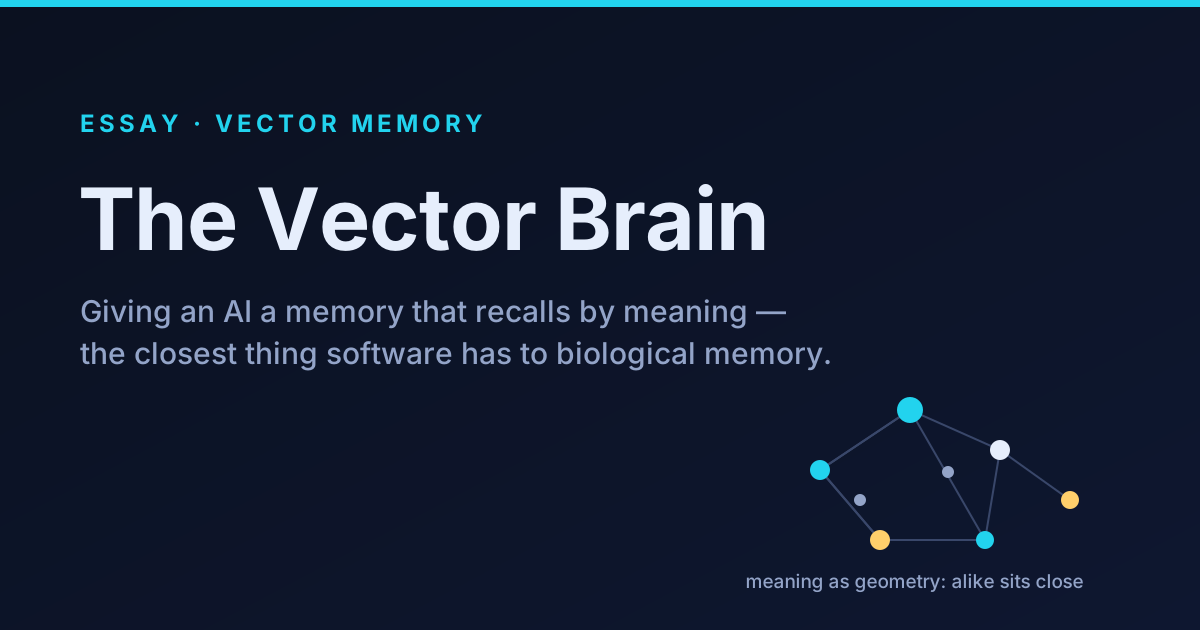
Ask someone what they had for lunch last Tuesday. They don’t scroll through a dated list of meals. A smell, a room, something a colleague said: one fragment drags the whole scene back into view. Human memory is addressed by meaning, not by row number. You never look anything up by its coordinates; you fall into it sideways, through resemblance.
Almost all software memory is the opposite. A database finds a record because you already know its key. A search engine finds a page because you typed the right words. Miss the exact term and the memory may as well not exist. For decades that was simply the deal: machines remembered by address, brains remembered by association, and the gap between them was where all the interesting cognition lived.
A vector database closes that gap. It is the first common storage layer that recalls things the way you do: by what they mean rather than what they are called. That single property is why, across every project I build, I stop thinking of it as “the database” and start thinking of it as the brain. This is a write-up of why that framing holds, where it stops being a metaphor, and how you can architect a lab around one shared memory that many different applications think through.
What biological memory does that filing cabinets can’t
Your brain does not keep a labelled folder per idea. A concept lives as a pattern spread across a population of neurons, and related concepts share overlapping patterns. “Espresso” and “insomnia” light up circuits that partially intersect, which is exactly why one can summon the other unbidden. Meaning, in the brain, is geometry: things that are alike sit near each other in some very high-dimensional space of activation.
Two more tricks matter here. The first is that memory is content-addressable: a partial cue is enough to pull back the whole. The hippocampus is very good at pattern completion: hand it a fragment, a few notes of a song, the corner of a face, and it reconstructs the rest. The second is that we keep different kinds of memory. Endel Tulving’s classic distinction separates episodic memory (the specific event: that dinner, that Tuesday) from semantic memory (the distilled fact: coffee keeps you awake). Both are recalled by association; neither is recalled by index.
Hold those three properties (distributed patterns, content-addressable recall, meaning-as-geometry) because a vector database reproduces all three, deliberately.
What an embedding actually is
An embedding model takes a piece of text and turns it into a point in a high-dimensional space: a list of a few hundred numbers (768 is a common size). The model is trained so that geometry encodes meaning: passages that say similar things land near each other, passages that don’t drift apart. The distance you care about is usually the cosine between two vectors (the angle between them), so “close” literally means “points in the same semantic direction.”
This is the artificial version of the brain’s population code. A sentence is no longer a string to be matched character by character; it is a location in meaning-space. And because the space is about meaning rather than surface form, the same idea expressed in French, in English, or in clumsy paraphrase can all land in roughly the same neighbourhood. Keywords never gave you that.
A vector database like Qdrant is the organ that stores these points and finds neighbours fast. Storing a memory means embedding it and dropping the vector in, alongside a payload (the original text plus any metadata you want to filter on). Recalling a memory means embedding your query the same way and asking for the nearest points: an approximate nearest-neighbour search, so it stays quick even when there are millions of them. That retrieval step is pattern completion: a fragment of a query reconstructs the fuller memories that sit closest to it. Filter by metadata, split the space into separate collections, choose your distance metric, but the core move never changes. Encode meaning as position; recall by proximity.
That is the whole reason I stop calling it a database. A filing cabinet gives you back exactly what you filed, provided you remember where. This gives you back what you meant, even when you’d half-forgotten it was there.
Three ways a machine “knows”, and why memory is the missing one
It helps to be precise about what a language model already has, because the vector brain slots into a specific gap.
A model’s weights are its instinct. Everything it absorbed in training is fused into billions of parameters: fluent, fast, always available, and completely frozen. This is the machine’s crystallised knowledge, closer to a lifetime of consolidated semantic memory than to anything it can update on the fly. It cannot learn that you changed your mind yesterday. Re-training to add one fact is like performing surgery to remember a phone number.
Its context window is working memory. Whatever you paste into the prompt is vivid and immediately usable, and gone the moment the conversation ends, capped in size, and expensive to keep full. It is the mental scratchpad, not the archive.
Skills (the reusable instructions, playbooks and system prompts you load on demand) are procedural memory: the how. They tell the model how to behave, not what it has lived through. A skill is a habit you can hand it at the start of a task. Static knowledge files sit somewhere nearby: a shelf of reference books, useful but inert, and only helpful if you already know which book to open.
None of those is a growing, writable, long-term memory recalled by meaning. That is precisely the hole the vector store fills. It is the machine’s long-term declarative memory: it accumulates across sessions, you can write to it cheaply, and you retrieve from it by association rather than by exact key. In a retrieval-augmented setup the division of labour is clean: the model supplies reasoning and language from its weights, the vector brain supplies what actually happened and what was decided, pulled back on relevance. The model thinks; the brain remembers.
So the vector store doesn’t compete with skills or knowledge: it reinforces them. Skills give continuity of behaviour; the vector brain gives continuity of experience. Together they turn a brilliant, amnesiac model into something that carries context forward, grounds its answers in real recall instead of confident invention, and scales far past what fits in a prompt, all without touching a single weight.
One brain, many minds
Here is where it becomes concrete. I run several projects that look nothing alike on the surface, and they all point at the same vector store.
One turns the memory into a landscape you can fly through: a 3D map where each remembered thing is a point, and clusters of related ideas physically gather into regions you can see and navigate. It is the brain made visible: meaning-as-geometry rendered literally, so you can watch a topic form its own neighbourhood.
Another is a kid-safe family assistant that has to remember context about the people it talks to while staying inside strict boundaries: the same recall machinery, wrapped in very different guardrails.
A third is a personal-growth companion whose entire value is that it remembers your own history and reflects it back over time; without long-term memory it would be a stranger every morning.
Different faces, different guardrails, different audiences, but one memory underneath. Something written by one becomes recallable by the others, because they share the same space of meaning. That is what “brain” earns you over “database”: not a store each app owns a slice of, but a single associative memory that many minds think through. Write once, recalled everywhere.
Architecting a lab around a shared memory
If the vector store is the brain, the rest of the system is the anatomy that keeps it honest. Drawn in generic terms, the shape is always the same.
Sources of every kind (documents, events, conversations, telemetry) flow into an ingestion step that cleans, splits and tags them. Everything passes through a single embedding model that turns text into vectors, lands in the vector database, and is later pulled back out through a retrieval step (nearest-neighbour search, optionally re-ranked for precision). A thin gateway (an MCP server or a plain API) puts one contract in front of the store so that every consumer, from an agent to a visualiser, talks to the memory the same way. Four disciplines keep the whole thing trustworthy:
One embedding space. The single most important rule: you must embed with the same model when you store and when you query. Vectors from two different models live in incompatible spaces: at best your similarity scores are quietly wrong, at worst the dimensions don’t even match. Change the encoder and you have to re-embed everything. One brain, one language for meaning.
Namespaces that don’t bleed. Split the memory into collections with intent. Human-authored notes and machine-generated logs should not share a pool, or the machine’s chatter will drown out the signal a person actually wanted. Separate spaces per kind of memory (think of them as distinct cortices) keep recall clean.
An evaluation loop. Semantic recall degrades silently. Bump the embedding model, change a prompt, corrupt an index, and nothing throws an error: the answers just quietly get worse. So treat recall like any other production surface: run a fixed set of known queries on a schedule, score whether the right memory still comes back on top, and alert when quality drifts. Without it, you only discover the regression when you’re relying on it.
A write-back loop. The detail that turns storage into a brain. Consumers don’t only read; they write new memories back through ingestion. Every session, decision and correction becomes recallable next time. That feedback is the difference between an archive that sits still and a memory that keeps growing.
The payoff
Strip away the metaphor and the engineering claim is modest and testable: give a model an external, writable, meaning-addressed memory and it stops being an amnesiac. It carries context between sessions, grounds its answers in things that were actually said and decided rather than plausible invention, and it does all of this without the cost of re-training: you update the memory, not the weights.
The metaphor is worth keeping anyway, because it earns its place at the point where the analogy holds: distributed patterns instead of labels, recall by resemblance instead of by key, one associative space that many different minds can think through. That is not a database with a fancy index bolted on. It is the closest thing our systems have to a brain, and once you have built on one, it is very hard to go back to filing cabinets.