The Variable Heart: what the jitter between your heartbeats says about recovery
A healthy heart does not tick like a metronome. The tiny beat-to-beat variation (heart rate variability) is a window on the balance between the body's accelerator and its vagal brake, and, read against your own baseline, a surprisingly honest gauge of recovery.
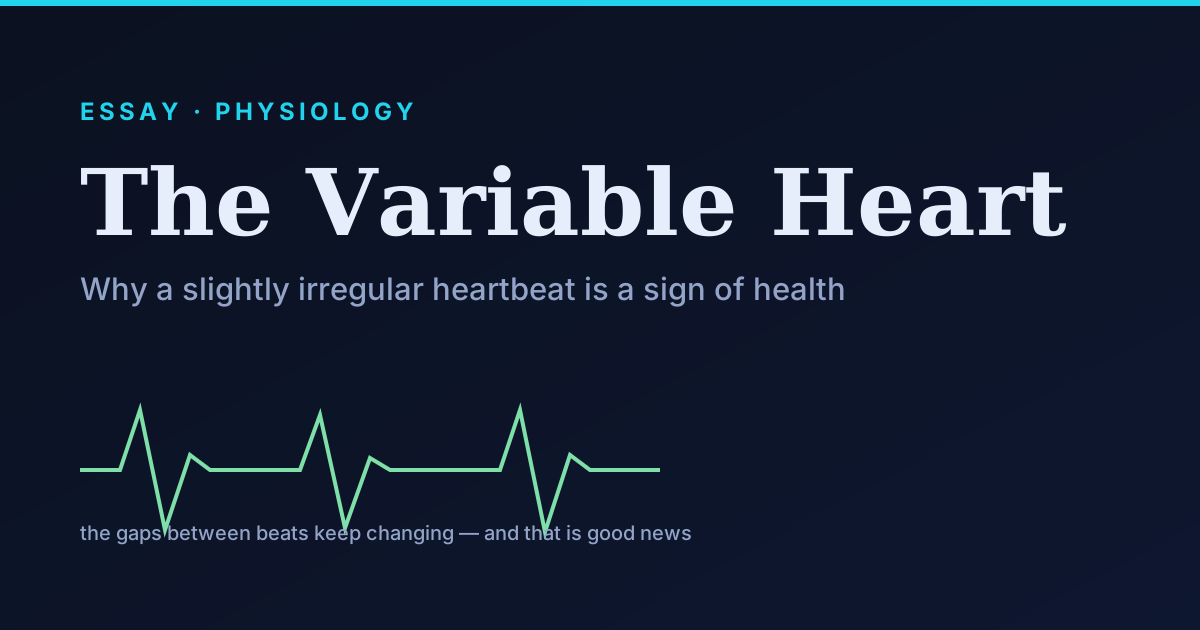
Put a finger on your pulse and count: sixty beats a minute, you would say, as regular as a metronome. Wrong. If you measured the exact interval between each beat, you would see it shifting all the time: 0.90 s, then 0.86 s, then 0.94 s. That small dance from one beat to the next is heart rate variability (HRV). And here is the counterintuitive turn: more of this variability is better. A heart that is too regular, too metronomic, is a bad sign. A healthy heart breathes: supple, ready to speed up or slow down at the slightest demand.
Two pedals: the accelerator and the brake
Why the suppleness? Because your heart is constantly tugged by the two branches of the autonomic nervous system, the part that runs without your thinking about it. The sympathetic branch is the accelerator: the “fight or flight” mode, raising the rate, slowly. The parasympathetic branch is the brake: the “rest and digest” mode, acting through the vagus nerve, a fast brake, able to change the rhythm from one beat to the next. HRV mostly reflects this vagal tone: how much “brake” you have available and active. Plenty of brake ready to play means plenty of variability, which means a supple, recovered system.
Why breathing changes everything
There is a phenomenon you can feel: your heart speeds up when you inhale and slows down when you exhale. It is called respiratory sinus arrhythmia, and the vagus nerve produces it: the brake eases on the in-breath, tightens on the out-breath. This is exactly why slow breathing (around six cycles a minute, with a lengthened exhale) raises HRV: you deliberately amplify the play of the vagal brake. It is the principle behind cardiac-coherence biofeedback, a free, immediate lever on your own autonomic system. Forget the acronyms your watch will show (RMSSD, SDNN); keep just this: HRV is “how much the gap between beats moves.” Lots of play means lots of available vagal brake, so recovered and adaptable. Little play (a metronome heart) means the brake is saturated or the system is under strain: fatigue, stress, sometimes an infection brewing. And the only number that matters is yours, compared to your own average, not your neighbour’s.
That is how a wearable uses it. Measured overnight or at waking, HRV is a window on recovery: above your baseline means recovered and ready to load; a sharp, sustained drop means accumulated stress, short sleep, alcohol, or the start of illness: the signal is not “push,” it is “ease off.” Mind the classic traps, though: HRV is noisy, deeply personal, dragged down by alcohol and late meals, and it is not a diagnosis, only a gauge of trend.
Where this stands in 2026
The vagus is moving from something we read to something we can push. A 2025–26 randomized trial in Scientific Reports found that auricular vagus nerve stimulation after exercise modulates autonomic and recovery responses in physically inactive young adults, framing vagal stimulation as an active recovery tool rather than a purely passive readout (Scientific Reports). Meanwhile wrist HRV is being taken seriously: a 2025 observational study tracked daily HRV against self-reported wellness over 14 days, showing the consumer measure captures real day-to-day change (14-day HRV & wellness study), while 2025 Long-COVID work uses wearable HRV to detect autonomic dysfunction and set thresholds for over-exertion (wearable HRV & post-exertional thresholds). The lesson is consistent: read as a trend against your baseline, HRV is a usable signal; read as a single isolated number, it misleads. None of this is medical advice: anything health-flagging belongs with a professional.
Further reading
- HRV biofeedback and non-invasive vagal neuromodulation · review (PMC), how breathing and vagal stimulation act on HRV: the physiological “user manual” for the breathing lever.
- Daily HRV and self-reported wellness · 14-day study (PMC): what daily HRV actually captures, and its limits, in healthy adults, with data.
- Wearable HRV and post-exertional thresholds · medRxiv (2025): a clinical example of reading an “over-exertion threshold” from a wearable, and the deload logic behind it.