The Sleep Pressure: why caffeine doesn't give you energy, it lies to you
Caffeine adds no fuel to your brain. It jams the very lock that tells you you are tired. A tour of adenosine, the A1/A2A receptors, the two-process model of sleep, caffeine's long tail, and the crash you cannot cheat.
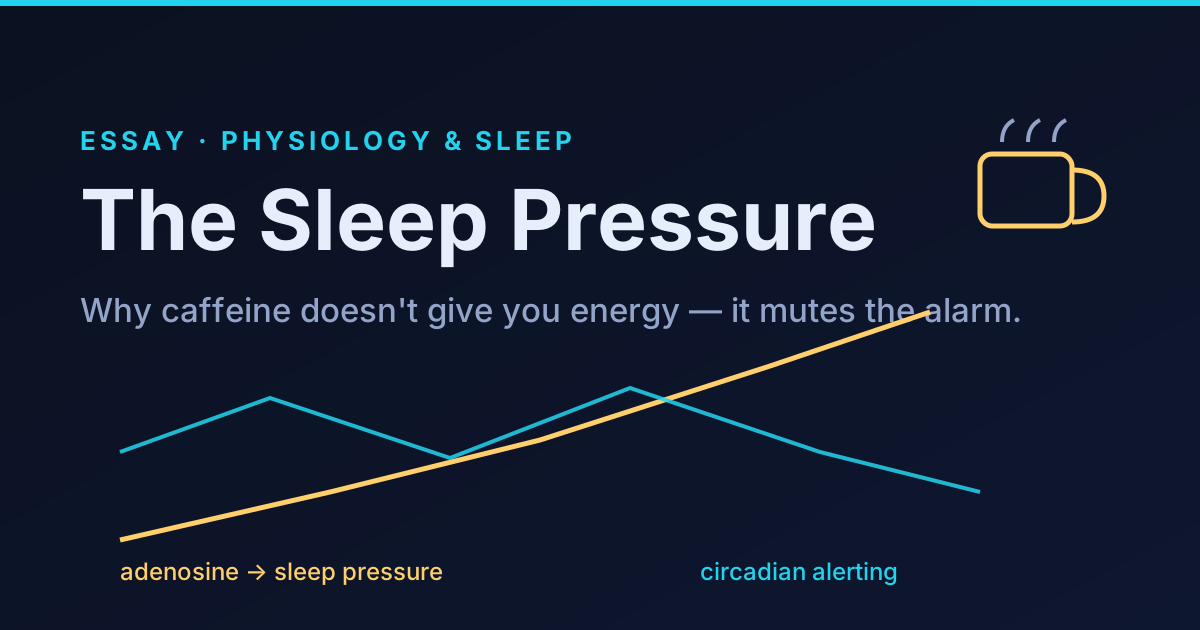
You think coffee gives you energy. It does not, and that is the first thing to unlearn. Coffee pours not a single drop of fuel into your brain. It does something far cleverer, and far more devious: it cuts the wire on the alarm that tells you you are tired. The tank is not refilled; the low-fuel light on the dashboard simply goes dark. To see the trick, you have to meet the molecule that holds that light on: adenosine.
Adenosine, the ash of thought
Every cell runs on a tiny energy currency called ATP, a molecule carrying three phosphate groups that neurons spend, constantly, to do their work. When a cell burns ATP, it snaps those phosphates off one by one, and what is left at the end, stripped bare, is adenosine. In other words: adenosine is what remains once ATP has been spent. It is the ash of the metabolic fire.
Here is the elegance of the system. The harder your brain works, the more ATP it burns, and so the more adenosine it releases. The molecule accumulates, hour after hour, in key regions of the brain. It is the odometer of your mental day, an honest chemical trace of time spent awake and effort spent thinking. The body has turned a mere waste product into a signal: this is sleep pressure. The higher the reading climbs, the more irresistible the pull toward sleep.
The brake, not the fuel
How does a molecule “make” you sleepy? It does not knock you out. It settles onto locks on the surface of your neurons, receptors named A1 and A2A. When adenosine clips into them, it acts like a brake pedal: it calms the arousal circuits, slows the machine, dims your alertness. Nothing violent: a gradual damper. Across the day the brake presses itself down, notch by notch, as adenosine piles onto the locks. By evening the brake is floored, and you nod off.
And caffeine? Its shape mimics adenosine’s closely enough to enter the lock, but not to turn it. It is a decoy key. It slots onto the receptor, occupies it, and keeps adenosine from binding. The brake releases, the machine revs back up. But (and here is the whole trap) caffeine has removed nothing. Adenosine keeps piling up, silently, behind the blocked lock. You no longer feel tired; you are exactly as tired as before.
Two clocks, not one
If adenosine were the only hand on the controls, your sleepiness would just rise in a straight line from waking to bedtime. But that is not what you live. There is that mid-afternoon slump (around 2–4 pm) that has nothing to do with lunch, and that second wind in the evening, the moment when, just as you should be dropping, you feel oddly re-energised. To account for this, Alexander Borbély proposed in 1982 what became the backbone of sleep science: the two-process model.
Two forces are stacked. Process S (for Sleep) is sleep pressure: the rise of adenosine, climbing all through waking and collapsing during sleep, when the brain clears it out. Process C (for Circadian) is your internal clock: a wake-promoting signal driven by light that is not flat but waves across 24 hours: strong in the morning, dipping slightly in the afternoon, then rising to an evening alerting peak before plunging for the night. Your sleepiness at any instant is the gap between the two: sleep pressure pushing down, circadian alerting pulling up.
A word on the numbers you will hear. Caffeine has a half-life of roughly 5–6 hours, but do not memorise the figure; keep the image. Caffeine is a guest who only ever half-leaves every five or six hours. A coffee at 4 pm? At 10 pm half of it is still camped on your receptors; near midnight a quarter is still there. It never slams the door: it lingers, slipping out by halves, long after you have forgotten it.
The debt you cannot cheat
Put the two ideas together and you see caffeine’s true face. It blocks the lock; meanwhile, adenosine keeps stacking up behind it. When the caffeine finally clears, all those receptors free at once, and the accumulated adenosine, more abundant than ever, floods onto them en masse. This is the famous crash: not a shortage of coffee, but the lump-sum settlement of all the fatigue that waited patiently offstage. You did not erase the debt; you deferred it, with interest.
Hence the one thing worth keeping: caffeine is a timing tool, not an energy source. It is superb at shifting your alertness to where you need it: papering over a slump, holding a window of focus open. It is useless (worse, counterproductive) at repaying your sleep debt, because the only time the brain truly clears adenosine is while you sleep. Block the lock too late in the day and you sabotage the very night meant to settle the account (and, along the way, you shave off the early-morning REM where dreams live).
Where this stands in 2026
The blanket rule “no coffee after 2 pm” is giving way to something personal. A 2025 study in SLEEP crossed individual caffeine metabolism with a variant of the A2A receptor gene (ADORA2A, rs5751876) to compute personalised cutoff times for a last dose. The point is that a single fixed hour is too crude: depending on your genetics you clear caffeine fast or slow, and your cutoff is not your neighbour’s. Measuring your system beats following an average.
There is also a surgical version of “synthetic caffeine.” Istradefylline is a selective antagonist of the A2A receptor alone, already FDA-approved in Parkinson’s disease. Where caffeine blocks adenosine receptors broadly (hence the jitters, anxiety, tolerance), a molecule aimed at A2A promises, in principle, to promote wakefulness with a cleaner profile. It is proof that we can already target one precise lock in the system, and that the line between “everyday stimulant” and “fine neuropharmacological tuning” of alertness is thinner than it looks (dependence and tolerance included).
Further reading
- Sleep Foundation · Adenosine and Sleep: the clearest illustrated entry point on how adenosine builds sleep pressure and how caffeine opposes it.
- Journal of Sleep Research · Reichert et al., Adenosine, caffeine, and sleep–wake regulation: state of the science: the reference review of the whole adenosine/caffeine/circadian machinery.
- Nature Communications · Adenosine integrates light and sleep signalling for circadian timing: the bridge between the two processes: how adenosine (S) also talks to the light clock (C).
- Purinergic Signalling · The belated FDA approval of the A2A antagonist istradefylline: the pharmacology of surgically targeting the same receptor caffeine hits.