Why smell is the sense we still can't digitise
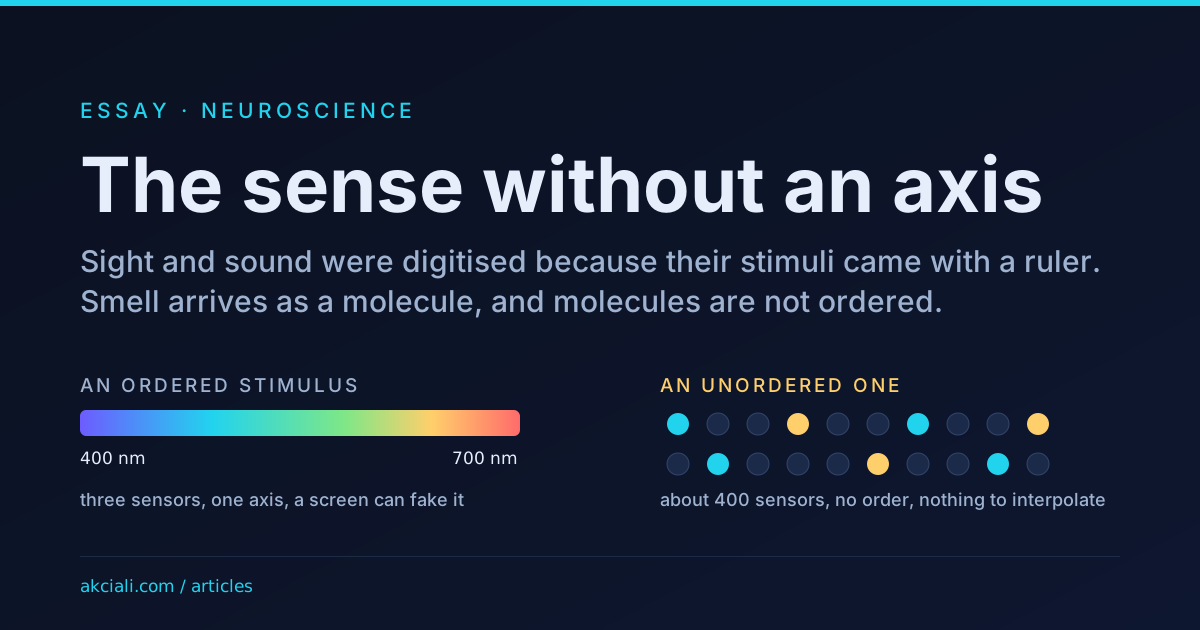
Sight and hearing were digitised because their stimuli come with a physical ruler. Smell has none, which is why the map of odour had to be learned from perception rather than derived from chemistry, and why prediction has advanced while capture and reproduction have not.
A building comes down and a search team arrives. The thermal cameras work. The acoustic listening devices work, well enough to pick a scratching sound out of settling concrete. The radios work. The instrument that actually finds the person under six metres of rubble is a dog.
This should be embarrassing, and it is worth being precise about why it is not simply a matter of insufficient effort. Every other sense in that scene has been engineered into hardware that beats the animal version and beats it badly. A camera sees further into the infrared than any eye, resolves more lines, and integrates for hours. A microphone hears below the human floor and above the human ceiling, and an array of them localises a source to within a degree. Vision and hearing were absorbed into machines decades ago and nobody thinks of it as a hard problem any more.
Olfaction was not absorbed. The gap is not a decade of engineering. It is structural, and it comes down to a single missing thing: smell has no axis.
What an axis buys you
Light is an electromagnetic wave and its perceptually relevant parameter is wavelength, a scalar. Wavelengths are ordered. 520 nanometres sits between 500 and 540 in a way that means something, and a stimulus can be moved continuously along that line. The human eye samples this line with three broadly tuned cone types, so any incoming spectrum, however complicated, collapses into three numbers before it reaches the optic nerve.
That collapse is the whole reason screens exist. Because the eye reports only three integrals of the spectrum, two physically different spectra that happen to produce the same three numbers are indistinguishable. Engineers get to exploit this: a display made of three narrow emitters never reproduces the spectrum of a sunset, it only reproduces the three numbers, and the eye cannot tell. Reproduction was never the hard problem it looked like, because the sensor had already thrown away almost everything.
Sound is the same story in one dimension of time. Air pressure at a point is a single function, and the cochlea performs a mechanical decomposition of it along the basilar membrane, where position corresponds to frequency. A microphone samples the identical one dimensional signal. Capture, transmission and reproduction turn out to be the same task performed three times: sample an ordered physical variable finely enough and you are done.
Now consider the stimulus for smell. It is a molecule. Not a value along a line, an object: a specific arrangement of atoms and bonds, arriving as a discrete item in a space that has no natural distance defined on it. There is no ruler along which molecules can be laid out. Two molecules differing by a single carbon in a chain can smell nothing alike. Two structurally unrelated skeletons can be confused by a trained panel. Nothing about a molecular formula tells you where its percept sits relative to another, which means there is nothing to sample and nothing to interpolate between.
The code, and why it has no geometry
Humans carry roughly four hundred functional odorant receptor genes, the largest gene family in the genome, all of them G protein coupled receptors sitting in the membrane of olfactory sensory neurons. The coding scheme is combinatorial: one receptor responds to many different odorants, and one odorant activates many different receptors. What reaches the brain is a pattern, a sparse vector of roughly four hundred activation levels.
The crucial property of that vector is that its axes have no order. Receptor 217 is not between receptor 216 and receptor 218 in any sense. Shuffle the labels and no information is lost. This is the formal statement of the problem: the peripheral representation of smell carries no geometry of its own. Whatever structure odour perception has, it is imposed downstream, in the olfactory bulb and cortex, by wiring and by experience. It is not sitting in the physics waiting to be read off.
The receptor is checking a fit, not measuring a property
For a long time it was unclear what an odorant receptor is actually responding to, and the vacuum attracted a range of proposals about molecular vibration and other single scalar properties, all of which would have handed the field the axis it lacked.
Cryo electron microscopy settled the shape of the answer. The structure of the active human receptor OR51E2 bound to propionate, a short chain fatty acid, showed the odorant sitting in an occluded pocket, making specific contacts that are required for activation, with molecular dynamics implicating extracellular loop 3 in the conformational change that switches the receptor on. Mutating the pocket shifted which chain lengths the receptor would recognise.
Translated into an image: the receptor is not a meter reading off a property of the molecule. It is a lock, and it is testing whether the molecule packs into a cavity of a particular shape, charge distribution and size. That single fact explains the notorious brittleness of structure to odour intuition. Adding a methyl group does not nudge a measured value slightly, it changes the packing, and packing is precisely what is being tested. A lock does not open slightly more when the key is slightly closer to correct.
Building the axis by learning it
If chemistry will not supply a metric, the alternative is to fit one. The approach that worked treats a molecule as what it is, a graph, with atoms as nodes and bonds as edges, and runs a message passing neural network over it. The update at each round is
h_v^(t+1) = U_t( h_v^(t) , SUM over w in N(v) of M_t(h_v^(t), h_w^(t), e_vw) )
which reads, in plain terms: every atom starts holding a short description of itself, then repeatedly listens to the atoms it is bonded to and rewrites its own description in light of what it heard. After t rounds, each atom’s vector summarises the chemistry within t bonds of it. Pool the atom vectors and the molecule has a single vector. Train the whole thing to predict the words a trained sensory panel uses for that molecule.
The result that matters is not the prediction accuracy, it is what appeared in the layer just before the output. That embedding space arranged itself so that molecules smelling alike sit close together, including across chemical families with no structural relationship to each other. The axis that chemistry refused to provide was recovered from perception instead. Its authors called it the principal odour map.
Where this stands in 2026
The map was validated prospectively rather than by cross validation, which is the part worth respecting. On a set of four hundred novel odorants never seen during training, the model’s predicted odour profile matched the panel mean more closely than the median individual panellist did. Read that carefully, because it is easy to overclaim: the model is not smelling better than a human. It is better than a typical human at predicting what a committee of humans will say. The map also transferred to odour prediction tasks it had not been trained on, which is the actual evidence that it encodes something general rather than memorising a dataset.
Work published in 2026 has started filling the gap that quality prediction left open, with an ordinal odour strength dataset covering more than two thousand three hundred molecules sorted into odourless, low, medium and high. Intensity and detection threshold have consistently lagged behind quality prediction, and for both perfumery formulation and safety assessment the threshold is the number people actually need.
On the hardware side, a review of robotic olfaction published in npj Robotics in January 2026 surveys where the sensing stands. The available transducers are metal oxide plates, electrochemical cells and optical devices, paired with gas source localisation strategies ranging from gradient following through anemotaxis to probabilistic plume mapping. The review is candid about what defeats all of them: turbulence, fluctuating wind, and the presence of more than one source.
What breaks
Five things, and none of them is a detail.
The target is words. The map is trained to predict verbal descriptors assigned by panels, and descriptors are a lossy, culturally loaded, low resolution projection of a percept. A model that nails the label may still be wrong about the experience, and perceptual similarity judgements, which would be a better target, exist in far smaller quantities.
The map covers single molecules. Real odours are mixtures of dozens to hundreds of volatiles, and mixture perception is not additive. Components suppress and mask each other, and beyond a handful of components a mixture tends to be perceived as one unanalysable thing rather than a sum of parts. A map of monomolecular odorants does not compose into a map of the world.
Concentration moves the percept. The same molecule can change perceptual category with dilution, indole being the standard example, faecal at strength and floral when dilute. A representation keyed on structure alone has nowhere to put that.
The instruments are not noses. An electronic nose has a handful of broadly tuned transducers, not four hundred selectivities, and they drift with humidity, temperature and age. Calibration transfer is bad enough that a model trained on one array frequently fails on a nominally identical one, which means a learned odour map has no clean sensor to sit on top of.
Finally, transport. The dominant failure in finding an odour source is not sensitivity, it is that in turbulent flow a plume is not a gradient. It is a tangle of intermittent filaments separated by clean air, and the concentration field only develops a usable gradient after averaging for longer than any moving platform has. Insects do not solve this by climbing anything. They surge upwind on contact and cast crosswind on loss, a behavioural policy that amounts to an admission that there is no slope to ascend.
The part that has not moved
Digitising a sense means three separate things: capture it, transmit it, reproduce it. For sight and sound all three fell at roughly the same time because they were the same problem wearing different clothes.
For smell, exactly one thing has advanced, and it is none of the three. Given a structure, we can now predict what it will smell like. That is genuine and it is useful, for screening candidate molecules without a panel and for designing replacements for materials that are being phased out. It is not capture: no instrument can record the volatile composition of a room the way a microphone records its sound. It is certainly not reproduction, and reproduction is where the missing axis takes its final revenge. Colour needs three primaries because the eye has three sensors, and low dimensionality is exactly what makes metamerism possible. A system with four hundred independently tuned channels and no enforced collapse offers no reason to expect that a small basis of molecules can span the space. A synthesiser for smell might need hundreds of reservoirs, and it might still leave holes.
The boundary between people and machines is usually drawn somewhere around reasoning, which is where it makes for the best argument and the worst prediction. The more durable line runs through the senses, and it is drawn by something as unglamorous as whether the stimulus came with a ruler. The senses that had one moved into hardware and stayed there. The one that did not is still on the far side of the line, in a dog on a pile of rubble.
Further reading
- Structural basis of odorant recognition by a human odorant receptor, the cryo electron microscopy structure of OR51E2 with propionate.
- A principal odor map unifies diverse tasks in olfactory perception, the graph neural network map and its prospective validation.
- Advanced electronic noses for future robotic olfaction, a 2026 survey of sensors and gas source localisation.
- Machine learning for smell: ordinal odor strength prediction of molecular perfumery components, on the harder problem of intensity.