The Sense of Where You Are
Proprioception, the body's silent sense of its own position, is easy to overlook and catastrophic to lose. This essay follows it from muscle spindles to forward models, and asks why robots with perfect encoders still lack it while surgeons are learning to rebuild it.
In 1971, a nineteen-year-old English butcher named Ian Waterman caught what looked like a stomach flu. Within days, from the neck down, he could no longer feel where his body was. The illness had triggered an autoimmune attack that destroyed the large sensory fibers carrying touch and position information from his limbs, while sparing the motor nerves entirely. His muscles worked. His strength was intact. And he was, functionally, paralyzed. Asked to stand, he would crumple, not because his legs failed but because his nervous system had no idea where his legs were. Doctors told him he would spend his life in a wheelchair. Instead, over years of brutal practice, Waterman taught himself to run his body by eye: watching a hand to guide it to a cup, watching his feet to walk, planning each movement like a chess move. Turn off the lights, and he fell where he stood.
Waterman’s case is famous among neuroscientists because it is a clean subtraction experiment that no ethics board could ever approve. Remove one sense, keep everything else, and see what breaks. What broke was almost everything, and the sense in question is one most people cannot name. Proprioception is the continuous, unconscious report of where your limbs are, how fast they are moving, and how hard your muscles are pulling. Close your eyes and touch your nose: the fact that this is effortless, that your fingertip arrives within a centimeter of target after a meter-long journey through the dark, is proprioception working. It is the sense that never makes it into the list of five, precisely because it never fails loudly enough to be noticed.
The hardware of the silent sense
The signal starts inside the muscle itself. Threaded among the ordinary force-producing fibers are a few hundred specialized structures per muscle called muscle spindles: tiny capsules, a few millimeters long, containing miniature muscle fibers wrapped in sensory nerve endings. When the muscle stretches, the spindle stretches with it, and its nerve endings fire faster. A second sensor family, the Golgi tendon organs, sits where muscle meets tendon and reports not length but tension, the actual force being transmitted to the skeleton. Add slowly adapting receptors in the skin, which fires in patterns as it stretches over moving joints, and receptors in the joint capsules themselves, and you have the raw channels.
The spindle is the star, and it is stranger than a simple gauge. Its firing rate is well approximated by r = a·x + b·v, where x is muscle stretch and v is the speed of stretching. In words: every spindle reports a blend of where the muscle is and where it is about to be, position and velocity fused into a single number. The sensor itself is predictive, leaning into the future by a few tens of milliseconds, which is roughly the delay the nerve conduction will cost. Evolution, having no way to make signals travel faster, made them leave earlier.
Stranger still, the spindle is not a passive instrument. It receives its own private motor supply, the gamma motoneurons, which tighten the miniature fibers inside the capsule and thereby adjust the sensor’s operating range on the fly. The brain does not simply read its position sensors; it tunes them, continuously, depending on the task. During a delicate movement the spindles are kept taut and exquisitely sensitive. The measuring tape is alive.
A sense that is mostly a guess
Here is the part that reframes everything: the brain does not trust these sensors very much, and it should not. Nerve signals from a foot take on the order of fifty to a hundred milliseconds to reach the brain and be processed. A sprinter’s leg swings through a full stride in about three hundred. Running on raw feedback alone would mean controlling the body with a noticeable satellite lag, and anyone who has tried to hold a conversation over a bad video link knows how well that goes.
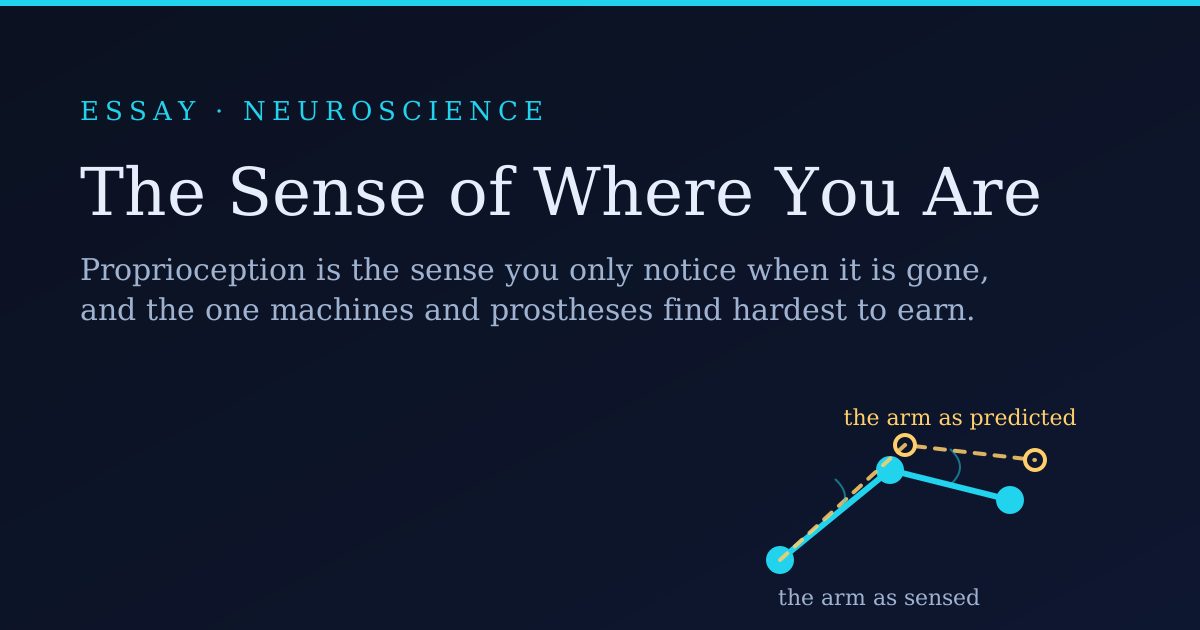
The nervous system’s solution is the forward model. Every time a motor command is sent to the muscles, a copy of that command, the efference copy, is routed to internal circuitry, prominently in the cerebellum, which predicts what the sensors should report if the movement goes as planned. What you experience as the position of your arm is not the sensor data. It is the prediction, continuously corrected by the difference between expected and actual signals. Perception of your own body is a running simulation, nudged by evidence.
You can feel the model being fooled. Vibrate the biceps tendon at around ninety hertz and the spindles fire as if the muscle were lengthening. The forward model dutifully concludes the arm is extending, and blindfolded subjects feel their stationary arm drift outward. Run the same trick while the subject holds their own nose, and some report the nose growing outward to impossible lengths, a laboratory Pinocchio effect. The illusion matters because of what it proves: position sense is an inference, and inference can be steered by anyone who controls the inputs.
Measurement is not a body
Now consider a machine. A modern humanoid robot knows every joint angle through optical encoders accurate to a fraction of a degree, sampled thousands of times per second, with none of the noise, drift, or fifty-millisecond lag of biological nerves. By any instrumentation standard, robots have vastly better proprioceptive sensors than humans. They do not, however, have better proprioception, and the gap is instructive.
An encoder reports a number. Proprioception is a model that owns its numbers: a body schema that fuses joint sensors, inertial sensors, force readings, and vision into a single answer to the question, where am I, and what am I touching. This is precisely where humanoid robotics has been pushing. Current state estimation stacks fuse multiple inertial measurement units with joint torque sensing to detect foot slip and external shoves, and the harder frontier is making the robot learn its own body rather than being handed a CAD file. Work published this year showed a humanoid learning to distinguish itself from other robots by discovering the correlation between its proprioceptive stream and what it sees moving in a mirror-like setting, without identity labels, and then bootstrapping a predictive model of its own three-dimensional occupancy from that correspondence. That is a forward model being born, and the recipe, prediction plus correlation between senses, is uncannily close to the biological one.
The convergence should not be oversold, and researchers in the field are the first to say so. A robot’s learned body schema, like any learned model, degrades outside its training distribution; a payload it has never carried shifts its dynamics the way a heavy backpack briefly confuses yours, but the robot recalibrates far more slowly. Encoders solve position but not the sense of effort, and torque sensing at every joint remains expensive enough that many platforms estimate rather than measure force. The instrumentation is superb; the ownership is still shallow.
Where this stands in 2026
The most striking recent progress is not in giving machines a body sense but in giving it back to people. For most of the history of amputation surgery, the residual limb was closed with the muscles anchored to whatever was structurally convenient, severing the agonist-antagonist pairing that spindles depend on. A biceps with no triceps to stretch against sends the brain gibberish, which is one reason a conventional prosthesis feels like cargo, a tool strapped to the body rather than part of it.
The agonist-antagonist myoneural interface, developed at MIT, is a surgical rewiring that reconnects opposing muscle pairs inside the residual limb so that when one contracts, the other stretches, exactly as in the intact anatomy. The spindles and tendon organs in both muscles then report physiologically meaningful signals, and clinical studies in Science Translational Medicine showed that this preserves proprioceptive sensorimotor circuitry: people feel their missing joint move when the reconnected muscles do. In 2025, the same lineage of work reached a milestone in Science with a tissue-integrated bionic knee. The device combines the myoneural interface with a titanium implant anchored directly into the femur, so the prosthesis loads the skeleton the way a biological leg does and takes its commands from the rewired muscles. Participants in the trial walked faster, climbed stairs, and negotiated obstacles better than users of socket prostheses, and, in some ways more telling, scored higher on measures of feeling that the limb was theirs. In parallel, a 2025 report in Science Advances demonstrated a magnet-based kinesthetic interface: tiny magnetic beads implanted in muscle, tracked by external sensors, delivering coordinated hand-movement sensation for prosthetic fingers, a possible route to proprioceptive richness without wiring into nerves.
The direction of travel is clear on both fronts. Medicine is rebuilding the loop from the sensor side, keeping the biological spindles and giving them something honest to measure. Robotics is rebuilding it from the model side, keeping the perfect sensors and learning the ownership. They are converging on the same architecture from opposite shores.
What the small print says
The honest caveats are substantial. The bionic knee trial involved two participants with the full osseointegrated system; the broader myoneural interface cohorts number in the tens. These are engineering existence proofs, not established clinical practice, and the surgery is largely an option at the time of amputation, not a retrofit for the millions living with conventional residual limbs. Magnetomicrometry has yet to leave early feasibility studies. Embodiment itself, the sense that the limb is yours, is measured through questionnaires and indirect behavioral markers, and the field has no agreed unit for it. On the machine side, learned self-models have been demonstrated in constrained laboratory settings, and nothing published so far shows them surviving the open-ended physical mess a human toddler handles by age two.
And the deepest lesson of proprioception cuts both ways. Waterman never got his sense back. What he built instead, movement run entirely on vision and conscious planning, cost him decades of effort and never became automatic; he described standing still in a dark room as an act of concentration. That is what a body without a forward model looks like: possible, exhausting, and always one distraction from collapse. It is worth keeping his silhouette in mind when a demo video shows a humanoid robot catching itself after a shove. The catch is not the achievement. The achievement, still mostly ahead, is the silence underneath it, a model of self so good that nothing needs to be noticed at all.
Further reading
- Tissue-integrated bionic knee restores versatile legged movement after amputation, Science, 2025
- Agonist-antagonist myoneural interface amputation preserves proprioceptive sensorimotor neurophysiology in lower limbs, Science Translational Medicine
- Coordinated hand movement sensation revealed through an implanted magnetic prosthetic kinesthetic interface, Science Advances
- Proprioceptive-visual correspondence enables self-other distinction in humanoid robots, arXiv