The Relativity of Now: why the present is not the same everywhere
One stubborn fact (light travels at the same speed for everyone) forces a strange conclusion: 'at the same time' has no universal meaning. From Einstein's train to the block universe, a visual tour of why the present might be a point of view rather than a thing, and why atomic clocks now measure it at the width of a hair.
Close your eyes for a second and try this: right now, on a planet a trillion kilometres away, something is surely happening, the same “now” as yours, isn’t it? It feels self-evident. It is also what Isaac Newton believed: a universal time, one great cosmic clock ticking the same instant everywhere at once. And it is wrong. The man who demolished it, in 1905, needed only one stubborn fact: light travels at the same speed for everyone, no matter what you do.
One stubborn fact
Hold on to that fact, because everything else hangs from it. If you chase a beam of light, it does not slow down a hair: you still measure it at about 300,000 km/s. If you rush toward it, same result. Light ignores your speed. But if the speed of light is fixed for everybody, then something else has to bend to compensate, and that something is time itself, along with the very idea of “at the same time”.
The train: simultaneous for whom?
Einstein told it with a train. Picture a carriage racing along a platform. At the instant its midpoint passes you (you are standing still on the platform), two bolts of lightning strike: one at the front of the train, one at the rear, at exactly the same moment from your point of view. You are equidistant from both ends, the two flashes cover the same distance at the same speed, so they reach you together. For you, the two strikes are simultaneous. Nothing to argue about.
Now the traveller sitting at the middle of the carriage, call her M′. She too is exactly halfway between the two ends. But while the light is in flight, she is carried forward: the train sweeps her toward bolt B. She therefore rushes to meet B’s light, which reaches her first; A’s light, coming from behind, has to chase her down. The result: for M′, B struck before A. Not “at the same time”. And here is the vertigo: she is not wrong. There is no supreme judge to rule that “the platform is right”. Both observations are equally valid. Simultaneity is relative: the sentence “these two events happen at the same time” depends on who says it and how they are moving.
The intuition, stripped of any formula: light has a fixed speed, like a conveyor belt that never changes pace. So the moment you move, you close in on one flash and pull away from the other; one necessarily arrives before the other. “Now” is not a blade that falls across the whole universe at once. It is a point of view. Move, and the view turns.
Draw time: the “now” is a slice you can tilt
There is a tool that makes all of this crisp: the spacetime diagram. Put time on the vertical axis (the future is up) and space on the horizontal. A stationary object is a vertical line climbing upward: it does not move in space, but it advances through time. Your whole life is a curve traced in this plane, your “worldline”.
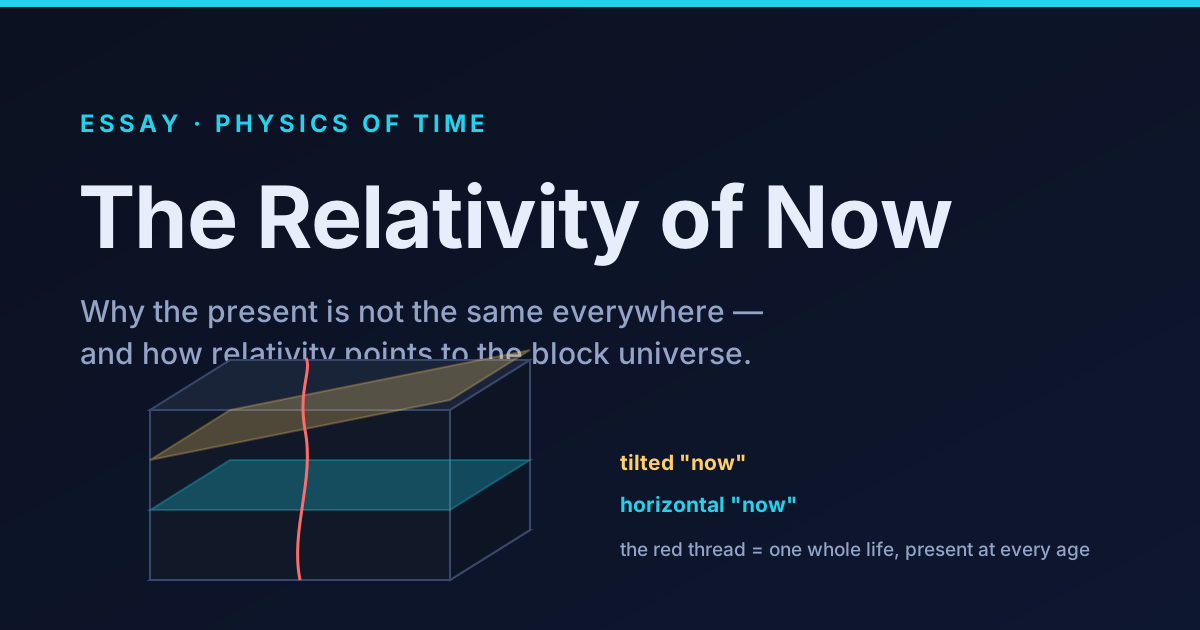
Here is the pivot: the “present” is not a thing sitting out there; it is a cut through spacetime, a slice of “everything happening now”. And the angle of the cut depends on your motion. You and I, passing on the street at different speeds, carve the same block of reality with two differently tilted knives. Our two “nows” do not contain the same distant events.
The conclusion that spins your head: the block universe
Follow the reasoning; it is short and merciless (philosophers call it the Rietdijk–Putnam argument, 1966). Take two people ambling past each other on a pavement, one walking toward the Andromeda galaxy, the other the opposite way. Andromeda is 2.5 million light-years off. At that distance, the tiny difference in the tilt of their two “slices of present” is multiplied enormously: their “nows” out there differ by several days. Roger Penrose made a striking picture of it, the “Andromeda paradox” (1989): for one walker, an invasion fleet has just set sail from Andromeda; for the other, met at the very same instant on the very same pavement, the decision to launch has not even been taken yet. Two pedestrians, side by side, two “presents” days apart across the sky.
Now the logical knockout: if an event still in your future is already in my present, or even my past, then it is as real as your cup of coffee. It is not waiting to “happen”; it is already there, somewhere in the block. Extend that to everything: all events, past, present and future, exist on equal footing. This is the block universe (or “eternalism”): time is not a flowing river but a frozen dimension, like space. The past has not vanished, the future is not yet-to-come: they simply are. Like the pages of a book already written: you read one line at a time, but every line exists at once.
And the famous flow of time, that vivid sense that “now” advances and the past streams away? In the equations of physics, it does not exist. Nowhere is there a “now” sliding along the time axis. The flow may well be a construction of the brain, the way a system that piles up memories (and so tells an “earlier”, full of traces, from a “later”, still blank) experiences its own passage through the block. If the mind builds space and builds the sense of a continuous self, why not the arrow of time?
Two honest caveats, because they matter. All of this is an interpretation of relativity, not a theorem carved in stone. Three camps still contend: presentism (only the present instant is real, but it sits badly with the relativity of simultaneity); eternalism / the block universe (everything is real, the reading most in tune with Einstein); and the growing block (past and present are real, the future not yet, and the block grows as new facts come into being). Relativity leans hard toward the block without quite forcing it. It is a live debate, not a settled dogma.
Where this stands in 2026
The physics of time keeps getting more tangible, and the metaphysics keeps moving.
The time at your head runs faster than the time at your feet, and we now measure it. Ever-finer atomic clocks bring relativity into the laboratory. In 2022, Jun Ye’s team at JILA measured the difference in tick-rate between the top and bottom of a single cloud of strontium atoms one millimetre apart (the thickness of a sharp pencil tip), published in Nature, with a claimed precision about 50 times better than earlier measurements. By 2024 the same group had pushed to the sub-millimetre scale (the width of a human hair), and a clock comparison between a Boulder lab and the summit of Mount Blue Sky was planned for 2025 (figures announced by the research teams). Time dilation is no science-fiction abstraction: it measurably separates two points a hair apart. Universal time is dead, even inside your own body. See NIST / JILA and Physics World.
Meanwhile the block universe is still on the grill. The question “does the future already exist?” is not shelved: a June 2025 essay attacks eternalism from an unexpected angle: if spacetime is an infinitely divisible continuum, “individuating” the events that would make up the block becomes mathematically thorny. Against it, growing-block models (past and present real, the future “becoming”) are regaining ground, trying to marry that becoming with relativistic invariance. The useful takeaway is a habit of thought: relativity constrains the metaphysics of time but does not decide it. Knowing what the physics proves, versus what we read into it, keeps you from mistaking an interpretation for a fact.
Further reading
- Simultaneity Spacetime Diagram (ComPADRE / Open Source Physics), an interactive: drag the observer’s speed and watch the “now” slice tilt in real time. The best way to feel with your hands what the second diagram shows.
- Einstein-Online · Spacetime (elementary tour, part 5), spacetime explained without a single heavy equation, by the Max Planck Institute. Ideal if you think visually.
- John Norton · Spacetime and the Relativity of Simultaneity (Univ. of Pittsburgh), the reference chapter, full of diagrams, by one of the subject’s best teachers. If you read only one, read this.
- The Rietdijk–Putnam argument and the Andromeda paradox (Wikipedia), the exact step from “relative simultaneity” to “block universe”, with the objections (Stein: relativity defines the present only locally).