The predictive brain: an organ that spends its life minimising surprise
Predictive processing flips perception on its head: the brain does not passively receive the world, it constantly predicts it and transmits only the error. A look at what that reframing explains: about attention, dreams, and the kinship between brains and machines.
Information theory gives us a precise notion of surprise: an event of probability p carries −log₂ p bits, so a rare event carries a great deal of information. It is striking to take that same quantity and place it at the heart of a 1.4-kilogram organ that spends its entire existence fighting it. Under one increasingly influential reading, the brain is, at bottom, a machine for reducing surprise.
We had it backwards
The classical intuition about perception is straightforward: the world strikes the senses, the signal travels inward (eye → optic nerve → visual cortex), the brain assembles it, and we “see.” A bottom-up flow, from sensor to interpretation: the brain as a camera wired to a hard drive.
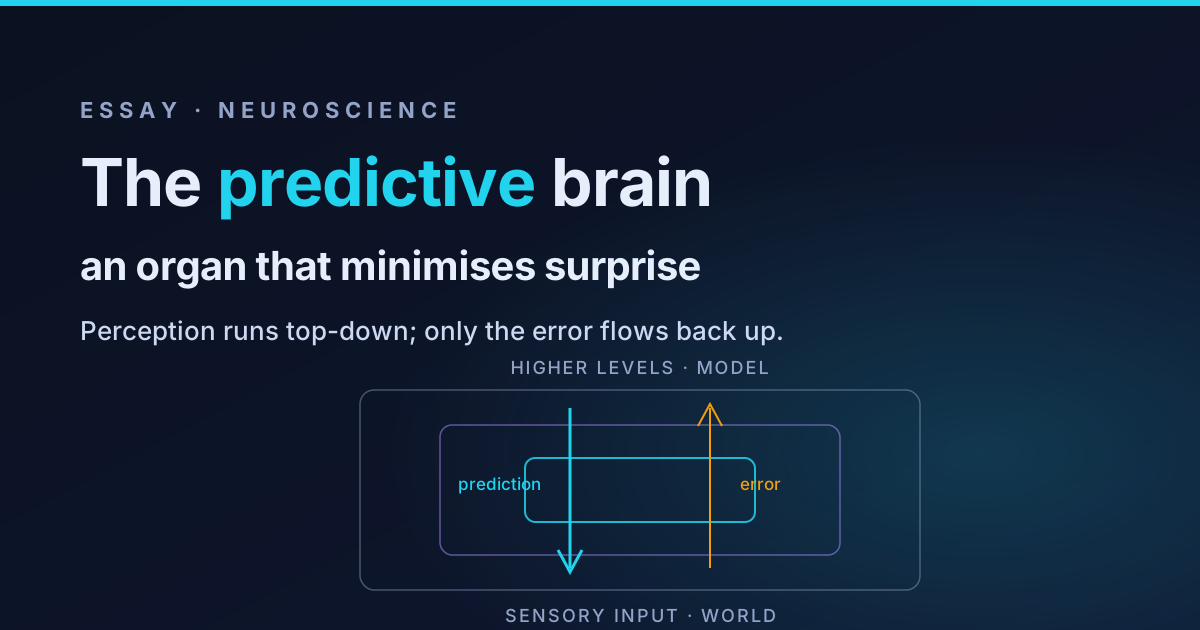
The problem is that this does not match the anatomy. In the cortex, the connections that travel downward, from high, abstract areas toward the sensory areas, far outnumber those that travel upward. The brain talks to itself far more than it listens to the world. The theory of predictive processing therefore inverts the picture: the brain does not receive passively, it continuously predicts what it ought to perceive, and only the discrepancy is sent back up.
The neuroscientist Anil Seth summarises this with a deliberately provocative phrase: perception is a “controlled hallucination.” What we see is not the world but the model the brain generates of the world, a hallucination that the sensory data merely correct. When everyone agrees on the hallucination, we call it reality.
Prediction error: the only thing that travels
The mechanism is formidably elegant. Each level of the cortical hierarchy sends a prediction down to the level below it: “here is what I expect to receive.” The lower level compares that prediction to what actually arrives and passes upward only the difference: the prediction error.
If the prediction is perfect, the error is zero and nothing travels up. The brain got it right; move along. This is enormously economical: instead of transmitting the entire sensory flood at every instant, the system transmits only novelty, only the unanticipated. It is exactly the principle of a video codec that encodes only the pixels that change from one frame to the next, and exactly the compression principle of information theory, where the predictable costs zero bits and only surprise has to be paid for.
Learning, in this framework, is simply the updating of the internal generative model so that its future predictions fit better. A prediction error is not a failure; it is the only fuel of learning. No error, no information, no learning. There is a quiet corollary here for anyone who has ever lost interest in a subject halfway through: once your predictions become “good enough,” the residual error drops below the threshold worth attending to, and the fuel runs dry. Boredom, on this account, is literally a prediction error that has fallen too low.
The free-energy principle: minimising surprise to stay alive
Karl Friston pushes the idea to a near-physical principle: the free-energy principle. The argument, in digestible form, runs like this.
A living organism must remain within a narrow band of viable states: body temperature near 37 °C, blood sugar within a range, the body not crushed under a truck. But “staying within a few probable states” is exactly the same as maintaining low entropy over the distribution of one’s possible states. A system that drifts toward high entropy dissolves into its environment; that is, quite literally, thermodynamic death.
The difficulty is that a brain cannot measure its own surprise directly: that would require knowing the true probability of every sensation. Friston shows that there is a computable quantity, free energy, which is an upper bound on surprise. By minimising that bound, the system minimises surprise without ever having to compute it. There are two levers for doing so. The first is perception: change the model to fit the data better, update one’s beliefs. The second is action: change the data to fit the model, move so that the world becomes the one you expected. This is active inference. You are hungry; your model predicts “I should be sated”; the gap is a prediction error; and you act (you eat) to cancel the error.
Action and perception become two faces of a single operation: reducing the gap between the expected world and the received one. It is, incidentally, a chilling description of habit. If a model has learned that “eating under stress yields expected relief,” active inference will steer the body toward the fridge to cancel a prediction error. The lever is not willpower; it is the model.
Precision weighting: this is what attention is
Not all prediction errors are equal. In fog, the visual signal is noisy: a large error does not mean the prediction was wrong, only that the data are unreliable. So the brain weights each error by its precision, the inverse of the estimated uncertainty. An error judged precise pulls hard on the model; an error judged noisy is ignored.
This precision weighting is simply a mechanistic name for attention: choosing which errors to grant gain. Dopamine and acetylcholine are thought to encode part of this precision. And when the setting goes wrong (too much precision granted to internal predictions, too little to the data) the model generates perceptions that nothing corrects. That is a computational reading of hallucination and of certain psychotic symptoms. The same mis-set dial explains why a tired mind, its sensory precision collapsed, “sees” things in the dark.
Dreams: the model running offline
The same machinery offers an unusually clean account of dreaming. At night, in REM sleep, sensory inputs are gated off and motor outputs are inhibited. The generative model then runs with no data to correct it. The result is an uncontrolled hallucination: the dream. It is the same apparatus as waking perception, simply unplugged from the real. The dream may be, among other things, the model training itself: replaying and consolidating its predictions offline, a kind of biological data augmentation.
And the lucid dream? In this framework it is the return online of a metacognition module (the prefrontal cortex, usually dormant in REM) that evaluates the model’s precision and detects an inconsistency: “this scene is too improbable to be real.” A second-order prediction error, in effect. The classical induction techniques, such as repeated reality checks during the day, amount to training that inconsistency detector so that it fires at night too.
The human-machine bridge
Predictive coding is no longer only a theory of the living; it has become an architecture for artificial intelligence. Autoencoders learn by predicting their own input. Predictive coding networks implement the error/prediction hierarchy literally. World models run an internal generative model on which an agent “dreams” its training. And above all, a large language model is, fundamentally, a surprise minimiser. Its training consists of predicting the next token and reducing the cross-entropy between its prediction and the real text. Self-supervised learning is predictive coding at industrial scale. Brain and model perform the same gesture: anticipate, measure the gap, correct.
The crucial difference is one of stakes. A brain minimises surprise about its own survival: active inference, anchored in a body that can die. A language model minimises surprise about a corpus of text, with no body and nothing at risk. The mathematics is the same; the purpose is opposite. That gap is worth holding onto. It is the difference between a system that predicts in order to keep living and one that predicts because it was trained to, and it is precisely where the easy equation of “the brain is just a prediction machine” starts to fray.
What the predictive view does give us, undeniably, is a single thread running through perception, attention, learning, dreaming, and the design of our machines. In every case the same logic recurs: build a model, predict, measure the error, and spend your existence (economically, relentlessly) trying to make the next surprise smaller.
Further reading
- Andy Clark, “Whatever Next? Predictive Brains, Situated Agents, and the Future of Cognitive Science” (Behavioral and Brain Sciences, 2013): the lucid survey that brought predictive processing to a wide audience.
- Anil Seth, Being You: A New Science of Consciousness (2021): the “controlled hallucination” view of perception, accessibly argued.