The neural manifold: why some brain-computer interfaces cannot be learned
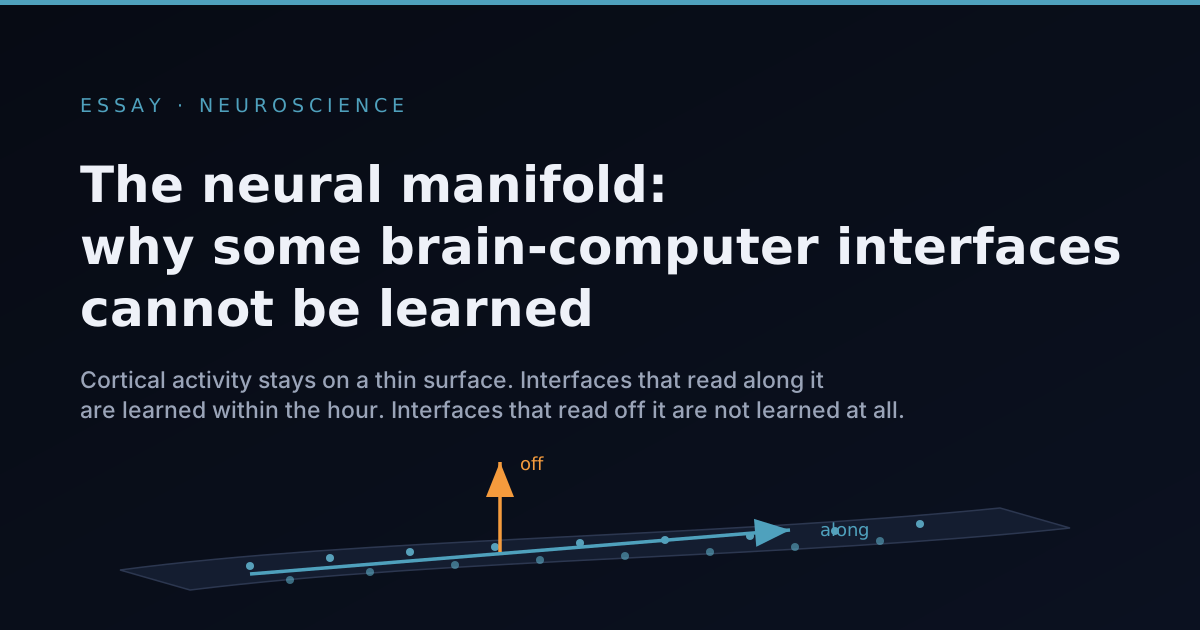
Activity in a cortical network does not fill the space it could occupy. It stays on a thin surface, and a 2026 human study shows that an interface reading along that surface is mastered within the hour, while an interface reading off it is never learned at all.
Someone is lying in an MRI scanner playing a video game with no controller. On the screen a small human avatar walks across a virtual field toward a flag. The only thing steering it is the pattern of activity in a network of the player’s own brain regions, read out every two seconds, projected onto a single direction, and converted into a heading. Nobody told the player how to do this. They were told to find a mental state that makes the avatar walk to the flag, and left to it.
It works. By the fourth trial the avatar is measurably going the right way. By the fortieth the player has plateaued at good control, and the software has handed over about half of the steering it was doing on their behalf at the start.
Two days later: same person, same scanner, same game, same instruction. One thing has changed, invisibly to them. The software now reads a different direction out of the same brain activity. This time nothing happens. Not slowly, not partially, not with a late breakthrough in the final ten trials. Across a full session, control does not improve at all.
The person did not get worse at concentrating. What changed was a geometric property of the code, and the failure was predictable in advance from a measurement taken before the session began.
The room the brain does not use
Point a scanner at a patch of cortex and you get, in this study, roughly 1,350 voxels. Each has a value, so the state of that patch at any instant is a point in a space of 1,350 dimensions, and its activity over time is a trajectory of that point.
In principle the point can go anywhere in that space. In practice it goes nowhere near most of it. Real neural activity stays on a much thinner subset, a surface with a few dozen effective dimensions embedded in the thousand-plus. This surface is the intrinsic manifold, and some version of it turns up wherever anyone records enough neurons at once to look.
A marionette makes the idea concrete. Fifty strings, but tied into ten bundles, so the puppeteer has ten independent controls. The postures the puppet can adopt form a ten-dimensional set inside a fifty-dimensional space of string configurations. The missing postures are not forbidden by physics. They are simply unreachable through the strings as they happen to be tied.
Cortex is tied similarly. Neurons share inputs, share local circuitry and settle into correlated patterns, so a population’s usable repertoire is far smaller than its neuron count suggests. In the study in question, activity across those 1,350 voxels was captured by a twenty-dimensional manifold, estimated from a first session in which the participant simply steered the avatar with a joystick while the scanner watched.
Then the description turns into a prediction. If activity lives on that surface, an interface asking for movement along the surface is asking for something the network already does. An interface asking for movement off the surface is asking for something the network has, as far as anyone can measure, never done.
The monkey version of this experiment
The prediction was first tested in monkeys, more than a decade ago. An animal with an electrode array in motor cortex learns to move a cursor through a decoder that maps population activity to cursor velocity. Then the experimenter quietly rewires the decoder.
If the new mapping keeps the cursor tied to directions the population already varies along, the monkey adapts within a single session, in minutes. If the new mapping demands activity patterns off the manifold, the monkey does not adapt within that session. Later work showed the second case is not impossible, merely expensive: with roughly ten times as much training, spread over days, animals eventually do produce genuinely new population patterns.
The two cases also differ in kind, not only in speed. Fast within-manifold learning happens by reassociation. The animal keeps producing patterns it already had and reuses them for new meanings, like relabelling the keys on a keyboard rather than learning to type differently. It is quick precisely because nothing new has to be generated.
Doing it in a person, without surgery
The 2026 study takes this to humans with no implant. Eighteen participants, four sessions each on separate days, real-time functional MRI at 3 tesla, images shipped out of the scanner and decoded inside the two-second acquisition cycle.
Two choices make it more than a replication.
The target is not motor cortex. It is a network associated with spatial navigation, defined from a meta-analytic map rather than from the participant’s own motor system. So the question is no longer whether motor cortex, which exists to produce a low-dimensional output, happens to have a low-dimensional manifold. It is whether a higher-order cognitive network has one, and whether that one constrains learning the same way.
The manifold is also not linear. fMRI signals are autocorrelated and noisy, and the usual move of taking principal components imposes flat structure on data that may not be flat. The authors instead used a diffusion-geometry method, which builds the surface out of local similarity between states rather than global variance directions, then trained a small autoencoder so that incoming volumes could be projected onto that surface fast enough to close the loop.
With the surface in hand, its twenty directions were ranked by how much activity they account for. Direction one became the intuitive mapping. Direction two became the within-manifold perturbation. Direction twenty, the least-used direction of the manifold, became the outside-manifold perturbation. Every participant did all three, with the order of the two perturbations counterbalanced across days.
The measured quantity was how much of the avatar’s steering the software was willing to hand over, ratcheted up when trials got straighter and down when they got worse. From the first trial of a session to the last, on a scale where 100 would be full control:
- intuitive mapping: +49, significant by trial four, plateauing around trial forty
- within-manifold perturbation: +17, significant from around trial thirty
- outside-manifold perturbation: -0.7, indistinguishable from zero at every point
The mechanism was not the monkeys’ either. Participants did not simply reuse existing patterns. The share of total activity variance falling along the trained direction rose over the session, for the intuitive and within-manifold cases and not for the outside one. The network realigned, generating patterns it had not been generating before. Realignment is the slower route and the better one, since it is the solution that actually holds, and in the animal work it shows up only after long training. Seeing it inside a single hour is the odd part of the result.
Where this stands in 2026
A commentary published alongside the study in September places it in the direct lineage of the primate experiments, and is written by the researcher who ran them. The framing is that one geometric constraint holds across species, across recording modalities and now across brain systems: not a quirk of motor cortex, not an artefact of electrodes.
The practical consequence lands on neurofeedback, which has an awkward track record. Protocols routinely need four to ten sessions to produce a robust change, and roughly a third of participants never manage to move their brain activity in the requested direction at all. That non-responder rate is usually attributed to individual variation, motivation or aptitude.
The manifold account offers something duller. Those protocols pick a target because it is clinically meaningful or easy to measure, without asking whether it corresponds to anything the region already does. Some proportion of non-responders may have been handed an off-manifold target and a training budget sized for an on-manifold one.
The logic cuts both ways. For a communication interface, riding the existing manifold is obviously right, and the paper’s suggestion of training several on-manifold directions at once, to get two axes of control instead of one, is the natural next step. For a psychiatric application, where the point may be precisely to change a manifold that is itself part of the disorder, off-manifold training is the goal, and this result says it needs an order of magnitude more time than anyone currently budgets. Either way the manifold has to be measured before the target is chosen.
What this does not show
The within and outside distinction is not a real boundary, and the authors say so plainly: it is continuous rather than binary. Direction twenty was selected because it was reliably low-variance for every participant. Direction three might well have been learnable, since for many participants it still carried more than a tenth of the variance. Had the manifold been estimated at a hundred dimensions instead of twenty, direction one hundred would presumably have been harder still. “Outside the manifold” means “far down the variance ranking of a surface estimated at a dimensionality the experimenters chose”.
“Cannot be learned” means “was not learned in one session, by eighteen people, with this much training”. The animal literature is explicit that the same class of perturbation yields to roughly ten times the practice. Nothing here demonstrates a hard limit. It demonstrates a steep price.
And the manifold measured is a manifold of blood flow. fMRI reports a hemodynamic proxy at a resolution of seconds, several inferential steps away from spiking. Whether the surface extracted from voxels corresponds to the population manifold seen with electrodes is an assumption carried over from the monkey work, not something this design can test. The authors go further and float the idea that realignment might appear at the macro scale before it becomes visible at the scale of individual neurons, which is a hypothesis rather than a finding.
One result sits awkwardly with the story. Searching the whole brain for regions that decoded the task better after training, the improvements showed up mainly in somatosensory cortex and hand-related motor areas, and only about three percent of the improved locations fell inside the navigation network being fed back from. Either participants converged on a motor strategy that the navigation framing does not describe, or the target region matters less to the learning than the design assumes. The paper reports this and does not resolve it.
There was also no control group, only simulated participants built from realistic noise. That rules out the pipeline manufacturing structure out of nothing. It does not rule out participants finding a strategy that happens to load onto directions one and two and not onto direction twenty, for reasons having little to do with manifolds.
What survives all that is narrow and probably durable. Ask a cortical network for something adjacent to what it already produces and it complies within the hour. Ask it for something orthogonal and it does not comply within any session length a clinic or a consumer device can afford. If that generalises, the design question for neurotechnology inverts. The interesting question stops being which signal is easiest to read, and becomes what the tissue already has on offer, and whether the machine is willing to be shaped around it.
Further reading
- Human learning of noninvasive brain-computer interfaces via manifold geometry, the study itself, in Nature Neuroscience.
- Neural geometry guides learning, the September 2026 commentary placing it in the lineage of the primate work.
- A neural manifold view of the brain, a broader perspective on what these surfaces are taken to mean.
- Neural manifold analysis of brain circuit dynamics in health and disease, a technical review of how the surfaces are estimated and where the methods disagree.