The Metabolic Switch: how your body repairs itself when you stop eating
After roughly half a day without food, the body flips from burning glucose to burning ketones, and quietly switches on a cellular recycling program called autophagy. The surprising lesson from recent research is that the benefit comes not from fasting itself, but from cycling between the fed and fasted states.
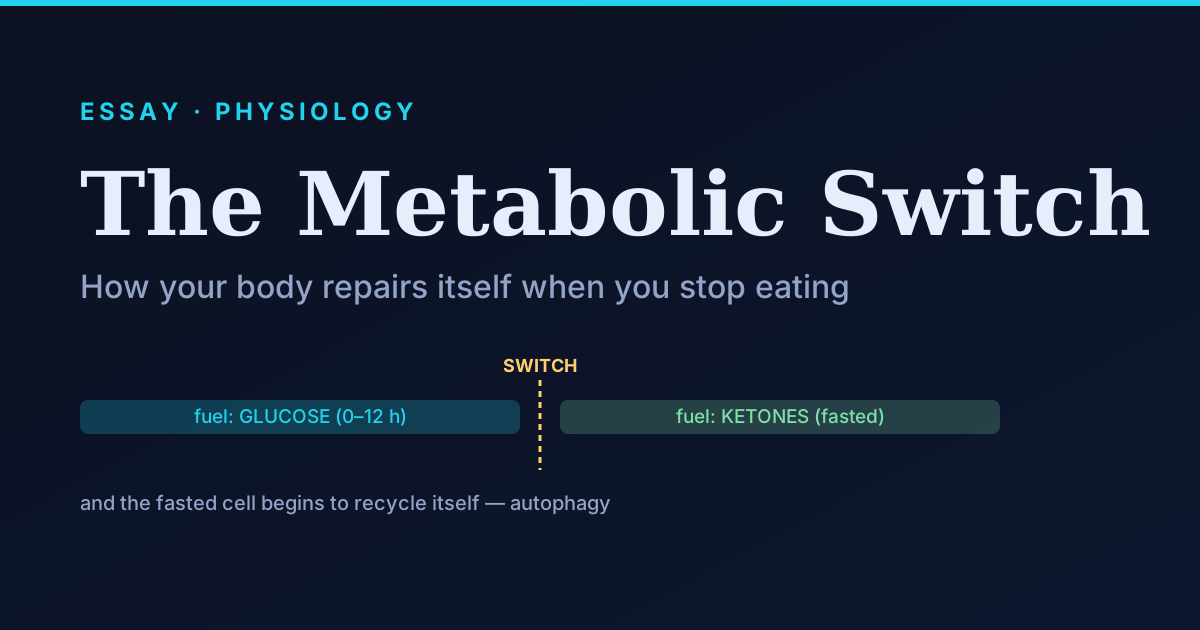
When you eat, your body runs on glucose and stores the surplus (glycogen in the liver, fat in the tissues). No surprise there. The interesting part is what happens when you stop. After enough time without food, the liver’s glycogen tank runs dry and the body switches to a different fuel. That changeover has a name, the metabolic switch, and it is the key to everything that follows.
From sugar to ketones
After roughly 8 to 12 hours of fasting (water only), the liver has spent its glycogen. It then starts making ketone bodies, chiefly β-hydroxybutyrate (BHB), out of fat. Ketones become the backup fuel for the body and the brain (which cannot burn fat directly). The body does not panic; it does exactly what millions of years of scarcity prepared it for: gliding from a “fed” mode to a “fasted” mode.
Autophagy: the cell that recycles itself
Here is the real star. In Greek, auto-phagy means “self-eating.” It is the process by which a cell dismantles its own damaged parts (misfolded proteins, worn-out mitochondria, debris), digests them, and recycles the building blocks into new ones. It is the cell’s cleanup crew and recycling plant in one. The Japanese biologist Yoshinori Ohsumi worked out its machinery and won the 2016 Nobel Prize in Medicine for it.
The point worth keeping: autophagy idles when you are fed (the body is in “build” mode, not “demolish”), and it accelerates when you fast (“repair” mode: sort, recycle, clear what’s lying around). For a long time this was only shown in animals; a 2025 analysis provides some of the first evidence in humans that time-restricted eating raises autophagic flux.
The real idea: it’s the cycle, not the fast
Two opposing states are driven by two cellular “sensors”: mTOR senses abundance (“build”), AMPK senses scarcity (“save and repair”). A 2025 framework, the cyclic metabolic switching theory, ties it together: the benefits of intermittent fasting come not from fasting per se but from alternating between a fasted phase that switches on adaptive stress and repair pathways (ketones, autophagy, AMPK) and a fed phase that switches on growth and plasticity (mTOR, protein synthesis). Like a muscle, it is the load and the rest that build, not permanent tension. Forget the acronyms and keep two modes and a switch: a construction site (eating) delivers concrete and builds, demolishing nothing; a renovation (fasting) pauses the build so a crew can sort the rubble, repair, and recycle. A house that is only ever a building site fills with dust; a house under permanent renovation is never built. Health is alternating the two, and never to extremes.
Where this stands in 2026
The human evidence is sharpening. A 2025 exploratory analysis in The Journal of Physiology found that time-restricted eating increases autophagic flux in humans, moving “fasting cleans the cells” from slogan toward a cautiously measurable effect (J. Physiology 2025). Meanwhile the “why it works” is being rewritten around the cycle rather than the fast: a 2025 perspective in Nature Metabolism proposes the cyclic metabolic switching theory, shifting the target from “fast as long as possible” to “cadence the two phases well” (Nature Metabolism 2025). And a sober 2025 review keeps the promises in check, weighing intermittent fasting against blood-glucose control and the gut microbiome (review 2025). None of this is a licence for extremes: the interesting science lives in moderate, well-timed cycling, and anything health-related is a matter for a professional, not an essay.
Further reading
- Time-Restricted Eating and Its Metabolic Benefits · PMC review: a clear, sober tour of what “eating within a window” actually changes metabolically.
- The cyclic metabolic switching theory · Nature Metabolism: the 2025 framework that puts alternation at the centre; the best single anchor for the mental model.
- Time-restricted eating and autophagic flux in humans · The Journal of Physiology: how autophagy is actually measured in people, and why it is hard.