The Fuel of Thought: how your brain eats, and why a dim bulb could run it
The brain is 2% of your body but burns 20% of your energy, and yet it runs on about 20 watts, a dim LED bulb. How glucose becomes ATP, why mitochondria are the real power plants, how ketones serve as a backup fuel, and why steady blood sugar means a steady mind.
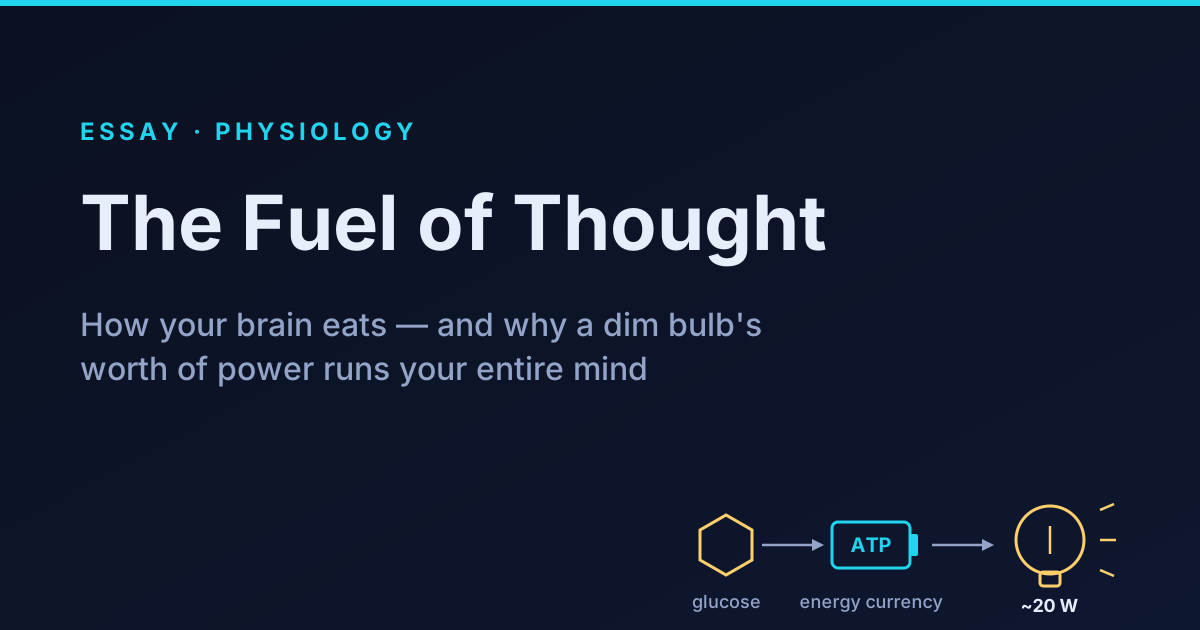
Here is a number worth keeping: your brain is about 2% of your body weight, yet it consumes roughly 20% of your energy at rest. Ten times its share. It is, gram for gram, the hungriest organ you own, an ogre housed in a small skull. And yet the raw power it draws, in watts, is almost comically small: on the order of 20 watts. All of your thought, memory, vision, your very awareness of reading this sentence, could be run by a dim LED bulb. A supercomputer running a comparable language model burns tens of thousands of watts. Your brain does better, on 20 watts, using nothing but sugar and oxygen. That is the first thing to sit with: the energy efficiency of living tissue is staggering.
Why the brain is so hungry: it never switches off
We tend to imagine that “thinking hard” is expensive and “doing nothing” is free. That is wrong, and the reason is illuminating. Almost the entire energy bill goes to one thing: keeping neurons ready to fire. A neuron is a tiny chemical battery. It pumps ions relentlessly (sodium out, potassium in) to hold a voltage across its membrane, the way you keep a battery charged so it can discharge in an instant. That pumping never stops, even when you are “doing nothing.” An estimated 70% of the budget goes to this background signalling (the infrastructure kept switched on) and only a thin slice to any particular bout of mental effort.
The surprising consequence: solving a hard problem raises your brain’s energy use by only a few percent. Most of the bill you pay simply by existing. Your brain is a power station running around the clock, not an engine you fire up on demand.
Turning sugar into currency
That fuel, under normal conditions, is almost exclusively glucose, a simple sugar circulating in your blood. The brain keeps virtually no reserve of it; it lives hand to mouth, on continuous delivery through the bloodstream. But glucose is not “burned” as-is, the way petrol is. It is converted into a middle molecule, ATP, the universal energy currency of every cell. Whenever a neuron needs energy (to pump an ion, to build a neurotransmitter), it pays in ATP.
The conversion from glucose to ATP happens in two stages, and the difference between them is the key to everything:
Don’t hold on to “2” and “30” as numbers. Hold on to an image. Glycolysis is biting into a fruit: a little energy, right away, no equipment. The mitochondrion is putting the whole log in the stove: slower, and it needs air (the oxygen), but you get vastly more heat out of it. Your body keeps both options on purpose: the nibble for emergencies, the stove for yield.
And ATP itself? It is not a fuel tank but a rechargeable battery. You store almost none of it; you make it and spend it in a loop, at a furious rate. The classic estimate is dizzying: over a single day, your body recycles a mass of ATP on the order of your own body weight. Not because you contain that much (you hold only a few grams at any instant) but because each molecule is recharged thousands of times a day. Life is a flow, not a stock.
Mitochondria, and how you grow more of them
That second stage happens inside mitochondria, minuscule organs within every cell: ancient bacteria swallowed a billion and a half years ago and never spat back out, which still carry their own DNA. They produce more than 90% of your ATP. A point with direct practical weight: their number and quality are not fixed. A heavily used cell builds more mitochondria, and better ones. This is exactly what endurance training constructs in muscle: not just a bigger pipe for oxygen, but a bigger factory to use it. The same principle holds, more quietly, elsewhere. To move is, quite literally, to install power plants in your body.
The backup tank: ketones
Glucose is the default fuel, but nature built in a spare wheel, and it is an elegant idea. When glucose runs short (a long night, a fast, a diet very low in carbohydrates), your liver starts making ketones from fat. And the brain, that supposedly sugar-addicted organ, runs perfectly well largely on those ketones. This is vital: without the plan B, a few days without food and the brain would shut down. You are therefore a dual-fuel machine: sugar in normal times, fat converted to ketones when sugar reserves fall. A ketogenic diet does nothing more than exploit this built-in backup mode. It is neither magic nor mandatory: it is a metabolic switch your body already owns.
Steady sugar, steady mind
Now to the useful part. Because the brain lives on a hand-to-mouth supply of blood glucose, the stability of that supply matters as much as the amount. Swallow a fast sugar on an empty stomach (juice, pastry, soda) and you trigger a spike: blood sugar shoots up, the body over-reacts by releasing insulin, and an hour later you are often left with blood sugar lower than where you started. That reactive dip is the notorious mid-morning or mid-afternoon slump: brain fog, irritability, cravings. Not a failure of willpower: an accident of the curve.
Three levers, no dogma, to flatten the red curve into the green one. First, meal order: start with fibre (vegetables), protein and fat, and keep the carbohydrates for last; the same plate, eaten in that order, rises much less steeply. Second, move after eating: ten minutes of walking, and your muscles soak up some of the glucose directly, shaving the peak without insulin. Third, don’t drink your sugar on an empty stomach: a sugary liquid alone is the perfect spike; taken with a meal, or swapped for water, it becomes harmless.
One honest caveat, because the topic is fashionable: in a healthy person, the size of these effects is modest and highly individual. The mechanism that keeps blood sugar in a narrow band (insulin pushing it down when it rises, glucagon pulling it up when it falls) is a textbook negative feedback loop, a thermostat for sugar. The point is not to chase every milligram; it is to internalise the model: avoid the roller-coaster.
Where this stands in 2026
The measurement side of all this is moving fast. A 2025 study in Nature Medicine combined continuous glucose monitoring with food, sleep and activity data to build a multimodal model that predicts and explains glucose spikes, in people with normal glucose regulation as well as in pre-diabetics and diabetics. The interesting step is from raw curves toward explanation: linking a physiological signal back to its causes (this meal, that short night, this stress).
The tools have also gone consumer. Since the 2024 clearance of the first over-the-counter continuous glucose monitors (Dexcom’s Stelo, Abbott’s Lingo), anyone can watch their blood sugar in real time. Enthusiasm is high, and scientists are quick to note that we do not yet know whether this helps healthy, non-diabetic people at all; the literature still calls it an “evidence-free zone.” It is a familiar pattern in self-tracking: the instrument arrives before the proof of its usefulness. A good habit is to ask what decision a measurement will actually change before adding another sensor.
And the backup fuel keeps drawing attention. A 2026 meta-analysis in Frontiers in Nutrition pooled the trials on exogenous ketones (ketones drunk directly, without a diet) and cognition, in healthy adults as well as people with mild cognitive impairment. It confirms the dual-fuel picture, ketones do feed thought, but the effects in healthy people remain modest and mixed. File it under “real but over-hyped”: physiologically interesting, not a magic performance button.
Further reading
- Cornell Chronicle · “Brain cells mobilize sugar in response to increased activity”: how brain cells fetch sugar on demand when a region becomes active. Short and vivid, a good entry point.
- NPR · “How a glucose monitor can help tame blood sugar spikes and crashes” (2025): the spike-and-crash for a general audience, with the honest debate about CGMs for healthy people.
- Sugar for the brain: the role of glucose in physiological and pathological brain function: the reference review, clear and well illustrated, on why glucose is the default fuel and what happens when the supply falters.
- Physiological Reviews · “Brain Glucose Metabolism: Integration of Energetics with Function”: the big panorama: energy budget, activity-metabolism coupling, mitochondria. To dip into, not to read in one sitting.