A frontier AI model that fits on one gaming card
This week Alibaba shipped a 27B open model that argues with the closed flagship on several benchmarks, and it runs at reading speed on a single gaming card. The size is the story, and it changes who gets to own a frontier model.
This week a model you can download for free started answering hard questions at a level people were paying a frontier lab for a few months ago. The surprising part is not the score. It is the size. The whole thing is about seventeen gigabytes, and it runs at reading speed on a single gaming card.
The model is Qwen3.8-27B, released by Alibaba on the 14th of August under an Apache 2.0 license. It is a dense 27 billion parameter model, it sees images and video as well as text, and its open weights were on Hugging Face within hours, already packaged into the small quantized files that ordinary hardware can load. That last detail is the one that matters.
The numbers, and who is reporting them
On the scores Alibaba published at launch, the small model lands close to systems that cost far more to run. It reports 89.2 percent on GPQA Diamond, a graduate level science exam, and 90.3 percent on LiveCodeBench v6. Those are the vendor’s own figures, so treat them as a claim to test rather than a settled fact.
Set them next to the current closed flagship, Claude Opus 4.6, which arrived in February. On independent testing Opus 4.6 posts 65.4 percent on Terminal-Bench 2.0, the leading measure of agentic coding, 68.8 percent on ARC-AGI-2, and roughly 80.8 percent on SWE-bench Verified. On the hardest agentic and reasoning work, the closed flagship is still ahead, and it is ahead by a real margin.
So the honest reading is not that the free model won. It is that a model you can hold in your hand is now in the same room as the one you rent, and on a good number of everyday tasks you would struggle to tell them apart. A year ago that room had one door and a turnstile.
What thirty tokens a second on a small card actually means
I ran the four bit build myself, on a single Radeon RX 7900 XT. It decoded at 30.83 tokens per second, measured, which is faster than you read this sentence. The weights on disk came to about seventeen gigabytes, small enough to sit on one consumer card with room for the working memory around it.
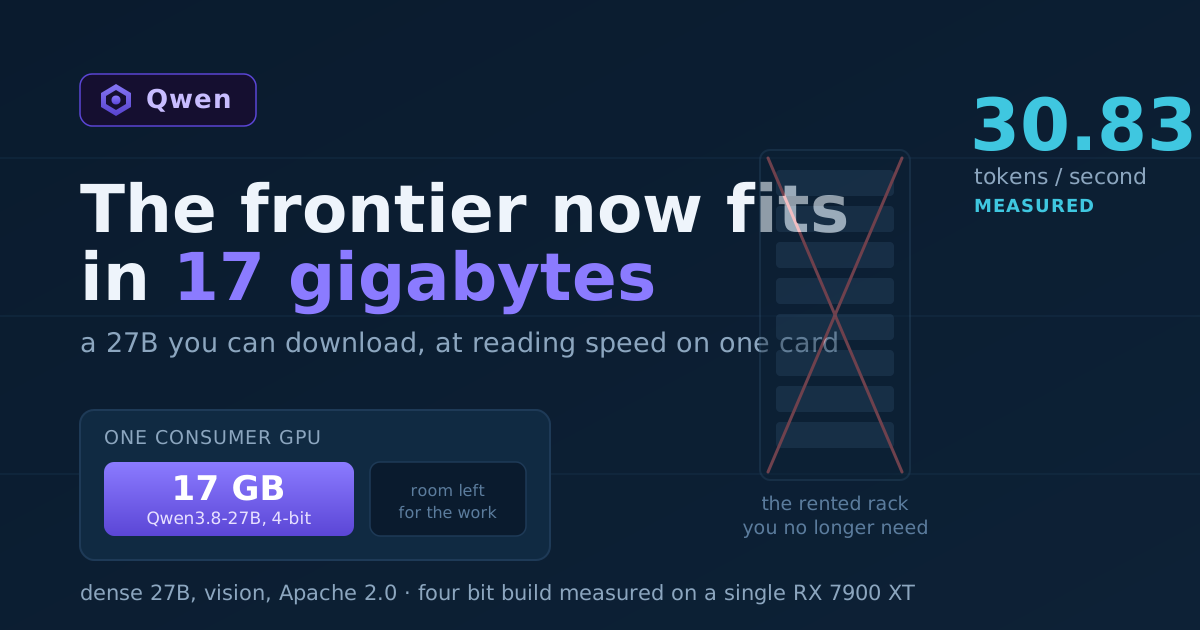
Reading speed on one card is the threshold. Below it, a local model is a demo you show people. Above it, it is a tool you actually work with, and the calculus flips. The question stops being “which API do I call” and becomes “why would I send this off my own machine at all”.
Why this changes the market, not just the leaderboard
Strip the benchmark noise away and three things follow from a frontier grade model that fits on a desk.
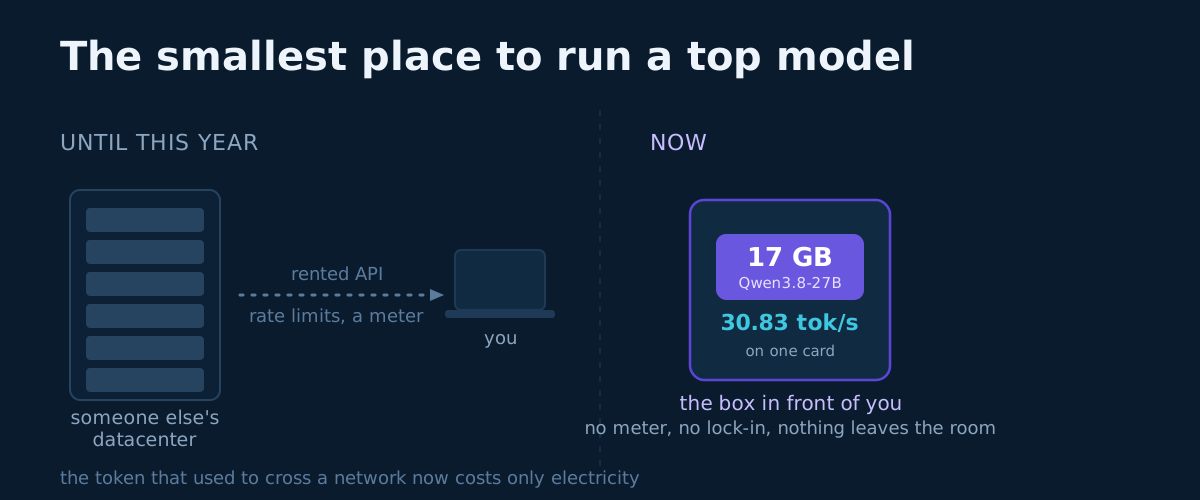
The unit of deployment shrinks. For two years the smallest sensible place to run a top model was a rented endpoint in someone else’s datacenter. When the model is seventeen gigabytes, the smallest place is a box in the corner of a room. That is a different kind of infrastructure, owned by a different set of people.
The marginal cost of a token collapses. A token you run yourself costs electricity and nothing else. No per call price, no rate limit, no meter running while you think. For anything high volume or repetitive, a summary of every log line, a first pass over every document, that difference compounds fast.
The frontier becomes a floor instead of a ceiling. When the free option is this capable, a paid frontier model has to justify itself on the hardest tenth of the work, not the easy ninety percent. That is healthy. It pushes the closed labs toward the problems only they can solve, and it hands everyone else a very strong default that owes no vendor anything.
None of this makes the closed labs lose. It makes them earn it, which is exactly what competition is supposed to do.
A note before the hype takes over
I want to keep my head here, because the marketing on both sides is loud.
The vendor numbers are vendor numbers. Some of the “it beats Opus” posts already circulating lean on a benchmark the vendor scored itself, against a product name Anthropic never shipped. When a claim has no primary source, I drop it rather than soften it. Read every “beats model X” line as a place to start your own testing.
“Runs on seventeen gigabytes” also hides a wall. I tried the same model on a 24 gigabyte MacBook, one tier up in memory, and it swapped under the operating system and gave me numbers I would not publish. Four bit quantization is not free either, it trades a little quality for the small footprint, and a model that sees images benched only on text is not the whole model. The comfortable story is “it runs anywhere”. The measured story is “it runs well on the right hardware, and the margin is thinner than the headline suggests”.
But underneath the caveats the direction is not in doubt. The best model most people can actually run just took a long step toward the best model that exists, and it did it in a file you can download before lunch. That was not true a year ago, and it will be more true in six months.
The tech moves fast. The fundamentals do not.
Further reading: the month the frontier went open, a 30B model on an 8 GB GPU, and from Ollama to llama.cpp.
Akciali