The free energy principle: why staying alive means refusing surprise
Karl Friston's free energy principle tries to derive perception, action, attention, and even the boundary of the self from a single imperative: keep surprise low. A walk up its steps, by images rather than equations.
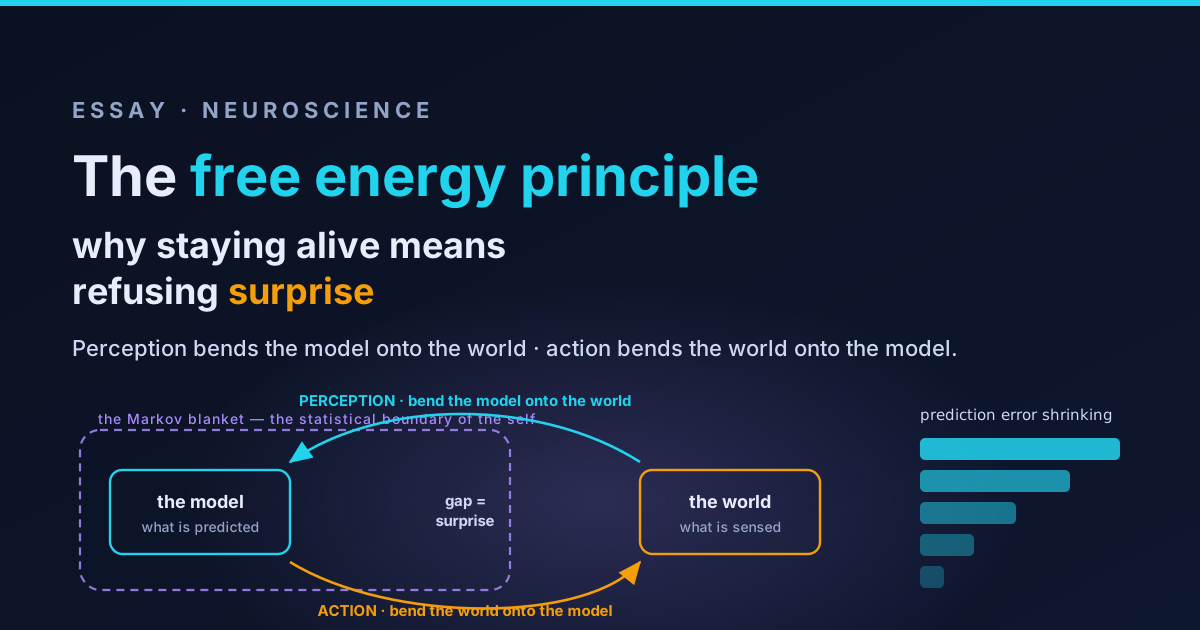
There is a theory in contemporary neuroscience that is at once the most discussed and the most contested of its kind. It is the free energy principle, forged by the neuroscientist Karl Friston, and its ambition is frankly outsized: to explain, from a single imperative, why a living thing perceives, acts, learns, and even why it exists as a “thing” set apart from the rest of the universe. The claim is large enough to invite suspicion, and the suspicion is healthy. But the idea is worth climbing, and it is best climbed by images.
To exist is to hold out against entropy
Recall the second law: the universe slides spontaneously toward disorder, toward the most probable state. Coffee cools, structures crumble, everything mixes. A living thing does something quietly scandalous in the face of this law: it maintains itself. A body holds thirty-seven degrees, a precise pH, blood sugar in a narrow band; it stays, day after day, within a tiny handful of states out of the infinity into which physics would happily scatter it. To be alive is to resist, actively, one’s own dissolution.
Friston turns this into a sentence that becomes the thread of the whole theory: an organism that endures is one that keeps itself in its expected states. And he gives a technical name to “finding oneself in an unexpected state”: surprise. Not the emotional kind, but surprise in the sense of information theory: the improbability of a state for a creature of your kind. A fish out of water is in a highly surprising state, and that is precisely why it does not survive. To exist durably is therefore, mechanically, to minimise one’s average surprise over time. To stay in the water, warm, fed, intact.
The trick: minimise a substitute you can actually compute
Here is the first real obstacle, and it is the one that justifies the entire edifice. To minimise its surprise, a brain would need to know the probability of each of its sensations: to know, so to speak, how rare what it perceives is in absolute terms. That is impossible to compute directly: it would require summing over every way the world might have produced that sensation. The brain is stuck. It wants to minimise a quantity it cannot measure.
The trick, and this is the clever heart of the theory, is to minimise instead a cousin quantity that it can compute: free energy. Its key property is that free energy always sits above surprise. It is a ceiling. So if you push the ceiling down, you necessarily crush whatever lies beneath it. You never need to measure surprise itself; you press on the substitute, and the real thing follows.
One formula is worth naming, only to translate it and then forget it: free energy equals surprise plus the gap between what you believe and what is true. Since that second term can never be negative, free energy always stays above surprise. The image to keep is this. Surprise is the true temperature of a patient you cannot measure directly; free energy is a readable thermometer that always reads a little above the real fever. You do not treat the invisible fever; you watch the thermometer and bring it down, and as the needle falls, the fever falls with it. Nothing in the equation needs remembering, only: a ceiling pushed down crushes what is under it.
Two ways to lower the ceiling, and that is the whole theory
Now the pivot. There are exactly two ways to reduce the gap between what a brain predicts and what it receives. The beauty of active inference is that it sees in these two ways the same gesture, run in opposite directions.
The first is perception. You change your model so that it better predicts what you are receiving. You see a vague shape in the gloom; the brain predicts “a cat”; the details refuse to fit; it revises and settles on “a plastic bag.” The gap closes because the belief has bent onto the world. This is the predictive brain in its familiar form: to perceive is to update one’s model so as to cancel the prediction error.
The second is action, and this is where the theory earns its strangeness. You can also close the gap the other way round: instead of changing your belief, you change the world so that it matches your prediction. You predict “my hand is holding the glass”? The prediction is false for the moment, but rather than abandon it, you move your hand until it becomes true. Action, in this framework, is not a response to a command. It is a self-fulfilling prophecy: you predict the state you want to reach, and the body acts to make the prediction true. That is active inference: to act is to infer by bending the world rather than the thought.
The vertiginous consequence is this: in this framework you do not act to obtain a reward, as all of reinforcement learning assumes. You act to confirm the model of yourself that you already carry. A healthy being is a prediction coming true (“I am someone who breathes, who is warm, who eats”), and it acts, ceaselessly, to keep that true.
Where does the self end? The Markov blanket
One question remains, and the theory dares to ask it: for a “thing” to minimise its surprise, it must first be a thing: there must be an inside and an outside. Where do “you” stop and the rest of the universe begin? Friston’s answer has a rare elegance: a thing exists wherever one can draw around it a Markov blanket, a statistical boundary.
The world never touches you directly. It speaks to you only through your sensory states (what comes in), and you touch it only through your active states (what goes out). Everything behind that blanket is you; everything in front of it is the outside. Between the universe and your inner model there is always this thin membrane (the retina, the skin, the muscles), and it is exactly this that makes you a “you.” A cell has its blanket (its membrane), an animal has its own, and perhaps a colony, a family, an institution have theirs. The boundary of identity stops being a metaphysical mystery and becomes the place where information must pay a toll to enter or leave. You never perceive the world; you perceive only your sensors. You never act on the world directly; you act only through your effectors. The self is not a substance. It is what holds itself in the shelter of that frontier.
Precision, or why attention keeps reappearing
One last gear, and it closes a loop of its own. Not all prediction errors are equal: some come from a reliable signal, others from a noisy sensor. The brain therefore weights each error by its precision, the confidence it places in it. An error judged precise pulls hard on the model (you believe it, you correct); an error judged imprecise is ignored (you write it off as noise). This weighting by precision is exactly attention: the same mechanism by which a system puts weight on what matters and turns down the volume on the rest. Mis-set the precision and you misjudge what to trust: too much precision on internal signals, and you “perceive” what is not there (hallucination); too little precision on a sensory return, and the gesture begins to oscillate, like the tremor of a damaged cerebellum. The same grammar, everywhere.
This is why the theory fascinates and irritates in equal measure. With one imperative, lower your free energy, it claims to derive perception (bend the model), action (bend the world), attention (weight by precision), learning (refine the model over time), and even the existence of a self (the blanket). It is, quite literally, an attempt at a single grammar of the living and the machine. Whether that is true, or merely too beautiful to be true, is the open argument of neuroscience today.
It is worth holding both reactions at once. As biology, the free energy principle may yet prove too sweeping to test, a frame so general it explains everything and therefore risks predicting nothing. But as a way of seeing, it has already paid for itself. It reframes the oldest puzzles (what perception is for, why we move, where the self ends) as facets of one act: closing the gap between what is expected and what arrives. Perhaps a creature, biological or artificial, is moved less by the carrot ahead than by the quiet need to keep being the thing it already takes itself to be.
Further reading
- Karl Friston, “The free-energy principle: a unified brain theory?” (Nature Reviews Neuroscience, 2010): the compact statement of the idea, by its originator.
- Thomas Parr, Giovanni Pezzulo and Karl Friston, Active Inference: The Free Energy Principle in Mind, Brain, and Behavior (MIT Press, 2022, open access): the reference book; best taken a chapter at a time rather than all at once.