The feedback loop: the science that blurred the line between machine and living thing
How a single idea (act, measure, correct) let one mathematician describe a thermostat, a missile, a reaching hand, and a living body in the same breath, and quietly dissolved the boundary between the mechanical and the alive.
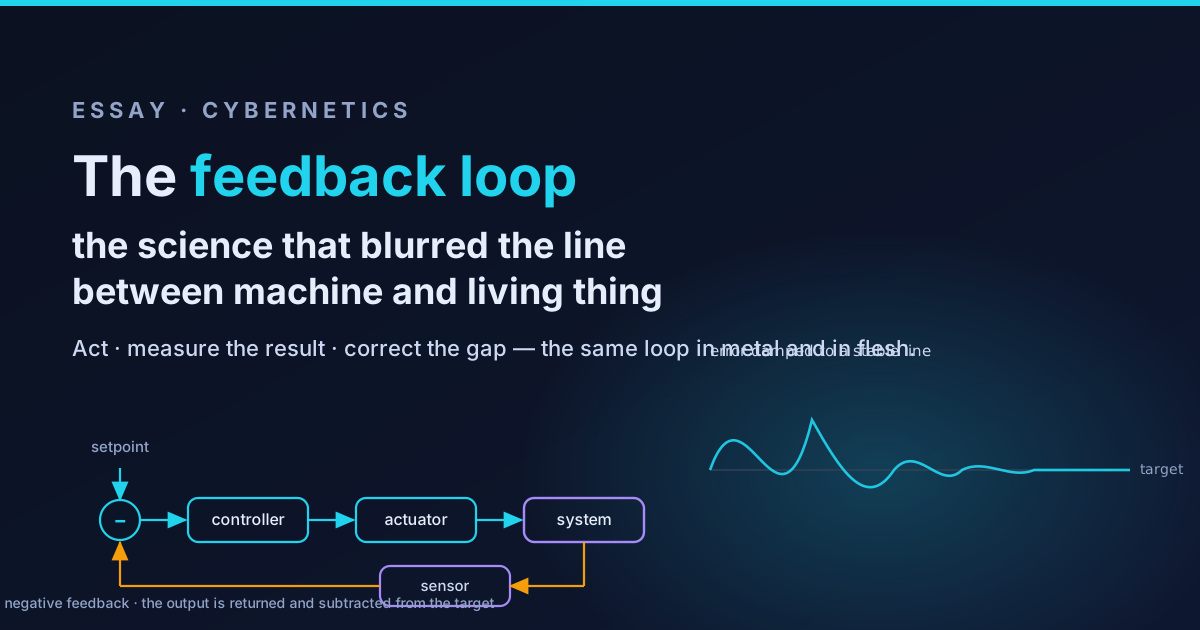
In 1948 a mathematician at MIT, Norbert Wiener, published a book whose title he had just invented: Cybernetics, from the Greek kubernētēs, “the steersman,” the one who holds the tiller. The idea behind it sounds banal and is not banal at all: a system can govern its future behaviour using its own past performance. It acts, it measures the result of that action, and it uses the measurement to correct the next action. That is the whole of it. The arrangement is called a feedback loop, and Wiener made a claim that was, for his time, faintly scandalous: this same loop describes a missile chasing an aircraft, a thermostat holding a room at twenty degrees, a hand closing around a glass, and a body keeping its blood sugar in range. The same pattern, whether the parts are metal or flesh. That is the moment when, intellectually, the boundary between the machine and the living thing began to dissolve.
The anatomy of a loop
Take the poorest possible example, a household thermostat, precisely because it contains everything. There is a setpoint, the temperature you want, say twenty degrees. A sensor measures the actual temperature. A comparator does the subtraction, “actual minus target,” and that difference is the error. If the room is at eighteen, the error is minus two: too cold. The error drives an actuator (the heater), which acts on the system (the room). The room warms, the sensor sees it, the error shrinks, and when it reaches zero the heater shuts off. Then the room cools, the error reappears, and the cycle begins again. A loop that turns endlessly and that, with no intelligence whatsoever, holds a quantity near a target.
The crucial word is negative, and it is counter-intuitive. Here “negative” does not mean “bad”; it means “opposing the gap.” Negative feedback is the great stabilising force of the world. It is what keeps a body near thirty-seven degrees, blood sugar in a narrow band, a cruise control locked at a steady speed. The state held actively in this way has a name, homeostasis, and it is precisely what a living body does, all day long, without thinking about it, through thousands of tiny loops correcting in the background.
The dark twin: positive feedback
There is a second family of loops, and it does the opposite. In positive feedback, the output is fed back to amplify the gap rather than reduce it. The result is not stability but runaway. The screech when a microphone is brought too near its loudspeaker: the captured sound re-amplified, captured again, re-amplified, up to the howl. A bank run, where withdrawals frighten more depositors into withdrawing. A warming climate melting the ice that used to reflect sunlight, which warms it further still. Positive feedback is the engine of everything that “takes off”: explosive growth, virality, collapse. A single intuition is worth keeping: the negative holds, the positive runs away. Durable systems are built mostly of negative loops; revolutions and catastrophes, of positive ones.
A simple controller can be written as action = K × error, and that is genuinely all there is to memorise. K is just a knob for nervousness: the gain. Picture driving and drifting to the right. The error is “how far off I am.” Your action on the wheel is proportional to that drift: small error, small correction; large error, large correction. A large K is a jumpy driver who over-corrects; a small K is a sluggish one who barely responds. The action chases the error, and the gain says with how much force.
Why a stabilising loop starts to oscillate
Here is the subtlety that turns cybernetics from a truism into a real science: a negative feedback loop, the one that is supposed to stabilise, can begin to oscillate and lose its mind. Everyone has met this in the shower. The water is too cold, so you push the mixer toward hot. Nothing happens (the hot water takes a couple of seconds to arrive), so you push further. Suddenly: scalding. You recoil toward cold, too hard; two seconds later, freezing. You swing from one extreme to the other and never settle on the right setting. The culprit is not impatience; it is the delay between an action and the measurement of its effect. When a system has lag in its loop and a gain that is too high (when it corrects too hard), it systematically overshoots the target, first one way and then the other. That is the signature of every instability: delay plus over-correction equals oscillation. And the cure is almost always the same: lower the gain (correct more gently) or shorten the delay (measure faster).
Keep the shower in mind rather than the equation. Three ingredients explain any system that “chases” a target without landing on it: a gain that is too high, so it reacts too violently; a delay, so the effect of the action is not seen at once; and the result, an overshoot that triggers a correction the other way, which overshoots again. The trembling hand taking aim, the novice who over-steers a car into a zigzag: the same loop, the same trap. Mastery, in every case, is to lower the gain and shorten the delay: act more softly, sense sooner.
The stroke of genius: it describes the living body too
Wiener did not stop at machines. With the neurophysiologist Arturo Rosenblueth, he noticed that voluntary movement is itself a feedback loop. When a hand reaches for a glass, the brain does not compute the perfect trajectory in advance; it launches the movement, the eye measures the gap still remaining between hand and glass, and it corrects continuously until the error is zero. The proof arrives, as it often does in biology, through failure. In certain lesions of the cerebellum this loop is broken, and the patient’s hand begins to tremble harder and harder as it approaches the target, a symptom called intention tremor. That is, exactly, a loop that oscillates: the gain is mis-set, the system overshoots one way and then the other. The same mathematics as the shower, written into nervous tissue.
And here several threads draw together. The predictive brain is one enormous feedback loop: it predicts, it measures the prediction error, it corrects its model. The modern descendant of Wiener’s cybernetics even has a name, active inference, in which an agent acts to minimise its own surprise and hold its homeostasis, which is Wiener’s thermostat applied to the whole of a living thing. Motor learning, the gesture that becomes engraved, is a loop that reduces its error trial after trial until it runs so reliably that it no longer needs conscious supervision. And a brain-machine interface is two coupled loops: the decoder adjusting to the brain while the brain adjusts to the decoder, two cybernetic systems intertwining until they behave as one.
So cybernetics is not “one more topic.” It is the common language running underneath the others. A single diagram (act, measure, correct) describes the room, the body, the brain, the machine, and the machine wired to the brain. The thing that drives the loop is never the raw signal; it is always the gap to the target, exactly as the predictive brain propagates only the prediction error. Information, in this view, is difference: the deviation that still needs closing.
There is a quieter, almost ethical reading hiding in the engineering. A great deal of what looks like a problem in a system (a process that won’t settle, a relationship that escalates, a market that whipsaws) is really a loop with too much gain reacting to a signal that arrives too late. The fix is rarely to push harder. It is to wait a beat before correcting, to soften the response, to measure sooner. The steersman’s art, it turns out, is not strength on the tiller. It is knowing how lightly to hold it.
Further reading
- Norbert Wiener, Cybernetics: Or Control and Communication in the Animal and the Machine (MIT Press, 1948): the founding text, where the loop first spans animal and machine in a single frame.
- Arturo Rosenblueth, Norbert Wiener and Julian Bigelow, “Behavior, Purpose and Teleology” (Philosophy of Science, 1943): the short paper that recast purposeful behaviour as feedback.