The Duck and the Turk: three centuries of dreaming up artificial life
Chips in the brain, digital doubles, the question of whether a machine really thinks: almost nothing about today's AI is new. The dream of building an artificial being runs as a single thread from antiquity to 2026, and three old objects still frame every debate we have.
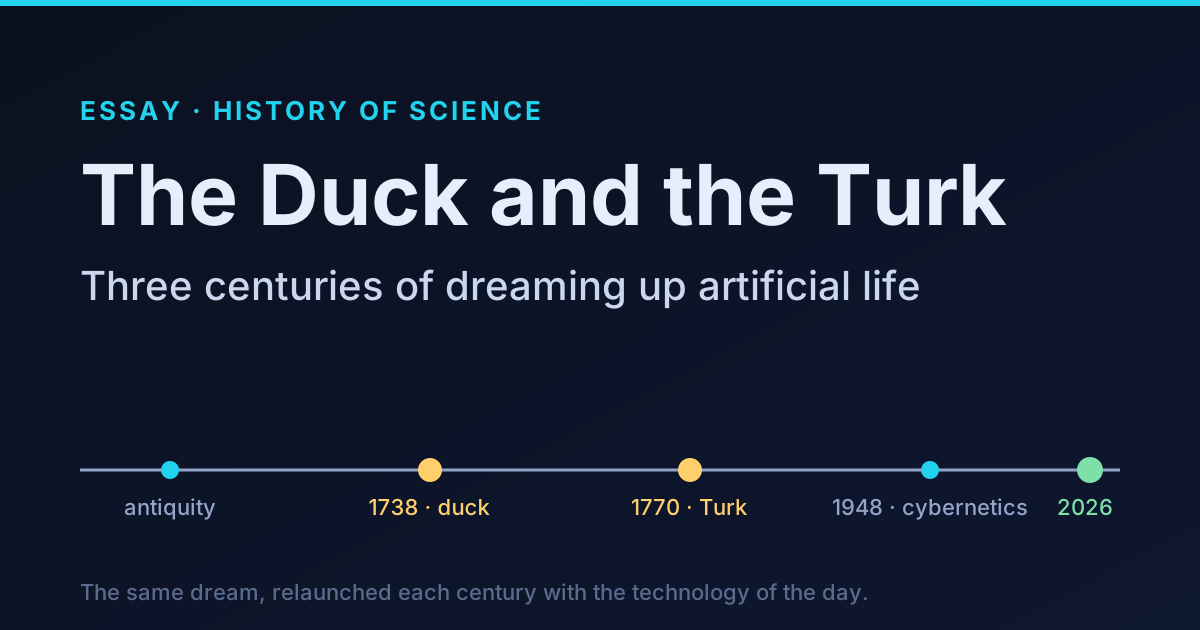
Almost nothing that feels new about today’s artificial intelligence is actually new. Chips wired into the brain, digital doubles of a person, the nagging question of whether a machine really thinks or only seems to: these are reruns. The dream of building an artificial being (a body that moves on its own, a mind lodged in matter) is one of humanity’s oldest, and its history runs as a single thread from antiquity to the present. Following that thread is not antiquarianism. It hands you landmarks, so that you are not taken in by each fresh wave of hype.
The dream is as old as myth
Long before any working machine, the fantasy already lives in stories. The Greeks imagine Talos, the giant of bronze who patrols Crete; Hero of Alexandria actually builds water- and steam-driven automata, temple doors that open “by themselves”. In the sixteenth century, the legend of the Golem of Prague tells of a creature of clay animated by inscribing a word into its mouth or onto its forehead: life breathed into matter by language. Hold on to that image: animating inert matter by writing the right symbol into it. It is, four hundred years early, exactly what a program does. Code is the word in the golem’s mouth.
Descartes: what if the animal were only a clock?
The decisive turn is philosophical. In 1637, Descartes advances an idea that scandalised his contemporaries: animals are machines: the bête-machine. A barking dog is biological clockwork: springs, tubes, fluids, nothing more. But Descartes sets the human apart: we would possess, in addition, a thinking soul (res cogitans) separate from the body-machine (res extensa). This is the famous dualism: two substances, mind and matter, not cut from the same cloth.
Why does it matter? Because that cut still haunts us. Every time someone asks “would an upload of my personality be me, or just a copy?”, they are replaying Descartes, silently assuming there is a “me” of a different nature from the substrate. The whole modern argument about artificial minds is, in part, a quarrel with Descartes’ ghost.
La Mettrie: man, too, is only a machine
A French physician, Julien Offray de La Mettrie, takes the step Descartes would not. In 1747 he publishes L’Homme-Machine and tears down the partition: if the animal is a machine, then the human is one too, soul included. No separate substance; thought is simply what nervous matter does when it is organised the right way. The book causes such an outcry that he has to flee. It is the first blunt statement of materialism about the mind: no magic in the skull, only matter in motion. Modern neuroscience (and any project to measure and improve a mind) is, philosophically, La Mettrie’s heir.
The Duck: the question that will not die
Here philosophy walks into the workshop. Jacques de Vaucanson, a brilliant mechanician, builds around 1738 a digesting duck: a gilded-copper automaton, hundreds of parts in each wing, that flaps, cranes its neck, swallows grain and, moments later, excretes it, apparently digested. Paris is in raptures. Except, as historians have shown, the digestion was faked: the grain dropped into one pouch, while pre-prepared “droppings” were released from another. Nothing was digested. Vaucanson simulated digestion without performing it.
This duck poses, two centuries before the computer, the question that returns whenever we talk about artificial minds: does simulating a function amount to accomplishing it? A duck that perfectly imitates digestion does not thereby digest, in the same way that simulating rain makes no one wet. And yet Vaucanson saw no betrayal of principle in it: he hoped that one day someone would build a duck that truly digests. The entire present-day debate (does a model that talks like a person understand? does a system that recombines what it has absorbed create?) lives in the gap between the rigged duck and the dreamed-of duck.
The Turk: the first “AI trick” in history
In 1770, Wolfgang von Kempelen presents to the Empress a chess-playing automaton: a mannequin in Ottoman costume seated before a cabinet: the Mechanical Turk. It beats aristocrats, tours Europe, and is said to have faced Napoleon and Franklin. Before each game, Kempelen opens the cabinet doors to show that there is nothing inside but gears. It was a hoax: a real chess master, folded into the cabinet, slid from one compartment to the next as the doors were opened one by one, and worked the arm through magnets.
The lesson has not aged. Two things. First, we are alarmingly quick to project a mind onto whatever behaves intelligently: anthropomorphism is our default reflex, and it is precisely the lever every AI demonstration leans on. Second, behind a great deal of “artificial intelligence” there hides, even now, concealed human labour. This is not a metaphor: the platform where people perform, piece by piece, the micro-tasks algorithms still cannot handle is literally called Mechanical Turk. The wink is deliberate. The 1770 automaton is the grandfather of every hype cycle in which “the machine does” what a hidden human is in fact doing.
Lovelace: “it can only do what we order it to do”
The last stop before the modern era is also the subtlest. In the 1840s, Charles Babbage designs the Analytical Engine: a programmable, punch-card calculator, never finished, yet containing in principle everything a computer is. Ada Lovelace, who writes the first real program for it, adds a now-famous note: the engine “has no pretensions to originate anything; it can do whatever we know how to order it to perform.” This is Lovelace’s objection: a machine merely unrolls what we put into it; it originates nothing.
You recognise the argument. It is, almost word for word, today’s quarrel over large language models: “it is only a statistical parrot, regurgitating what it was fed” against “no, it generalises, it composes something new.” For nearly two centuries the question has stayed open: at what point does recombining what one has learned become creating? Lovelace posed it without settling it, and neither have we.
Wiener: the dream becomes a science of the loop
The dream stops being the work of an isolated genius in 1948, when Norbert Wiener founds cybernetics. His decisive move: to describe a living organism and a machine with the same equations: not by their matter, but by their feedback loop (sense an error, correct, sense again). A thermostat, a hand reaching for a glass, a missile tracking its target: one and the same scheme. From there, “the man-machine” is no longer a salon provocation; it becomes a research programme, and the door swings open toward artificial intelligence, robotics, and brain-machine interfaces.
Where this stands in 2026
Two recent developments show the old thread tightening. The first is the Turk inverted. At CES 2026, a software vendor demonstrated a platform that builds AI replicas of employees from their video, voice and writing: a digital stand-in that answers questions and speaks on video in many languages. Where the 1770 Turk hid a human to fake a machine, these doubles hide a machine to fake a person; it is the duck-of-a-personality question, now sold as a product. (Market sizings for human “digital twins”, projected to grow from roughly €16.5bn in 2026 to over €240bn by 2032, come from market-research forecasts, not facts, and should be read as such.)
The second is the duck’s mechanical body, finally walking off the bench. In early 2026, humanoid robots are leaving the demo stage: roughly thousand-unit factory deployments are being announced, with one maker claiming hundreds of hours of real factory work and aiming for the home. Vaucanson’s old wager (an artificial body that acts in the world) is becoming industrial. It is worth reading against Moravec’s paradox: for a machine, the hard part is not calculation but the hand and the sense of balance, so “deployment” numbers (largely corporate communication) deserve a sceptical eye.
The pattern holds. Each era believes it has finally built the real duck, or unmasked the real Turk. Each time, the three old questions slip out the side door, intact. Knowing the history will not answer them for you, but it will stop you mistaking a very old question for breaking news.
Further reading
- Jessica Riskin · “The Defecating Duck, or, the Ambiguous Origins of Artificial Life”, the reference essay on what Vaucanson’s duck reveals about the boundary of the living. Dense and brilliant.
- Atlas Obscura · “The Turk, a Mechanical Chess Player”, the story of the hoax, illustrated; the best way to picture the cabinet and its hidden master.
- Wikipedia · “Digesting Duck”, the clean facts on Vaucanson’s automaton: mechanism, deception, legacy, with sources.
- Euronews · AI digital clones of employees unveiled at CES 2026, the modern Turk, in pictures.