The Map in Your Head: your brain's inner GPS, and why it files your ideas
Two kinds of neuron let you know where you are: place cells that say 'you are here' and grid cells that lay down a honeycomb of coordinates. The surprise is that the brain reuses this same map to organise concepts and memories, which is exactly why the ancient memory-palace trick works.
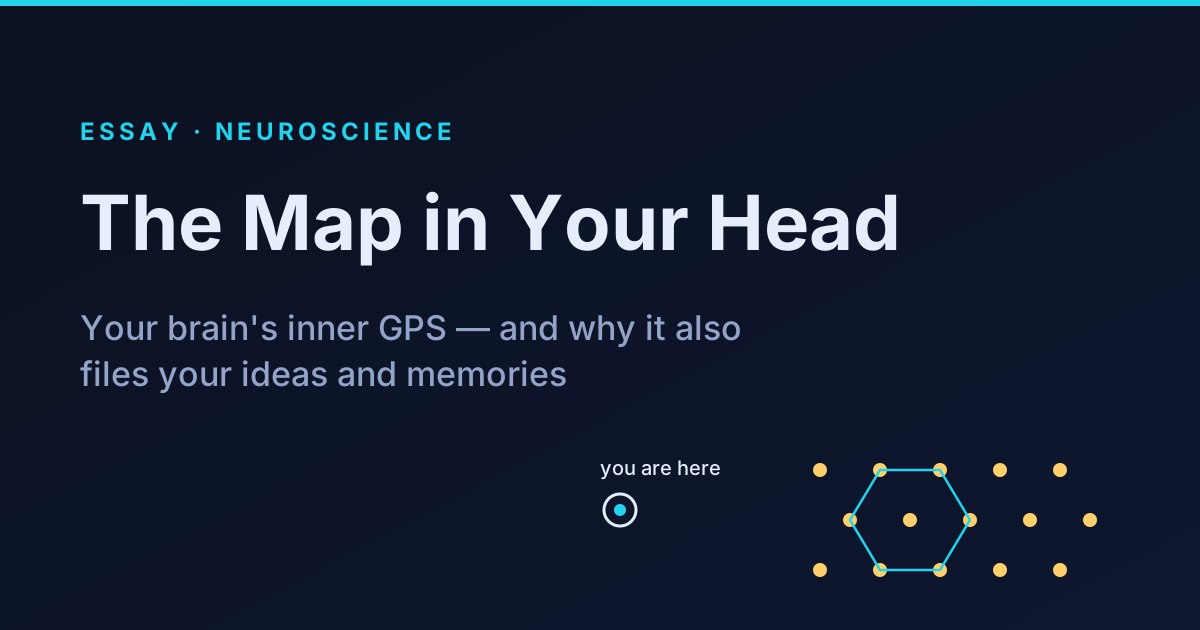
Close your eyes and ask a strange question: how do I know where I am? You can cross a dark room, sense that one more step means barking your shin on the table, feel which way the door is. That is not magic, and it is not vision. It is a map, physically written into a small seahorse-shaped structure at the centre of the brain: the hippocampus, named for that shape. The beautiful part, and the subject of this essay, is that the very same map, built for space, is also used to file ideas and memories. The brain did not invent one system for memory and another for navigation. It invented a single map-making machine, and it uses it for almost everything.
1971: the cell that says “you are here”
In 1971, the neuroscientist John O’Keefe lowered fine electrodes into the hippocampus of a rat wandering in a box and listened to individual neurons. He found something startling: a given neuron fired only when the rat passed through one particular spot in the box, say, the north-east corner. There it crackled like a Geiger counter; everywhere else, silence. Move the rat to another corner and a different neuron lit up. O’Keefe called them place cells. Each is a little “you are here” bulb that switches on only over its own patch of ground. Taken together, they form a map of the room made out of neurons.
2005: the brain’s graph paper
A map made of “you are here” bulbs is fine, but something is missing: distances and directions. How does the brain measure? The answer arrived three decades later, just next to the hippocampus, in a region called the entorhinal cortex. A pair of researchers, May-Britt and Edvard Moser, found neurons stranger still: each fired not at one place but at many regularly spaced places, forming a honeycomb lattice that tiled the whole enclosure. These are grid cells. Where a place cell says “here”, a grid cell lays an invisible sheet of graph paper over the world, a native coordinate system that lets you track “I have moved this far, turned this much”, even with your eyes shut.
Why a hexagon, rather than a square grid like our paper maps? Because nature solved a packing problem: to cover a surface with points all equidistant from their neighbours, the equilateral triangle (hence the honeycomb) is the densest, most regular arrangement possible. Bees know it; your grid cells know it too.
The honest translation, stripped of jargon: the place cell is the red “You are here” dot on a shopping-mall map. The grid cell is the grid printed underneath, the little squares that let you say “the exit is three cells up and to the right”. One says where; the other says how far and in which direction. Together: a GPS.
And that is not the whole circuit. There are also head-direction cells (an internal compass: “I am facing east”), border cells (which fire along walls), and speed cells. Assembled, these neurons are quite literally a biological GPS chip. In 2014, O’Keefe and the Mosers received the Nobel Prize in Physiology or Medicine for the discovery: the brain contains a positioning system, and we finally read its code, cell by cell.
The real twist: the map is not just for space
Here is where it becomes vertiginous. For a long time we assumed this GPS existed only to move the body through a room. It does far more. Over the past decade, experiments have shown that the same honeycomb code fires when we navigate spaces that are not physical at all: a space of concepts, a space of sounds, even a space of emotions. In one now-classic study, people were asked to morph two features of a drawing of a bird (the length of its neck, the length of its legs), a purely abstract “space”, and the entorhinal cortex mapped it with exactly the same hexagonal signature it uses for a real room.
In other words: to think is to move. When you “bring two ideas closer”, “step back”, or feel that an argument is “heading in the right direction”, these are not dead metaphors. The brain reuses the machinery it built for not getting lost in the savannah to organise concepts. The cognitive map is a general-purpose tool: give it space, it makes a plan; give it ideas, it makes a map of ideas. This is very likely one of the secrets of generalisation: the ability to carry what you learned here and apply it over there.
The hijack: the memory palace
Now the useful part. Since the most robust, most ancient, best-wired circuit in your memory is the spatial one, you might as well store what you want to remember inside it. That is precisely what memory champions have done since antiquity with the method of loci, better known as the memory palace: to memorise a list, you mentally place each item at specific spots along a route through a place you know by heart (your home) and then “walk the route” to read it back. You do not memorise a list; you take a walk.
Why does it work so powerfully? Because you plug the information into those same place and grid cells, the sturdiest network in your skull, instead of leaving it floating as a list of bare words. Brain imaging confirms it: the method of loci makes the hippocampus (the place), the visual cortex (the image) and the prefrontal cortex (the plan) work together, and it is that interlocking that makes the memory harder to lose. It is not a party trick; it is reverse-engineering of your own memory. Three rules suffice: pick a place you know cold, always walked in the same order; at each stop, an image that is shocking, funny, multisensory (the brain discards the bland and keeps the salient); and re-walk the route a few times, spaced out over days, so the trace sets rather than fades.
Where this stands in 2026
The cognitive map has moved from a curiosity about rats to one of the busiest frontiers in both neuroscience and AI.
The map of ideas, it turns out, sharpens with age and predicts reasoning. A study in Cell (March 2026, 203 participants aged 8 to 25) found that the entorhinal honeycomb code strengthens through maturation, and that its quality predicts the ability to reason by inference, to guess a relation you were never shown directly. The cognitive map does not merely store; it infers, which ties “mapping well” to “reasoning well”.
Sleep appears to be when the brain files new memories onto the map. Work in Neuron (2025) recorded hippocampal “ripples” (brief bursts of activity) that, during rest after learning, aligned fresh experiences onto a pre-existing grid-like schema. The night does not only engrave; it shelves the new against the structure of the old, which is a strong argument for sleeping on something well organised rather than on a heap.
And machine learning keeps rediscovering the same map. The Tolman–Eichenbaum Machine, a model that learns to generalise, spontaneously grows grid-like and place-like cells, and turns out to be mathematically close to the Transformers that power today’s large language models. The same principle (learn the structure so you can transport it elsewhere) seems to be at work in brains and in artificial networks alike. The cognitive map may be less a quirk of biology than a common blueprint of intelligence.
Further reading
- National Geographic · “Use this ancient technique to remember (almost) anything”: the method of loci explained simply, with the link to place and grid cells. The best place to start if you want to use it.
- Explore Biology · “Grid and place cells: keys to the spatial map in your brain”: the story of the key experiments, richly illustrated with the real firing maps.
- NobelPrize.org · 2014 press release, “the brain’s inner GPS”: the clean primary source on O’Keefe and the Mosers: who found what, when, and why it was a shock.
- Psyche · “How to build a memory palace”: a step-by-step guide to building your first palace. Concrete, no hype.