The Clock Inside: how your body keeps time, and what throws it off
Locked in a cave with no light and no watch, you would still sleep and wake on a near-24-hour cycle. A master clock in the brain runs that rhythm, but it drifts slightly, and needs light to reset it every day. Miss the reset, and the whole body falls out of step.
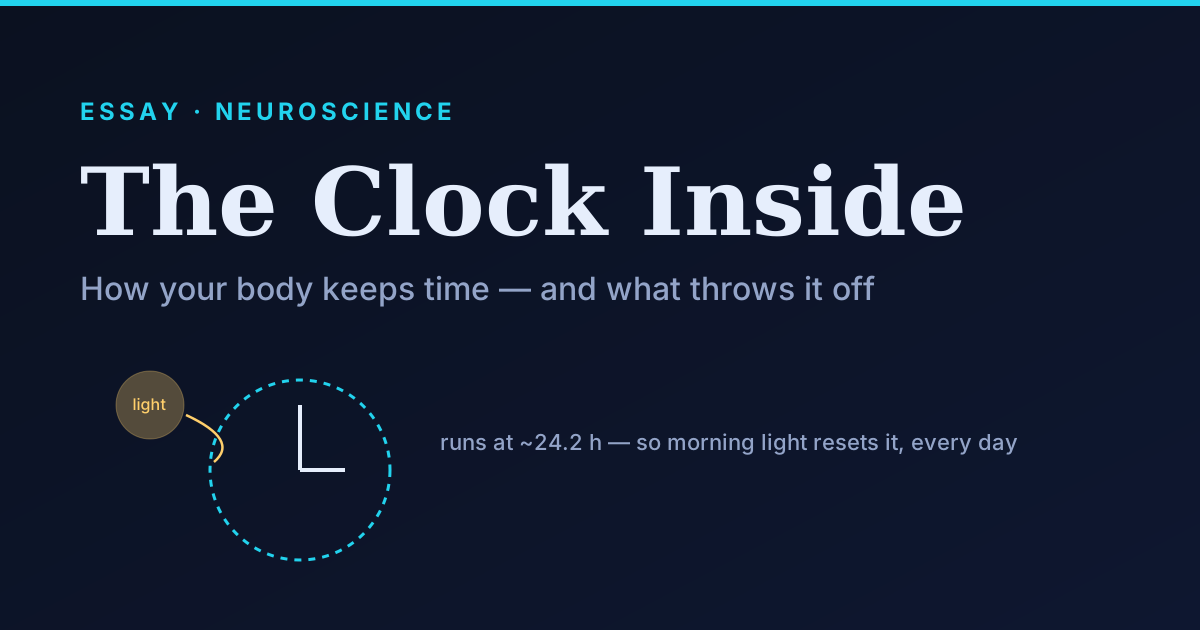
Try a thought experiment: you are shut in a cave with no watch, no daylight, no cue of any kind. After a few days you would still fall asleep and wake on a cycle close to 24 hours. How? Because you carry an internal clock, wired into your cells. The caver Michel Siffre tested this on himself in the 1960s: cut off from every cue, his body kept a rhythm, but a slightly longer one than 24 hours. That is the whole story: the clock is real and precise, and it needs to be reset every day.
The master clock: a tiny conductor deep in the brain
At the centre sits a cluster of about 20,000 neurons, just above where the optic nerves cross: the suprachiasmatic nucleus (SCN), the master clock. Inside each of its cells runs a molecular loop of roughly 24 hours: “clock” genes make proteins that, as they pile up, shut off their own production; the proteins then degrade, the block lifts, and production restarts. That “I brake myself, then restart” cycle takes about 24 hours: the fundamental chemical tick. Working it out won the 2017 Nobel Prize in Medicine (Hall, Rosbash, Young).
The catch: it runs slow. Light resets it
The problem: this clock averages ~24.2 hours, not exactly 24. Left to itself (as in the cave) it drifts: you go to bed a little later each day. So it needs a daily synchroniser, a “time-giver” (the German term stuck: Zeitgeber). The main one, by far, is light. Special cells in your retina (carrying melanopsin) do not help you see; they tell the SCN “it is daytime.” Morning light advances the clock (anchors you early); evening light delays it (screens included). And melatonin, the “it’s dark” hormone, is released in the evening, but light suppresses it. That is why a screen at midnight matters: you send a false “still daytime” to your SCN. Hold one mental image: a wind-up watch that loses twelve minutes a day. On its own it drifts, and within a week it is hopelessly off. But if every morning you set it against the station clock (daylight), it stays right. Your SCN is exactly that: a good metronome that runs a little slow, reset each day by morning light. Miss the reset (a lie-in in the dark, bright light at night) and you let the watch drift.
The conductor and the orchestra
The SCN is not alone: it is a conductor. Every organ has its own little clock (liver, gut, muscle) and the SCN keeps them in phase. One detail matters enormously: the timing of meals is a Zeitgeber for the liver clock, so eating late shifts your digestive clock out of step with the master. When you eat speaks to your body clock as much as what you eat. And people differ: chronotype is the genetically tinted preference that makes larks (early) and owls (late). Trouble starts when your biological clock and your social clock (the imposed alarm, the schedule) disagree: social jetlag, a permanent mini time-difference you inflict on yourself each week, associated with worse mood and metabolic health. A tidy recent twist: in adolescents the clock actually entrains to social time more than to sun time: the light you get is itself dictated by your schedule. The good news is that the levers are simple and free: bright light in the morning, dim light in the evening, regular timing (meals included).
Where this stands in 2026
A 2025 study in Current Biology settles an old debate on the young: the adolescent circadian clock entrains to the light–dark cycle set by social demands rather than to solar time, which means “being an owl” is not pure genetic fate but partly a matter of when your schedule exposes you to light, so the lever is actionable (Current Biology 2025). At population scale, a large representative survey links daily rhythms, light exposure and social jetlag to demographics and health (more social jetlag among the young, the urban, the schedule-bound), and other work shows chronotype and social jetlag reach all the way down to clock-gene expression (survey; clock-gene expression). This is not a soft magazine idea: it is measurable into the genes, and it is corrected mostly by regularity.
Further reading
- The adolescent circadian clock entrains to social time · Current Biology (2025): the study reframing the solar-versus-social debate; dense but illuminating on what really sets your clock.
- Daily rhythms, light exposure and social jetlag · Scientific Reports: the numbers behind social jetlag across a population: who has it, and why.
- Chronotype and social jetlag influence clock gene expression · PMC, how far the misalignment reaches: down to the expression of the clock genes themselves.