The Chinese Room: is understanding the same as computing?
Searle's Chinese Room argued that running the right program is never enough for understanding. Forty-five years on, interpretability research is turning that armchair intuition into a measurable question.
There is a tempting modern thesis: to understand something is to compress it. A model that predicts the next token is, in effect, searching for the short program that explains its training data, and the better it compresses, the better it seems to “understand.” The relationship can even be measured. And just as that idea starts to feel settled, a voice from 1980 cuts in: not so fast: manipulating symbols according to rules, however well, is still not understanding. That voice belongs to John Searle, and his weapon is the Chinese Room. It is the most argued-over thought experiment in all of philosophy of mind, and the rise of large language models has dragged it back to the centre of the table.
The thought experiment
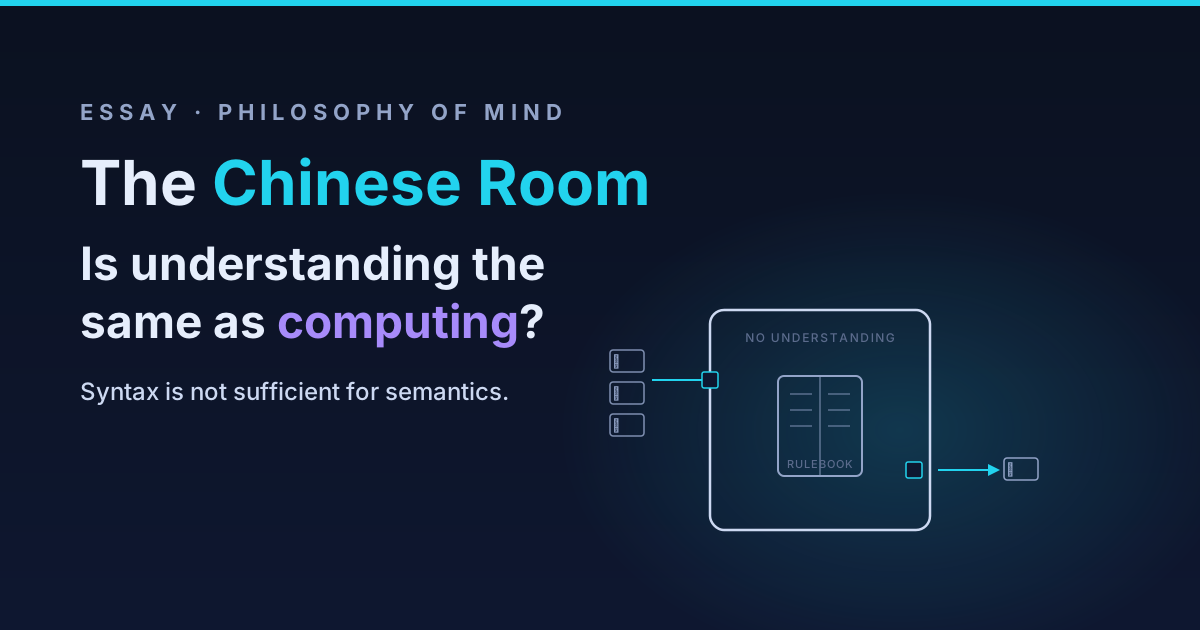
Picture a person sealed in a room. They speak no Chinese at all. Sheets covered in Chinese characters are slipped under the door. Inside, the person has an enormous rulebook, written in their own language: if you see this squiggle followed by that squiggle, copy this third squiggle onto an output sheet. They follow the instructions meticulously and pass their answer back under the door. Outside, a Chinese speaker reads the replies and finds them fluent, fitting, even witty. From that vantage point, the room speaks Chinese. It sails through the Turing test.
Searle’s question is blunt: does the person in the room understand Chinese? Obviously not. They have only pushed symbols around according to their shapes, never touching what those shapes mean. They could not say whether the conversation was about noodles or politics. And here is the sting. That is exactly what a computer does: manipulate symbols by their form (syntax) with no access to what they refer to (semantics). Searle’s conclusion: running the right program is never sufficient to produce understanding. The slogan is compact.
Syntax is not sufficient for semantics. Shuffling symbols is not the same as grasping them.
Searle aimed this at what he called strong AI: the claim that a well-designed program would literally have a mind, that it would understand and think in the full sense. He never denied that the machine is useful (that is “weak AI”). He denied that there is anyone home.
The replies: where it gets interesting
A thought experiment is only as good as the counterattacks it provokes, and Searle anticipated the main ones himself. Three still matter.
The systems reply concedes the first point and then turns it around: of course the person does not understand, but the person is only a component, a processor. It is the whole system (person plus rulebook plus sheets plus room) that understands Chinese. This is the most serious and the most modern objection, because it treats understanding as an emergent property of the system rather than of any one part. Nobody looks for understanding in a single neuron; why look for it in a single human-as-processor? Searle’s response is widely judged weak: let the person memorise the entire rulebook, internalise it, and walk out of the room: they still understand nothing, and now there is no external “system” left to point to. The debate has never really closed here.
The robot reply attacks the room’s isolation. The trouble, it says, is that the room is cut off from the world. Put the program inside a robot with cameras and arms, something that perceives and acts, and the symbols will be connected to the things they denote. This touches the heart of the matter: the symbol grounding problem. For a symbol to mean anything, it has to be anchored to something outside language: a perception, an action, a consequence. A pure dictionary runs in circles, each word pointing only to other words, never to the world. This reply bears directly on language models, as we will see.
The brain simulator reply raises the stakes again. Suppose the program simulated, neuron by neuron and synapse by synapse, the exact brain of a Chinese speaker. If it reproduces the biology faithfully, surely it must understand, otherwise the real brain would not understand either. Searle answers with a memorable image: imagine the same room, but with a network of pipes and valves the person operates to reproduce the neural flows. Water runs through the right pipes, the output is perfect, and clearly nobody would say the plumbing understands Chinese. The form of the computation, he insists, does not manufacture meaning, whatever the substrate.
Strip away the labels and a single fault line remains. On one side: the mind is the right program, never mind whether it runs on neurons, silicon, or pipes. This is functionalism. On the other side, Searle: meaning needs something more than the form of the computation, perhaps biology, perhaps grounding in the world. Everything else in this debate, and most of the argument about modern chatbots, plays out along that one seam: is form enough, or do you have to be plugged into reality?
The collision with language models
This is why a 1980 argument made headlines again. At first glance, a large language model is the Chinese Room made real: a gigantic engine for pushing symbols (tokens) around according to statistical rules (weights), with no eyes, no body, no access to the world, trained only on the form of text. Searle would have said: there it is, it understands nothing, it simulates. Many still say exactly that, under the banner of stochastic parrots: the machine regurgitates plausible patterns without grasping anything.
Except the ground has shifted under the argument, in two ways.
First, the semantic premise wobbles. Searle assumed you could have perfect syntax with zero semantics. Modern theories of meaning (teleosemantics, causal and structural theories of representation) suggest something awkward for that assumption: meaning emerges from optimisation. When a system is forced, across billions of examples, to predict correctly, the only way to succeed is to build an internal structure that mirrors the structure of the world. On this view, meaning is not a mystical spark added on top of computation; it is what computation ends up building when you optimise it hard enough. To predict well, to compress, you have to model. Understanding would then be the obligatory by-product of compression pushed to its limit.
Second, we have opened the room and found a map inside. Searle bet the room was empty of meaning, pure symbol-shuffling. But mechanistic interpretability has begun to look inside these models, and the verdict is not a dumb lookup table. A small transformer trained only to predict the moves of a board game reconstructs, in its activations, a representation of the board state it was never shown, a miniature world model. Language models trained on raw text encode a geographic map of cities, a directional arrow of time for historical events, all linearly readable from their internal states. These are not the symptoms of a parrot. They are the symptoms of something that built an inner world in order to better predict the outer one. The systems reply and the robot reply, once purely philosophical, become empirical questions.
The key shift: “does the machine understand?” stops being an armchair intuition and becomes a research programme: you open the model and measure whether it contains, or does not, a structure that looks like understanding.
Does this mean Searle was wrong? Not so fast either. His sharpest arrow still holds: grounding. A text-only model has a map of cities, but it has never walked through one, never been cold, never wanted anything. Its symbols are anchored in other symbols, human text, not in lived experience. Many philosophers now land on a middle position: language models have a real but partial form of understanding: structural, derived, disembodied. Neither Searle’s empty parrot nor the naive functionalist’s full mind. And that is precisely why the Chinese Room, far from being refuted, has become the reading lens of the moment: it names exactly what might be missing.
Understanding as a quantity, not a switch
Cross the compression thesis with Searle’s objection and something useful falls out. The Chinese Room in its purest form is an enormous rulebook, which is to say, the least compressed intelligence imaginable: a table that lists the answers instead of holding a theory of them. A system that has genuinely understood does not need the rulebook. It holds the short rule, the world model, and it generalises to sentences it has never seen. Compression hands us a criterion Searle lacked: the difference between mimicking and understanding is the difference between a lookup table and a compressed model that generalises.
That reframes the whole question. “Understanding” stops being a mysterious all-or-nothing and becomes a magnitude: how much has the system compressed, how far does it generalise beyond its training data. The pure Chinese Room sits at one end of that axis (zero compression, zero meaning); a brain sits at the other; and language models sit somewhere in the middle, exactly where it itches. The thought experiment that was meant to settle the matter turns out to be most valuable as a ruler.
Further reading
- John Searle, “Minds, Brains, and Programs” (1980): the original paper, surprisingly readable, the adversary’s voice without an intermediary.
- Stanford Encyclopedia of Philosophy, “The Chinese Room Argument”: the canonical survey, with every reply dissected cleanly.
- Kenneth Li, “Do Language Models Have a World Model?” (the Othello-GPT experiment): the founding empirical study of internal world models, told by its author.