The Black Hole Information Paradox: Why the Universe Never Forgets
Burn a book and the text is scrambled, not destroyed: physics insists information is never lost. Then Hawking showed that black holes evaporate, and the deepest paradox in modern physics was born. Here is the story, up to the 2019 breakthrough that saved the universe's memory.
Start with a claim that sounds harmless and is in fact one of the sturdiest pillars in all of physics: information cannot be destroyed. Burn this page. The paper turns to ash, smoke and heat; to you, the text is “gone”. But a patient enough demon, measuring the trajectory of every smoke molecule and every emitted photon, could in principle run the film backwards and reconstruct every letter. Nothing was erased. Everything was scrambled, dispersed into an unreadable mess, but the information is still there, in full, smeared across the state of the world. In the physicist’s language, the evolution of the fundamental laws is unitary and reversible: the present holds enough to rebuild the past, and the future follows from the present without ever losing a thing. The universe has no delete key. It only shuffles.
Hold on to that image, scrambling rather than erasing, because the whole drama that follows hangs on one object that seems to have a genuine delete button: the black hole.
An object with only three numbers
A black hole is a region where matter has collapsed so densely that the curvature of spacetime becomes impassable: past a boundary called the event horizon, nothing can climb back out, not even light. What is astonishing, proven in the 1960s–70s, is how simple a black hole is. Take a star, an entire library, or a mountain of scrap metal; drop each into a black hole, and once the turbulence settles, the resulting black hole is described by exactly three numbers: its mass, its electric charge, and its spin. That is all. Physicists call this, with a straight face, the no-hair theorem: a black hole “has no hair”, no surface detail betraying what went in.
At this stage it is not yet a scandal. You can hope the library’s information is simply hidden inside, below the horizon: unreachable, but not destroyed. The black hole would be a locked safe, not an incinerator. That escape hatch holds. Then Stephen Hawking blows it apart.
Hawking: black holes evaporate
In 1974 Hawking applied quantum mechanics right at the edge of the horizon and found the unexpected: a black hole is not perfectly black. It radiates a very faint glow, it loses mass, and so, over astronomical timescales, it evaporates until it disappears entirely. The safe does not stay locked forever: it melts, and eventually ceases to exist at all.
Where does the glow come from? Picture the vacuum not as “nothing” but as a sea that permanently shivers with tiny particle pairs that pop into being and annihilate at once. Just outside the horizon, a pair sometimes gets separated: one falls in, the other escapes outward. Seen from afar, that escaping particle is the Hawking radiation, and it carries off a crumb of the black hole’s energy. Repeat for billions of billions of years and the mountain erodes grain by grain down to zero.
Here the trap snaps shut: what has been called the information paradox ever since. The Hawking radiation, as he computed it, is perfectly featureless: a uniform, random heat that depends only on the three numbers (mass, charge, spin) and nothing else. It carries no imprint of what was swallowed. So wait to the end: the black hole is gone, all that remains is a bath of memoryless radiation, and the library’s information is neither inside (there is no inside anymore) nor in the radiation (it is featureless). It has been plainly and simply erased. The delete key exists.
Weigh the stakes, because this is no footnote of astrophysics. Two of the most thoroughly verified theories in the history of science flatly contradict each other: quantum mechanics swears information is never lost (unitarity), and Hawking’s general relativity answers that in an evaporating black hole, it is. One of them is wrong. For forty years this disagreement was the deepest battlefield in theoretical physics, because settling it means deciding whether reality, at the very bottom, keeps or destroys.
The clue that changes everything: entropy is a surface
The first crack in the wall came from a remark by Jacob Bekenstein, just before Hawking. A black hole must possess an entropy, a measure of how many hidden configurations it has, of the amount of information you would need to describe it in full detail. The question was: how much? The answer is one of the strangest facts in all of physics: a black hole’s entropy is proportional to the area of its horizon (the surface) and not to its volume.
For any ordinary object (a USB stick, a room, a brain), the maximum amount of information grows with the volume: more room inside, more you can store. For a black hole, it is the skin that counts, not the interior. It is as if everything knowable about a region of space were written on the boundary that encloses it, like text etched on the glass of a jar rather than on the objects inside. This oddity has a name, and it is the key to the way out: the holographic principle.
The holographic principle, proposed by Gerard ’t Hooft and made concrete by Juan Maldacena in 1997 (the famous AdS/CFT correspondence), says something dizzying: a region of space with gravity inside it (the “volume”) can be perfectly equivalent to a description without gravity living on its boundary, in one fewer dimension. Exactly like the hologram on a credit card: a rich, three-dimensional image entirely encoded in a flat film. The “bulky” black hole and a system of quantum particles smeared over a flat surface would be two ways of describing the same thing. But on the boundary there is no black hole, no horizon, no gravity going haywire, just plain old quantum mechanics, where information is never lost. If the two descriptions are truly equivalent, then information cannot be lost inside the black hole either. The paradox begins to dissolve.
2019–2020: the curve that proves information comes out
It remained to show how, concretely, the information comes back out in the radiation. The decisive tool is the Page curve, named after Don Page, who framed the right test back in 1993.
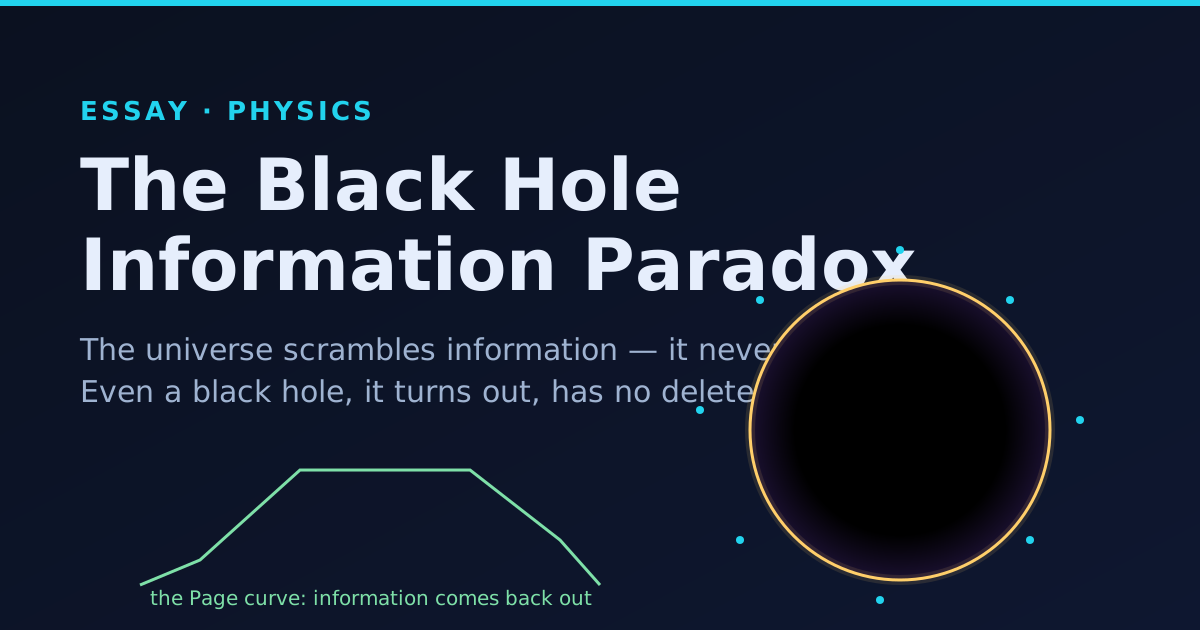
Track the entanglement of the escaping radiation, a measure of how tightly that radiation is still correlated, “tied”, to the leftover black hole (and therefore still blind to the information). In Hawking’s featureless calculation, this entanglement only ever rises: every particle leaves entangled, never resolved; at the end, the black hole is gone yet the radiation stays maximally entangled with… nothing. That is mathematically absurd, and it is the signature of information loss. Page objected: if evaporation is unitary (information conserved), the curve must first rise, then come back down and return to zero as the last photon departs. It must make a hat. That peak, the Page time, is the moment when the black hole has given back half of its information and starts to “spit out” the rest.
The turn came in 2019–2020. Two teams (around Geoff Penington, and Ahmed Almheiri, Netta Engelhardt and colleagues) managed to derive the green Page curve from gravity itself, using two twin ideas: quantum extremal surfaces and, above all, “islands”. The idea, in one sentence: after the Page time, part of the black hole interior must be counted as already belonging to the outside radiation, an “island” of interior that really lives out there. Redo the calculation including these islands (through an acrobatic technique called replica wormholes), and the entanglement stops rising at the right moment and comes back down: the Page curve appears. Information comes out. Unitarity is saved.
It is worth being honest about the status: the paradox is not formally closed. We now know, with very high confidence, that information comes out (the Page curve is the right one); we do not yet know how to describe in detail by what physical mechanism each bit imprints itself on the radiation of a real astrophysical black hole. But the bottom-line verdict is in, and it is beautiful: even a black hole erases nothing. It is the most violent scrambler in the universe (it mixes information so finely that it becomes unrecognisable for billions of years) but it does not destroy it. The universe, decidedly, has no delete key. Information, rather than matter or space, looks more and more like the deepest layer of reality: the one that even extreme gravity is forced to respect.
Where this stands in 2026
The paradox is not settled history; it is a live front, pushed on from two directions at once: telescopes and pen-and-paper theory.
On the observational side, the Event Horizon Telescope, the collaboration behind the first image of a black hole in 2019, reported in January 2026 new observations tying the ring of light around the supermassive black hole in galaxy M87 to the base of its jet, the beam of matter thousands of light-years long that it launches. It is the first time the precise place where the jet is born has been approached, at a scale comparable to the black hole itself. The information paradox is theoretical, but it is these real images, right at the horizon’s edge, that discipline the models of what happens there.
On the theory side, a run of 2026 papers has extended the “island” calculation to more realistic black holes: rotating, of the Kerr type. The robust result: the entanglement entropy climbs linearly at first, then falls back to a constant, the Page curve, in every situation tested, without ever violating unitarity, with some cases even showing a phase transition that puts a sharp break in the curve. This matters because it shows the 2019 breakthrough was not an idealised toy: it holds on black holes closer to the real thing.
And there is a bench-top angle. Because a black hole “is” equivalent to a quantum system on a boundary (the holographic duality), one can simulate its information properties on table-top quantum systems (cold atoms, quantum processors) and watch the ultra-fast scrambling of information that is a black hole’s fingerprint. Treat it as a controlled analogy, not a real black hole; but it turns the physics of horizons into something you can probe in a lab.
Further reading
- The Most Famous Paradox in Physics Nears Its End (Quanta, 2020): the best narrative entry point, the whole story, from islands to the Page curve, told without equations and beautifully illustrated.
- Hologram Within a Hologram Hints at Fate of Black Holes (Quanta, 2019): the credit-card-hologram analogy pushed all the way, how a “bulky” black hole equals a flat, gravity-free surface.
- Wormholes Reveal a Way to Manipulate Black Hole Information in the Lab (Quanta, 2020): how entanglement and “wormholes” connect, and why pieces of this can be tested on real quantum systems.
- Probing the jet base of M87’s supermassive black hole (EHT, January 2026): the primary source for the 2026 observation, with images, the real view of the horizon’s neighbourhood.