Pretraining brain-computer interfaces: Neuralink's 50,000 hours of neural data
An implanted brain decoder slowly stops understanding the brain it reads, and users pay for that with daily recalibration. Neuralink now says self-supervised pretraining on 50,000 hours of unlabeled recordings cuts that tax sharply. What the claim shows, and what it does not yet.
On 1 October 2026, Neuralink published a technical update titled “Pretraining on 50,000 Hours of Unlabeled Brain Data”. The headline number is a cursor control record: 11.32 bits per second, up from a previous best of 10.39, set by one participant in the company’s implant trial. The more interesting number is quieter. Some participants who used to spend close to an hour a week recalibrating their implant now spend about ten minutes.
That second figure points at the least glamorous problem in brain-computer interfaces, and probably the one that matters most for anyone who would live with one. A decoder trained on Monday understands Monday’s brain. By Thursday it understands it a little less.
Why a working decoder stops working
An intracortical brain-computer interface, or BCI, listens to individual neurons through fine electrodes placed in the motor cortex, the strip of brain that plans movement. Each time a neuron fires it produces a spike, a brief electrical pulse. A piece of software called a decoder learns the mapping between patterns of spikes and what the person intends: move the cursor left, slow down, click.
The mapping does not stay put. Electrodes shift by micrometres relative to the tissue around them. Some neurons fall silent near a contact while others become audible. Scar tissue thickens. The person’s own strategy changes as they get better at using the device. Engineers call the sum of all this drift, and its effect is that a decoder fitted to yesterday’s recordings slowly loses accuracy today.
The standard response is recalibration: the user follows targets on a screen for a few minutes so the system can relabel spikes with known intentions and refit. In Neuralink’s trial this had settled at roughly ten minutes a day, or around 55 minutes a week on average, according to the company. That is the hidden tax on a device sold as effortless. It is paid every day, for as long as the implant is in.
What Neuralink did with the data nobody labeled
Most of the hours a participant spends with an implant produce no labels at all. They browse, game, type and rest while the device records, but nobody knows at each instant what the person intended. Over two years of the trial, now at 21 participants, that background stream added up to more than 50,000 hours of recordings. Neuralink says its first participant alone contributed over 9,000 hours, about 22.4 billion spikes.
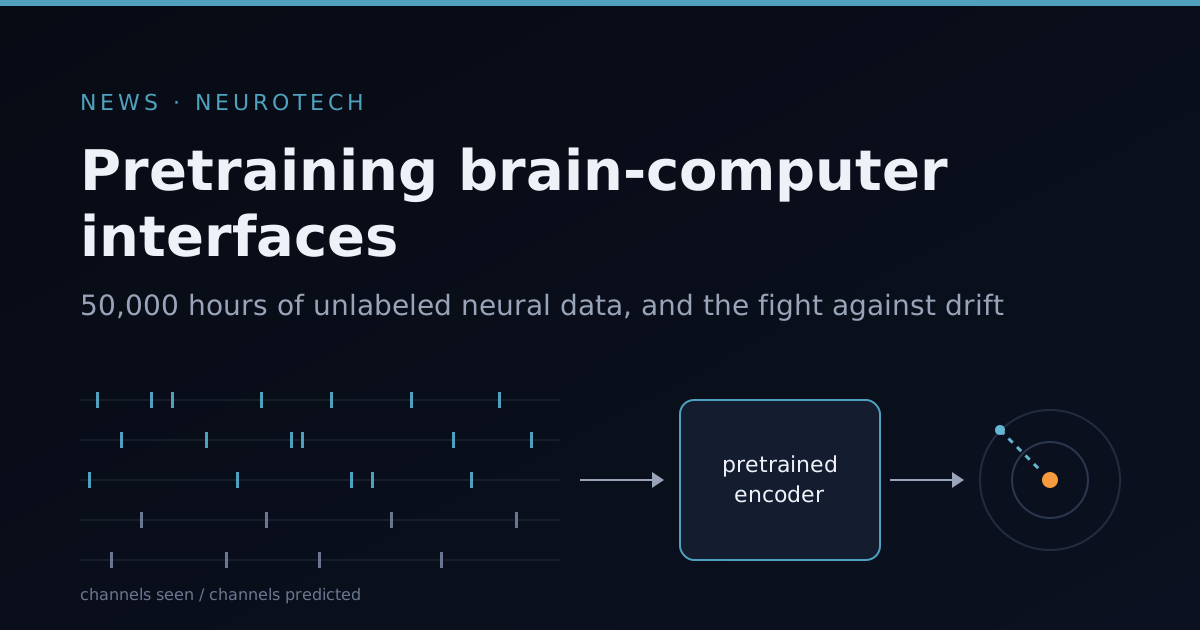
The company used that stream the way language models use raw text. In self-supervised learning, a model invents its own exercise from unlabeled data. Here, as described in the post and in subsequent coverage, the model is shown activity on half of the recording channels and asked to predict what the other half is doing. To succeed it cannot memorise any one electrode; it has to learn the population structure, the coordinated patterns that many neurons share and that survive when individual channels come and go.
The result is an encoder, a network that turns raw spikes into a compact numerical summary called an embedding. The trick is to split the decoding job in two. The big encoder is trained rarely, on everything. A small decoder sits on top and translates embeddings into cursor movement, and only that small piece needs recalibrating.
According to the company, thirty seconds of labeled data passed through the pretrained encoder matched what about three and a half minutes of raw spikes achieved before, and decoders built this way kept working for weeks rather than days. One participant’s decoder is reported to have stayed usable for more than a year and a half.
Reading the record correctly
Bits per second is the field’s way of scoring speed and accuracy together. On a grid of targets, a correct selection among many possible targets carries more information than one among few, and wrong clicks subtract. The score multiplies that information per selection by how many selections per minute the person manages. Neuralink says its median participant now sits around 10 bits per second, six participants set personal records in the reported period, and one reached 11.32.
The post also describes an experimental mode the company calls “teleporting cursors”. A normal decoder estimates velocity, so the cursor glides toward the target like a mouse pointer. The experimental one predicts the destination coordinates directly and jumps there. It cut travel time and crossed 10 bits per second in early tests, though the company concedes it is not yet precise enough for pixel-level targeting.
The record is real progress, but it is the smaller story. A few percent more bandwidth matters less to a person with paralysis than not spending the first ten minutes of every morning teaching the machine to understand them again.
What the announcement does not show
It is a company blog post, not a peer-reviewed paper. The figures are Neuralink’s own, measured on its own participants with its own task, and no independent group has reproduced them. Comparisons with able-bodied mouse users, which the company makes, depend heavily on how the task is set up.
The idea itself is not new. Academic groups have pretrained neural decoders on pooled recordings for several years, with models such as POYO, which treats individual spikes as tokens, and Neural Data Transformer 2, both trained across sessions and animals or people. What Neuralink brings is scale: tens of thousands of hours from humans living with a home-use implant, a dataset no university lab can collect.
The most telling result is a partial failure. Offline, a model trained on one participant transferred to another while keeping 99 percent of its weights frozen and beat the second person’s own decoder. But when the company pooled several participants’ data into one model and tested it live, the pooled model did no better than single-person versions. Every brain still has its own encoder. The foundation-model promise in its strong form, a new user who needs almost no calibration because the model has already seen thousands of hours of other people’s motor cortex, is the stated goal, not the result.
Finally, the whole approach depends on recording almost everything a participant does for years, unlabeled and unprompted. That is what makes the model work. It is also neural data of an intimacy no keyboard log comes close to, held by one company. How it is stored, who may train on it, and whether a participant can withdraw it are questions the technical post does not address.
Further reading
- Pretraining on 50,000 Hours of Unlabeled Brain Data, Neuralink’s original post.
- Neuralink trains on 50,000 hours of brain data, hits 11.32-bit/s cursor record, a news summary with the main figures.
- Neural Data Transformer 2: Multi-context Pretraining for Neural Spiking Activity, an academic precursor to cross-session pretraining.
- A Unified, Scalable Framework for Neural Population Decoding, the POYO paper on tokenising spikes.