Perovskite tandem solar cells: the record and the roof
Stacking a perovskite layer on silicon has pushed certified cell efficiency to 35.5 percent, well past what silicon alone can ever reach. The harder number is the one no laboratory can certify yet: how many of those percent are still there after twenty-five summers on a roof.
A silicon solar panel installed today comes with a promise most people never read: after twenty-five or thirty years it will still deliver something like 85 percent of its original power. That promise is backed by four decades of panels that actually sat in the rain, and it is the reason a bank will lend against a solar farm. Efficiency gets the headlines. Durability gets the financing.
In July 2026, LONGi announced a solar cell that converts 35.5 percent of incoming sunlight into electricity, certified by the European Commission’s European Solar Test Installation. That is far beyond anything silicon can do alone. The cell is a tandem: a thin layer of a crystal called perovskite sitting on top of a conventional silicon cell. The company also said, a month earlier, that it had no active plan to mass-produce it. Those two facts together are the whole story of perovskite photovoltaics right now. The physics works. The question is whether the material can survive the job.
Why silicon is running out of room
A solar cell turns light into current because a photon with enough energy can kick an electron loose in a semiconductor. “Enough” is set by the material’s bandgap, the minimum energy an electron needs to break free and conduct. Silicon’s bandgap corresponds to near-infrared light.
This creates a double waste. Photons with less energy than the bandgap pass straight through and are lost. Photons with much more energy, blue and violet light, do free an electron, but the surplus energy is shed as heat within a trillionth of a second. A single material can only be tuned to one compromise. Worked out carefully in 1961, that compromise caps any single-junction cell at roughly a third of sunlight, and silicon’s own practical ceiling sits a little below 30 percent. The best laboratory silicon cells are already within a couple of points of it. Each further tenth of a percent is expensive.
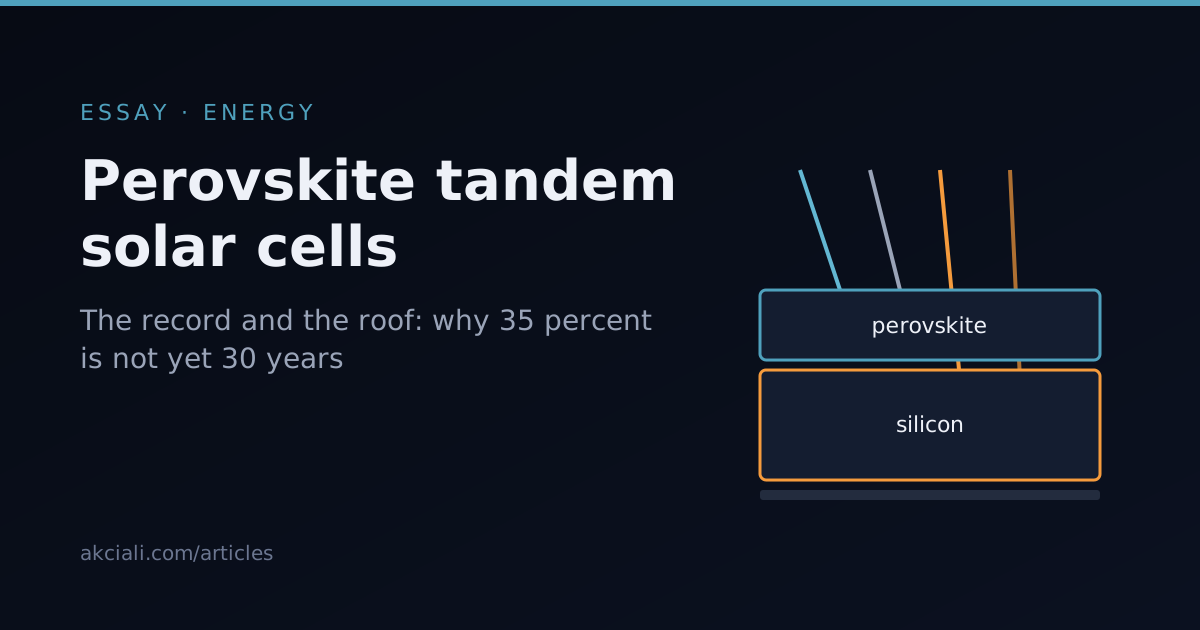
The way out is old and simple in principle: use two materials. Put a wide-bandgap layer on top that captures the energetic blue and green photons at a high voltage and lets the red and infrared through. Put silicon underneath to catch what passes. Each layer wastes less, because each sees only the part of the spectrum it is suited to. LONGi cites a theoretical limit around 43 percent for the perovskite on silicon pair.
Researchers tried this for decades with other materials. Stacks of gallium arsenide and related compounds reach far higher efficiencies and power satellites, but they cost hundreds of times more per watt than silicon. What makes perovskites different is that they promise the top layer at nearly the price of paint.
The crystal that is easy to make and easy to break
“Perovskite” names a crystal arrangement, not a single substance. The versions used in solar cells are metal halides: a lattice of lead and halogen atoms (iodine, bromine) with small positive ions, organic molecules or cesium, tucked into the gaps. They can be deposited from solution or vapour at temperatures close to a kitchen oven’s, where silicon wafers are grown from a melt at over 1,400 degrees Celsius. Their bandgap can be dialled by changing the recipe; swapping some iodine for bromine pushes it up into exactly the range a top cell on silicon needs.
They are also remarkably forgiving of defects. Silicon must be purified to a few impurities per billion to work well. Perovskite films full of imperfections still convert light efficiently, which is why single-junction perovskite cells went from about 4 percent to over 26 percent in roughly fifteen years, a climb that took silicon half a century.
The same chemistry that makes them easy to build makes them easy to unbuild. The bonds holding the lattice together are soft. The halide ions are not fixed in place; under an electric field and in sunlight they wander through the crystal and pile up at the interfaces, where they degrade the neighbouring layers. Moisture can dissolve the organic components. Heat can drive them out. Ultraviolet light attacks some of the contact materials. And the mixed iodine and bromine recipes that give the right bandgap tend, under illumination, to separate into iodine-rich and bromine-rich patches, so the film quietly drifts away from the composition it was designed to have.
Silicon has its own failure modes, but none of this kind. A silicon crystal does not rearrange itself in sunlight.
What twenty months outside actually looks like
The most useful evidence is the least glamorous: cells left outdoors and examined afterwards. In a study published in Joule this year, a team led from Helmholtz-Zentrum Berlin aged perovskite cells for twenty months in an outdoor test field in Berlin, then compared them, microscope image by microscope image, with cells aged artificially in the laboratory.
They found three dominant ways the outdoor cells had failed. The most important was exactly the phase segregation described above, visible as circular domains a few micrometres across where the composition had shifted. The other two, corrosion of copper contacts and degradation spreading in from the edges, were tied more to how the cells were built than to the perovskite itself. That distinction matters: design flaws can be engineered away, while a material that segregates under light has to be reformulated.
The second finding is the uncomfortable one for the industry. Accelerated tests reproduce some of these mechanisms and miss others. Turning up light intensity speeds up the processes that matter; turning up heat alone can trigger failure paths that never occur on a real roof, or skip ones that do.
This is the core problem. Nobody can wait thirty years to certify a module. Silicon’s warranties rest on standardised stress tests, damp heat, thermal cycling, ultraviolet exposure, that were calibrated against decades of real field data. For perovskites, that calibration does not exist yet, so a pass on a silicon-era test says less than it appears to. A frequently cited 2022 Princeton study extrapolated a lifetime of around thirty years for one carefully engineered perovskite cell from tests at elevated temperature, a genuine advance in method, but an extrapolation from one design, not an observation.
Perovskites add a further twist: some of their damage partly reverses in the dark, and their output can rise or fall over the first hours of illumination. A module’s measured efficiency depends on what happened to it before the measurement. That makes even the starting number, the one every warranty is written against, harder to pin down than for silicon.
Where this stands in 2026
The efficiency race is effectively settled. LONGi’s 35.5 percent, presented on 14 July 2026, follows a staircase of its own records from 33.9 percent in late 2023. The record is for a small laboratory cell; the company reports 34.3 percent on a 261 square centimetre device, closer to a commercial wafer, though that larger figure is its own claim. Several academic groups have published certified results above 33 percent this year.
Commercial deployment exists but is small. Oxford PV shipped what it described as the first commercial perovskite on silicon modules to a US utility-scale customer in September 2024, at 24.5 percent module efficiency and, by the company’s own figure, up to 20 percent more energy than a standard panel of the same size. The cells come from a pilot line in Brandenburg rated in megawatts; a gigawatt-scale factory remains a plan. A module at 24.5 percent while the cell record sits above 35 tells you how much is lost between a square centimetre in a lab and two square metres on a frame.
The field data are thin and mixed. The European Commission’s Joint Research Centre ran two commercial single-junction perovskite modules outdoors from June 2024 to June 2025. One held up reasonably, with seasonal swings. The other degraded severely, ending below 7 percent efficiency. Two modules prove nothing about a technology, which is precisely the point: the industry is betting on a product whose long-term field record is still measured in single digits of years and handfuls of devices.
What still breaks
Three issues remain open, and none is solved by another efficiency record.
The first is the lifetime gap. Until tests are shown to predict outdoor behaviour for perovskites specifically, every lifetime claim is an extrapolation, and a bank financing a 25-year asset will price that uncertainty in. A tandem that delivers 30 percent more energy but must be replaced after ten years is not cheaper than silicon.
The second is that a tandem fails as a pair. In the most common design, the two layers are wired in series, so the same current must flow through both. If the perovskite layer degrades and produces less current, it throttles the silicon beneath it. A tandem can lose more than its top layer’s share when that layer ages.
The third is lead. The best perovskites contain a small amount of it, far less than a lead-acid battery, but spread across millions of square metres of glass that will eventually break, be hailed on, or be landfilled. Encapsulation and recycling schemes exist on paper. Lead-free alternatives so far perform much worse.
None of this makes the technology a dead end. Silicon itself had durability problems in the 1980s that were engineered out once enough panels failed in enough places to show why. Perovskites are at that stage now: efficient enough to matter, not yet old enough to trust. The number to watch is no longer the efficiency on the certificate. It is the power a field of these modules is still producing in 2035.
Further reading
- How long do perovskite solar cells last? (Adlershof, on the HZB outdoor ageing study)
- LONGi sets new world record with 35.5% efficient perovskite-silicon tandem cell (pv magazine)
- One-year perovskite solar module testing shows promising outdoor stability (pv magazine)
- Oxford PV ships first commercial perovskite tandem modules (PV Tech)