Order Without a Boss
How flocks, cells, sandpiles and even minds build order from simple local rules, with nobody in charge. A tour of emergence, self-organization and the edge of chaos.
On a winter evening, above a field, thousands of starlings draw a fluid shape in the sky that folds, turns inside out, stretches and recomposes like a single liquid organism. It is a murmuration. The first question anyone asks is: who is leading? Which bird sets the motion for the whole? The answer, unsettling and beautiful, is: nobody. No starling sees the global shape. None decides it. Each bird watches only its six or seven immediate neighbors and applies three tiny rules. The giant shape exists nowhere in any bird’s head: it emerges from the sum of local interactions. That is the whole subject here, and it is one of the deepest ideas in modern science: emergence.
Three rules, and a flock appears
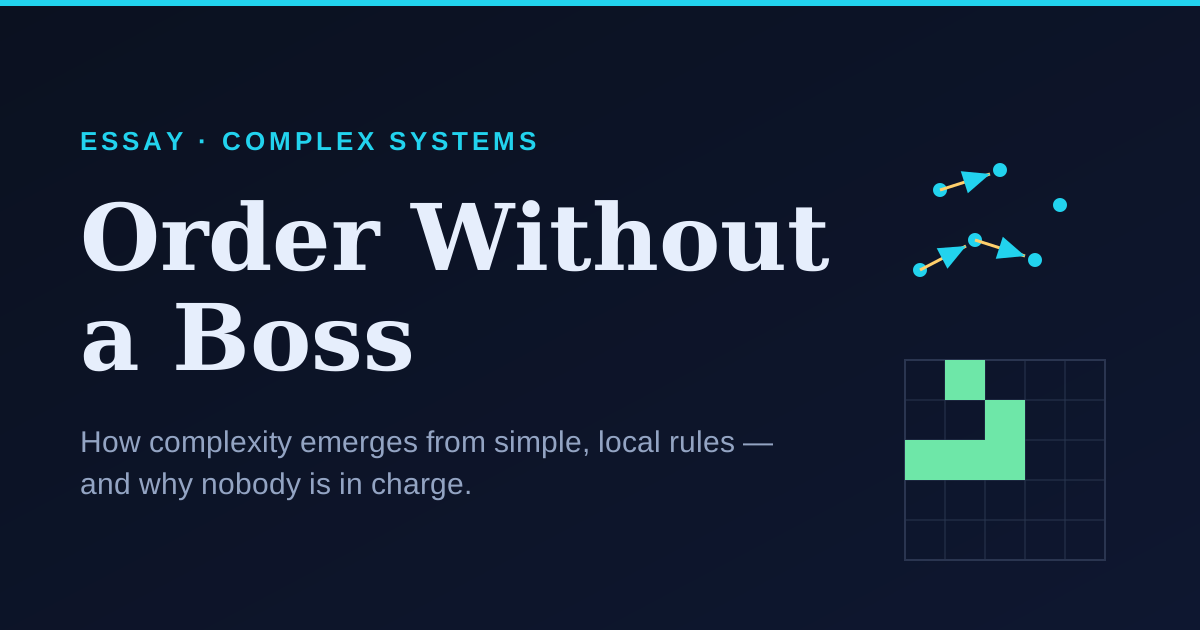
In 1986 the computer scientist Craig Reynolds wanted to animate flocks of birds for film without drawing each one by hand. He programmed agents he called boids (“bird-oids”), each blind to the big picture, each obeying three rules while looking only at its nearby neighbors:
Launch five hundred boids with those three rules and within seconds a flock appears that turns, dodges obstacles, splits and re-fuses, exactly like real starlings. The astonishing part is that the flock was programmed nowhere. We wrote the behavior of an individual; the behavior of the group is an unwritten bonus. That is the definition of emergence: the whole has properties none of its parts has, properties you cannot read off from the spare parts. A neuron does not think; a brain does. A water molecule is not “liquid”; a glass of water is. Liquidity, the flock, thought: properties that appear only at the scale of many things interacting.
The game that makes complexity out of nothing
Push the idea to its extreme with the most stripped-down example there is: John Conway’s Game of Life (1970). The set: a grid of cells, each alive (black) or dead (empty). Time advances in clock ticks, and at each tick every cell looks at its eight neighbors and applies two rules, full stop:
- a live cell stays alive if it has 2 or 3 live neighbors; otherwise it dies (loneliness or overcrowding);
- a dead cell is born if it has exactly 3 live neighbors.
That is all. Two rules and a little neighbor-counting. Nothing more. And yet those two rules give rise to an entire bestiary. Stable shapes that never move (“still lifes”). Blinkers that oscillate forever. And above all gliders: small five-cell patterns that, by regenerating, travel diagonally across the grid, a “thing” that moves although no cell moves; only the shape propagates, like a wave on water.
This is not a geek curiosity. The Game of Life has been proved Turing-complete: with enough gliders and glider guns you can build logic gates, memory, a universal computer. In other words, from two counting rules emerges the ability to compute anything. Keep the conceptual shockwave: the richness of a system is not read off from the complexity of its rules. Trivial rules, repeated by a crowd of interacting agents, are enough to generate bottomless complexity. Complexity is not in the rules; it arises between them.
Self-organization: order that gets paid for elsewhere
A word about a close cousin of emergence: self-organization. That is when a system moves from disorder to order all by itself, with no outside hand tidying up. The crystallizing snowflake. The hexagonal convection cells that appear in a pan of oil heated from below (Bénard cells). The regular ripples wind carves in sand. Nobody draws these patterns; they settle in on their own the moment energy flows through the system.
Here we have to connect to an old idea: entropy, our measure of disorder, which only ever increases in an isolated system. Self-organization seems to taunt it: order appearing spontaneously? The Nobel laureate Ilya Prigogine dissolved the paradox with the notion of a dissipative structure. A whirlpool in a sink, a flame, a living being: these are islands of order crossed by a flux (of water, heat, food). They keep their local order by exporting disorder all around: the flame dumps more entropy into the room than it creates order in itself. Self-organized order is therefore never an anti-entropy miracle: it is bookkeeping that stays positive only as long as energy flows through it. A living thing is exactly that: a structure that stands up as long as the flux keeps running.
There is an even sharper example of order computed rather than drawn. In 1952 Alan Turing showed that two chemicals (one that “activates” and spreads slowly, one that “inhibits” and diffuses fast) are enough to bring out regular patterns: leopard spots, zebra stripes, the spacing of fingers. Forget the reaction-diffusion equations and picture a brush fire lighting its neighbors, chased by firefighters faster than the flames. Where the fire gets a little ahead: a spot. Where the firefighters catch up: empty space. Repeat across the whole surface and you get a frozen pattern, not drawn by a plan, but computed by the race between a slow activator and a fast inhibitor. An animal’s coat is a chemical spreadsheet that ran once, in the embryo.
The edge of chaos: where things come alive
One question remains: why do some systems produce this richness and others do not? Mentally arrange all possible systems along a dial. Far left, frozen order: a crystal, a fixed grid. Nothing ever happens, no novelty. Far right, boiling chaos: pure noise, everything changes all the time, nothing lasts long enough to mean anything. Between the two lies a narrow band: the edge of chaos. It is there, and only there, that structures can both hold (memory) and change (computation, adaptation). Life, brains, languages: all live in that band.
A 1987 discovery gave that band a measurable signature: Per Bak’s self-organized criticality. His image: a sandpile onto which grains are dropped one by one. The pile rises, steepens, and holds itself right at the brink of collapse. From there, each grain may trigger nothing at all, or set off an avalanche of any size. There is no typical size of avalanche. We say the sizes follow a “power law”: many small ones, a few medium, very rarely a huge one, in a strict regularity. Don’t memorize a formula; hold the image of a rocky coastline. Seen from a plane or on all fours on a boulder, it has the same jagged look, no privileged scale. A power law is exactly that: a system that looks like itself at every size, where there is no “normal” event. Earthquakes, mass extinctions, the cascades of neurons firing in a cortex (“neuronal avalanches”) all follow this same signature, a hint that these systems too poise themselves right at the edge.
Memory in the world, not in the boss
One last floor, the most troubling for our intuition of “who’s in charge.” Watch a column of ants trace the shortest line between the nest and a crumb. No ant knows the map. None computes the route. Each drops a trace of pheromone as it walks and tends to follow the strongest traces. Short paths are walked faster, so refreshed more often, so reinforced: the solution is deposited in the environment, not in a head. This is called stigmergy: coordinating without communicating directly, by leaving marks in the world that others read. The colony “computes” without anyone computing; its memory is spread outside, in the pheromones.
Now gather the five ideas: local rules (boids), repeated by a crowd (Game of Life), crossed by a flux of energy (dissipative structures), held at the edge of chaos (the sandpile), with memory offloaded into the world (ants). This cocktail needs no boss, no plan, no center. And it is precisely the recipe that produced organisms, ecosystems, markets, cities, and, at the summit, the brain. A brain is 86 billion neurons, none of which “contains” you, none of which is in charge, each following local rules of excitation. A self, a sense of “I,” is arguably the glider of that particular Game of Life: a stable pattern propagating over a substrate in perpetual turnover, an identity with no fixed substance. Which is what makes the idea of copying or transferring a mind at once vertiginous and concrete: the question is never about copying the matter, but about whether the pattern, and the flux that keeps it alive, can be carried across.
Where this stands in 2026
Emergence is not a settled museum piece; it is an active research front. The international Artificial Life (ALIFE) 2026 conference (August 17–21, Waterloo, Canada) takes as its theme “Living and Lifelike Complex Adaptive Systems”, life read as a process that emerges from the interactions of components able to adapt, learn and organize across scales. It is the crossroads where artificial life, AI and complex-systems research meet.
The engineering is moving too. Google’s Self-Organising Systems group recently presented Differentiable Logic Cellular Automata: instead of hand-coding the update rules of a Game of Life, the system learns them by gradient descent, then grows and regenerates complex patterns. That shifts the frontier from “we write the rule” to “we let the rule discover itself”: self-organization climbing one level up, into the rules themselves.
And in biology, Michael Levin’s work at Tufts argues that morphogenesis (how an embryo builds a correct shape, repairs and regenerates it) is a form of collective intelligence of cells pursuing anatomical goals through bioelectric signaling, with no central plan. His recent synthesis in BioEssays (2025) proposes to “talk to” that intelligence of the body for regenerative medicine. It is emergence applied to the most concrete living matter there is: a body is already a collective that thinks in deeds.
Further reading
- Differentiable Logic CA · Google Research: from the Game of Life to learned patterns, with animated demos in the page: you see self-organization at work. The best visual entry point.
- Self-organizing systems: what, how, and why? · npj Complexity (2025): a recent, readable stock-take of what self-organization is (and is not), and how it relates to emergence.
- Emergence, (Self)Organization & Complexity · Santa Fe Institute: the world’s home of complex-systems science: a launch pad for criticality, networks and artificial life.
- Neural Cellular Automata: From Cells to Pixels · review (2025): for going further: how identical cells learn to self-regenerate and form robust patterns, the modern, trainable descendant of the Game of Life.