Computing Like a Brain
Our computers separate memory from compute and pay a fortune moving data between them. Brain-inspired chips fuse the two and only fire when something happens. Here is why that matters, and where it actually stands.
Start with a number that ought to bother you. The human brain runs on roughly 20 watts (a dim light bulb) and does things no supercomputer can match in real time. Training a large AI model, next to that, draws the electricity of a small town. A factor of millions separates the brain’s efficiency from our machines’. That gap is not an engineering detail to be shaved away with a better cooler. It is a sign that we are doing something structurally wrong. Understanding what, is the whole case for neuromorphic computing.
The invisible wall
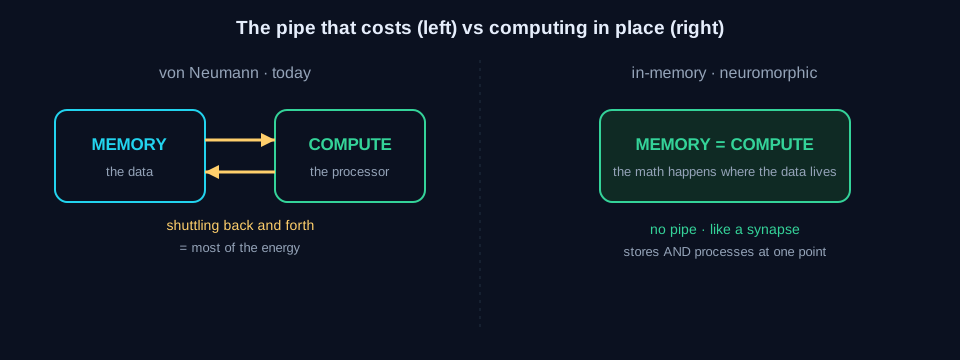
Since 1945, almost every computer has followed the same blueprint, the von Neumann architecture: memory on one side holding the data, a processor on the other doing the arithmetic, and a bus (a pipe) between them. To add two numbers, the machine fetches them from memory, sends them down the pipe to the processor, computes, and ships the result back. When compute was rare and data small, this was fine. Modern AI is the opposite: mountains of numbers (the “weights” of a network) that must be multiplied and summed constantly. The machine now spends most of its time and energy not computing but moving data through the pipe. Today, moving a number costs far more energy than multiplying it. This is the von Neumann bottleneck, the “memory wall.”
The brain never built that wall. It has no “memory here, compute there.” The synapse (the contact between two neurons) is both where information is stored (the strength of the link) and where it is processed (it lets a signal through, or not). Storage and computation sit at the same place, repeated a hundred trillion times. No pipe, no round trip. That is the first big idea neuromorphic hardware copies: bring memory and compute together, to the point of fusing them.
Speak only when there is something to say
A GPU computes to a metronome: a clock drives billions of operations a second across whole arrays of numbers, useful or not, even when most values are zero. The brain does the reverse. A neuron stays silent, almost free, until it has something to say; then it emits a brief electrical pulse, a spike, and falls quiet again. Information is not a continuous stream of figures; it is a rain of rare, timed events. This is event-driven computing, and networks built this way are spiking neural networks (SNNs).
The consequence is enormous. At any instant only a tiny fraction of neurons are “talking”: that is sparsity. Because a neuromorphic chip spends energy only when a spike occurs, and spikes are rare, the bill collapses. Time itself carries meaning: when a neuron fires, and how often, encodes the message. It is a different language from mainstream AI: no longer “numbers everywhere, all the time,” but “pulses, only when needed.”
The physical magic: the memristor’s “free” math
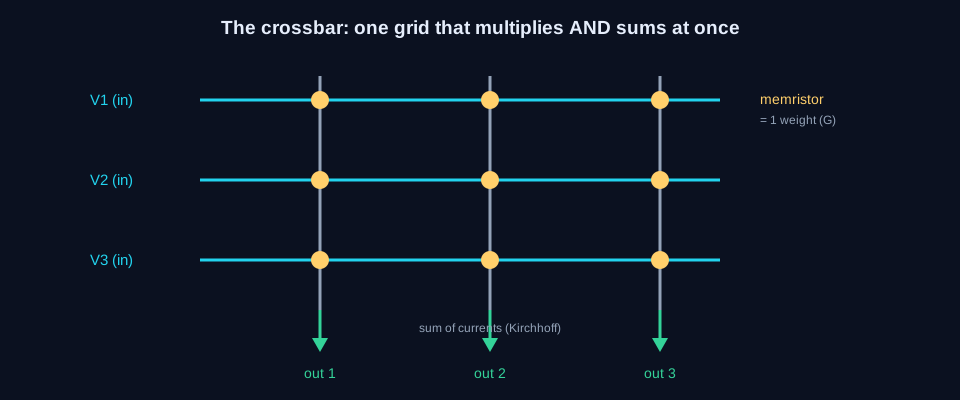
Here is the most concrete part. The core operation in AI is the matrix-vector multiply: take a list of input numbers and combine them with a grid of weights to produce an output. On a GPU that means millions of multiply-adds, one at a time. Neuromorphic designers do it differently, using a device called a memristor, a “resistor with memory,” a tiny element whose ease of passing current (its conductance) can be set and remembered. A memristor stores a weight, physically.
Now arrange thousands of memristors in a grid (a crossbar): horizontal wires (inputs), vertical wires (outputs), a memristor at every crossing. Apply your input numbers as voltages on the rows. Two laws of high-school physics then do all the work, instantly and in parallel: by Ohm’s law, each crossing passes a current proportional to voltage times conductance: that is the multiplication; and by Kirchhoff’s law, the currents on a shared column add up on their own: that is the sum. The entire matrix-vector multiply (millions of operations on a GPU) happens in a single analog step, at the speed of electricity, moving no data at all, because the weights are the grid. This is in-memory computing in its purest form.
Where this stands in 2026
These ideas are no longer lab toys. Three families of chips embody them. On the digital event-driven path, Intel’s Loihi line: its research system Hala Point wires up 1.15 billion artificial neurons across 1,152 Loihi 2 chips (roughly the neuron count of an owl’s brain), targeting order-of-magnitude efficiency gains over a GPU on event-driven workloads (vendor figures, read as such). IBM’s NorthPole pushes the memory-compute fusion hardest: by placing memory on the compute units and eliminating external memory access, IBM claims about 25× the energy efficiency of a standard GPU and ~22× on a reference vision task. And on the analog / memristor path (the crossbar above), edge players like BrainChip’s Akida already ship inside automotive-safety systems and always-on sensors, where every milliwatt counts.
But this is where the hype needs a brake: neuromorphic hardware has not dethroned the GPU, and will not tomorrow. Two frictions. First, we still do not know how to train spiking networks well: a spike is all-or-nothing, mathematically hostile to the methods that made mainstream AI work. Second, the energy advantage only pays if activity stays sparse enough; recent work puts a number on it: below roughly 6% of neurons active, an SNN beats its conventional equivalent; above that, the edge evaporates. The signal that the field is maturing is that both walls are cracking at once: a 2026 multi-core architecture in Nature Communications is built specifically to train deep SNNs at 190–330% of a Jetson Orin’s performance, while 2026 RRAM crossbars demonstrate 5-bit analog control per cell for in-situ multiplication.
So the honest verdict is not “GPUs are finished.” It is narrower and more interesting: neuromorphic chips are radically frugal exactly where information is sparse and never stops: event-based vision, always-on audio, sensors, embedded robotics, prosthetics. The kind of work a body, or a mind, has to do continuously on a light-bulb budget. The brain has computed this way for millions of years. Silicon is only just beginning to imitate it.
Further reading
- Towards spike-based machine intelligence with neuromorphic computing · Nature, the reference review by Roy, Jaiswal and Panda: why and how spiking networks work, from neuron to hardware.
- Neuromorphic Computing: An Overview (arXiv, 2025): a recent, readable tour linking algorithms, hardware and applications.
- Neuromorphic computing for robotic vision · Communications Engineering (2025): how event-driven sensing reshapes a robot’s vision, at tiny latency and power.
- Review of Memristors for In-Memory Computing and Spiking Neural Networks · Wiley (2026): the deep dive on memristors as both synapses and compute units.