Muscle is a bad motor
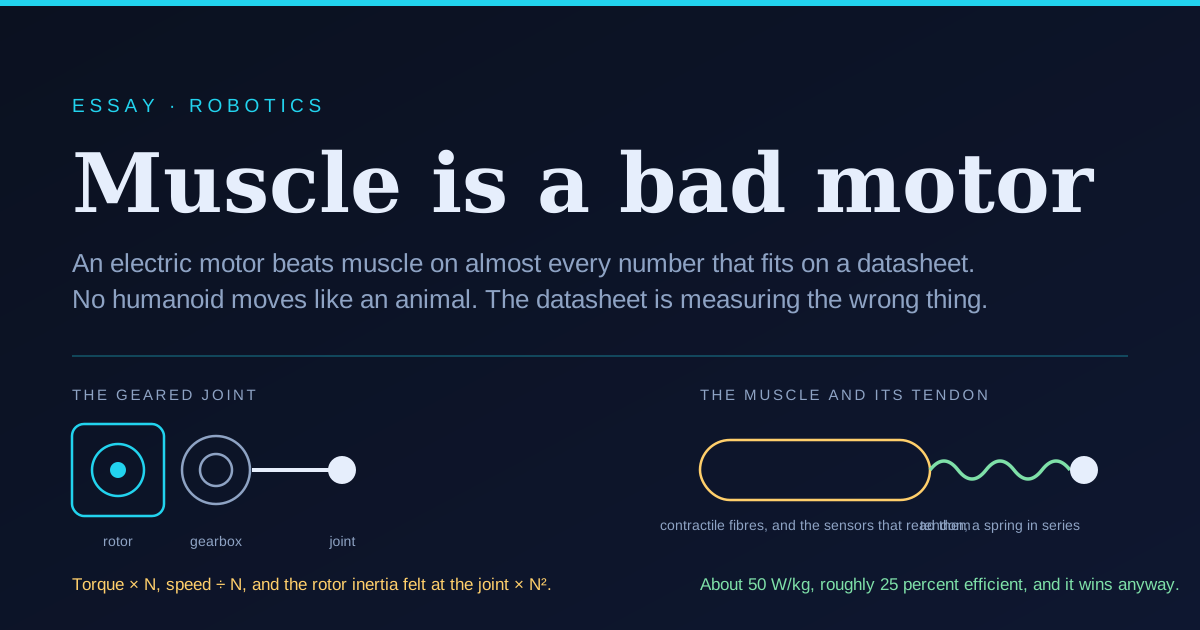
An electric motor beats skeletal muscle on power density, efficiency and speed, and still no humanoid moves like an animal. The gap is not intelligence. It is a gear ratio, a thermal ceiling, and four devices that biology packs into a single tissue.
A humanoid is asked to carry a crate up a flight of stairs. Perception is fine: it segments the steps, tracks the handrail, estimates the load. Balance is fine, and the policy choosing where to put each foot was trained on more hours of contact than any person has walked. Halfway up, the knee joints begin to derate. Winding temperature has climbed past the controller limit, the current ceiling drops, available torque drops with it, and the robot sets the crate down.
Nothing in the interesting part of the system failed. What failed was a coil of copper that could not hold a torque at a low speed for two minutes.
That is the shape of the actuator problem, and the counterintuitive part is worth stating immediately. On almost every number that fits on a datasheet, the electric motor is the better actuator. It is more power dense, far more efficient, faster, more precise, and it does not fatigue. Mammalian skeletal muscle produces something like 50 watts per kilogram in sustained use, with peak values in the fastest fibres reaching a few hundred, and it converts metabolic energy into mechanical work at roughly 25 percent efficiency. A decent brushless motor beats both figures without effort. And yet nothing built moves like an animal. The specifications are not lying. They are describing the wrong axes.
Where the power actually lives
A motor’s power density is a claim about one operating point, and that point is high speed at low torque. A rotor turning at fifteen thousand revolutions per minute produces a great many watts from very little mass and almost no torque. Limbs want the opposite.
The requirements are not mysterious, since human biomechanics has measured them for decades. Ankle plantarflexion at push-off during walking runs at roughly 1.2 to 1.9 newton metres per kilogram of body mass, which for a 75 kilogram adult is 90 to 143 Nm, delivered while the joint rotates at 8 to 12 radians per second, at a positive mechanical power of 190 to 260 watts. Lifting a load from floor to waist asks the knee for around 3 Nm per kilogram, so 225 Nm and upward, at under 2 rad/s. Those are the numbers a leg has to render, and they sit at high torque and moderate to low speed, which is exactly where a motor is worst.
So you gear it down. A reduction of ratio N multiplies torque by N and divides speed by N, and the transaction looks free. It is not, and the price is written into one term: the rotor’s inertia, as felt from the joint side of the gearbox, is multiplied by N squared.
That exponent is the whole story of humanoid actuation. At a ratio of 100, a rotor of no consequence at all presents itself to the limb as ten thousand times its own inertia. Push the limb and you are not pushing a limb, you are pushing a rotor backwards through a gear train, against its friction. The joint has stopped being transparent.
Everything a body does well degrades from there. A leg landing on a step takes an impulse in a few milliseconds. A transparent joint absorbs it by moving; a stiff geared joint has to absorb it by deforming something, usually a gear tooth. Force control degrades, because the joint can no longer feel the world through its own transmission. And the range of mechanical impedances a controller can render stably, what the literature calls the Z-width, narrows as reflected inertia and friction climb.
Two escapes exist, and both are compromises. The series elastic actuator inserts a deliberate spring between a high ratio transmission, typically 50:1 to 200:1, and the output link. Spring deflection becomes an accurate force measurement, the spring absorbs impact, and the bill arrives as closed loop bandwidth, because the controller now acts through a compliance. Quasi direct drive goes the other way, pairing a large diameter, low pole count motor with a ratio of only about 6:1 to 9:1. Transparency and torque bandwidth survive, and the bill arrives as motor mass and as heat.
The ceiling nobody puts in the headline
Which brings us to the second number a datasheet quietly hides. Peak torque is a burst figure, on the order of a few hundred milliseconds. Continuous torque is what the joint holds while its winding temperature stays flat, and it is often a small fraction of the peak.
The reason is unkind. Resistive loss in a motor scales with the square of the current, and current is roughly proportional to torque. Holding a static load is therefore the worst case available: full heating, and zero mechanical power leaving the joint, because the joint is not moving. A robot standing still with a box in its arms produces no useful work while dissipating close to its thermal maximum. Stair climbing is that same regime stretched over time, plateaus of two to four seconds at under two radians per second, which is why it is the task humanoids fail on first.
Muscle’s version of the constraint differs in kind rather than degree. Muscle is perfused: the coolant runs inside the actuator, distributed to every fibre, and the same circulation delivers the fuel. Muscle also fails gradually. It fatigues along a curve instead of tripping a limit, which leaves the nervous system time to recruit differently, shift posture, or put the box down on its own terms.
What muscle is instead
The mistake is reading muscle as a motor that happens to be organic. It is better read as four devices sharing one tissue.
It is a variable impedance element. Contracting an agonist and its antagonist together raises joint stiffness continuously, with no change of mechanism and no reconfiguration of anything. A robot renders stiffness by computing it, so it can only render what its bandwidth and its Z-width allow.
It is self-sensing. Muscle spindles report fibre length and rate of change, Golgi tendon organs report force, and both sit inside the tissue generating that force. No encoder, no separate torque cell, no calibration problem between the two.
It is spring coupled. The tendon in series is not packaging, it is a load bearing part of the control strategy. During running, the elastic contribution to the positive work of the muscle-tendon unit rises with speed, from roughly 0.09 to 0.16 joules per kilogram per metre, and the Achilles releases its stored strain energy about 70 to 77 milliseconds after touchdown. The consequence for the fibres is that they work over smaller length ranges, at slower shortening velocities and at lower activation, which is to say the spring moves the muscle’s operating point to where muscle happens to be good.
And its force-velocity curve, which looks like a defect, is a control feature. Muscle loses force as it shortens quickly, so it self-limits against a light load and stiffens against a heavy one before any neural loop has had time to notice.
Where this stands in 2026
The engineering response has split into two tracks, and both produced results worth naming this year.
The first track builds the missing actuator. In Science Robotics, a group from the MIT Media Lab and the Politecnico di Bari described electrofluidic fiber muscles: two millimetre fibres containing antagonistic fluidic actuators driven by electrohydrodynamic pumps in a closed circuit, needing no external reservoir, electrically driven and silent. The reported power density is about 50 watts per kilogram, comparable to skeletal muscle, with 20 percent contraction strain and a 0.3 second response. The demonstrations were deliberately varied: a fast lever moving at 180 mm/s, a bundle lifting 4 kilograms, roughly 200 times its own weight, over a 30 millimetre stroke, and a woven muscle bending a robot arm by 40 degrees while staying compliant enough for a human handshake. Separately, hydraulically amplified low voltage electrostatic actuators have been reported at 50.5 W/kg average power density.
The second track builds the missing sense. Also this year, in Advanced Materials, a liquid crystal elastomer muscle-tendon complex with embedded liquid metal channels was reported to contract while simultaneously measuring its own force and length, arranged antagonistically, with closed loop bidirectional control demonstrated on a robotic finger and a gripper. That is muscle’s self-sensing property being designed in rather than bolted on, which in the long run matters more than the actuation figures.
Running alongside both is an argument about measurement. A preprint posted in November 2025 proposes scoring humanoids on Human-Equivalence Envelopes: a joint passes only if it delivers human torque and human power at the same posture and the same rate, weighted by where humans actually perform positive work. The framing is the useful part. Stated that way, the overlap between what a joint can do and what a task requires can be empty even when every headline specification looks generous.
What does not hold up
The benchmarking preprint is a single author document from a company affiliation, and it is not peer reviewed. It collected no human data and tested no robot. Its worked example is explicitly labelled synthetic, and its illustrative ankle grid uses a torque requirement around a third of the human ankle torque printed in its own table. The framework is worth borrowing. The score it produces is not evidence of anything.
The soft actuator results are laboratory demonstrations at small scale, and 50 W/kg measured on a two millimetre fibre is not a route to a 143 Nm ankle. Scaling fluidic actuation means scaling the pumps, the sealing and the failure modes, and none of those scale linearly with the part that photographs well.
The comparison itself is usually posed badly. Muscle’s 50 W/kg is per kilogram of muscle, and the animal carries its power supply, its cooling and much of its control inside that same budget. A humanoid module quoted at 30 or 36 Nm per kilogram is quoting the module, excluding battery, drive electronics and thermal management, and quoting a peak rather than something it will hold on a staircase. Those figures generally come from manufacturers, not from independent measurement.
Even efficiency, where the motor’s advantage is largest, is a smaller win than it looks. Muscle’s 25 percent is poor, and it was never the quantity under selection. What was selected for is a body that also has to heal, grow, thermoregulate and fail gracefully, running on a fuel supply that is itself part of the actuator.
None of this argues that humanoids are stuck. It argues about which bottleneck is real. Controllers that know precisely what torque a task requires already exist. They are being bolted to joints that cannot render that torque where the task actually lives, and no amount of learning repairs a factor of N squared.
Further reading
- Electrofluidic fiber muscles, Science Robotics, 2026
- A bio-inspired artificial muscle-tendon complex of liquid crystal elastomer, Advanced Materials, 2026
- More than energy cost: multiple benefits of the long Achilles tendon in human walking and running, Biological Reviews, 2023
- Human-Level Actuation for Humanoids, preprint, November 2025