Mapping the human insula: four regions for feeling the body from inside
A study in Nature stimulated the insula directly in 87 people and found four functional regions, from a map of pain and touch at the back to a silent front pole that steers the rest. It turns a vague 'seat of feelings' into a wiring diagram, with clear limits on what it can say about consciousness.
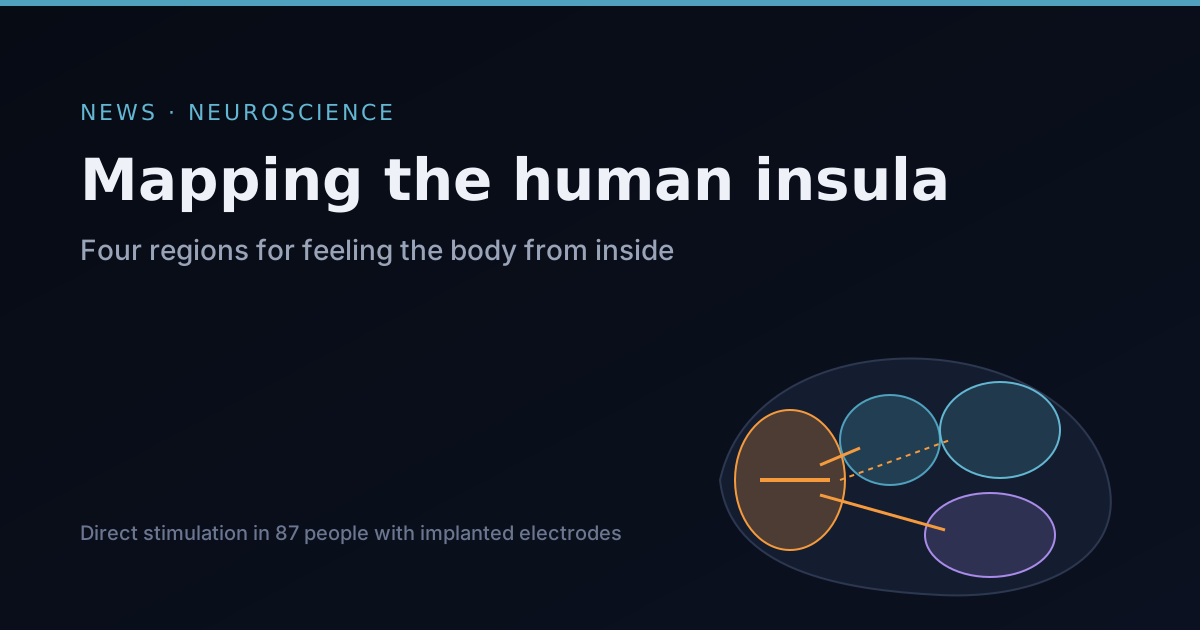
When a neurosurgeon passes a small electrical current through one spot of a patient’s insula, the patient may report a burning patch on the left hand. A few millimetres forward, the same current may produce a wave of nausea, a tight chest, or a sudden feeling that something is wrong. Further forward still, often nothing at all. On 21 October, a team led by Josef Parvizi at Stanford published in Nature the largest attempt so far to turn these scattered reports into a map: Functional architecture of the human insula, built from 87 people with electrodes implanted in this region.
The result is a division of the insula into four regions with different jobs, plus a direction of control between them. It matters because the insula has long been the brain area most often invoked, and least precisely described, whenever science talks about how we feel our own body.
The cortex folded out of sight
The insula is a fold of cortex, the brain’s outer layer, tucked inside the deep groove on each side of the brain, hidden under the frontal and temporal lobes. It is roughly the size of a matchbox, and it receives a steady stream of signals from inside the body: heartbeat, breathing, stomach and gut, temperature, pain, itch.
The sense built from those signals is called interoception, the perception of the body’s internal state, as opposed to the outward senses of sight or hearing. In the early 2000s the neuroanatomist Bud Craig proposed that the insula assembles interoceptive signals in stages, from raw body readings at the back to an integrated “how do I feel now” at the front, and that this front end might be a building block of conscious awareness. The idea was influential and hard to test. Brain scanners such as fMRI show where blood flow rises, which is correlation. They do not show what a region causes when it is active, and the insula’s position deep inside the brain makes it awkward to reach with tools that work from the scalp.
Why stimulation inside the brain is different
The new study uses people who already have electrodes in the insula for a medical reason. Patients with epilepsy that does not respond to drugs sometimes have thin electrodes placed in the brain for days or weeks, so doctors can find where their seizures start. During that time, with consent, researchers can do two things that are impossible in healthy volunteers: record activity directly from the tissue while the person does tasks, and pass a mild current through a single contact to see what the person experiences.
Stimulation is the closest thing neuroscience has to a causal test in humans. If activating a site reliably produces warmth in the right foot, that site is doing something with warmth in the right foot, not just lighting up alongside it. The same group had already shown, in a 2023 study of 17 patients in Brain Stimulation, that about 40 percent of insula sites produce a reportable change in experience when stimulated, and that the kind of change tracks the tissue’s microscopic structure. The new paper scales that up and adds a third layer: connectivity, measured by stimulating one site and recording how quickly and how strongly other sites respond.
Four regions and a direction of control
Combining stimulation reports, task recordings and connectivity with a cytoarchitectonic atlas, a map of brain areas defined by how their cells are arranged under the microscope, the authors describe four regions.
At the back and top, the dorsal-posterior region behaves like a body map for pain, temperature and touch: stimulating a given spot produces sensations in a specific body part, the kind of point-to-point layout called somatotopy. Below it, the ventral-posterior region also carries bodily input, but pooled from several body parts at once. Further forward, the mid-anterior region is tied to visceral sensations, the feelings from internal organs, and to anxiety. So far, this fits the old picture of a gradient from raw sensation to something more like emotion.
The surprise is the front end. The anterior-polar region is largely silent when stimulated: patients report little or nothing. Yet it becomes active during salience detection, the brain’s process of flagging what deserves attention right now, and the connectivity measurements show it exerting strong, direct influence on the other three regions while receiving only weaker, indirect input in return. It is also strongly linked to the prefrontal cortex and the anterior cingulate cortex, areas involved in planning, conflict and the evaluation of pain.
Put together, that suggests a top-down route. The front of the insula does not produce a feeling of its own; it seems to adjust how the rest of the insula weighs what the body is reporting. The authors present it as an electrophysiological pathway by which thinking can modulate pain and bodily perception, which is a concrete anatomical candidate for things clinicians see every day: pain that grows with fear and shrinks with distraction.
What the map does not show
The study’s strengths come with known limits. Every participant had epilepsy, and long-standing seizures can reorganise brain tissue, so the map describes these brains first and healthy brains by inference. Electrodes are placed for clinical reasons, not to sample the insula evenly, so some parts are covered densely and others thinly, even across 87 people.
Stimulation reports are also verbal. A patient who says “a strange feeling in my stomach” gives researchers a description, not a measurement, and the same current can feel different from one moment to the next. A region that is “silent” under stimulation may not be inactive; it may produce changes that people cannot put into words, or that only show up in behaviour.
The paper is also the peer-reviewed version of a preprint first posted in March 2026, and readers comparing the two should treat the published text as authoritative. The four-region scheme comes partly from a statistical clustering of 16 microstructural areas, and a different clustering method or a larger sample could redraw the boundaries.
Most importantly, the map does not settle whether the anterior insula is a seat of awareness, as Craig suggested. Finding that the front of the insula shapes how bodily signals are weighed is compatible with that idea, but also with a more modest role as a router of attention. Interoception, consciousness and emotion are linked in this region; this study shows wiring, not experience.
Why it reaches beyond the clinic
For medicine, the practical value is targeting. Chronic pain, anxiety disorders and some forms of depression involve distorted signals from the body or distorted weighting of them, and a map that separates “where the sensation is” from “where it gets amplified” tells future neuromodulation therapies where to aim.
For anyone thinking about bodies and machines, the result is a reminder of what a nervous system does that most engineered systems do not. A robot reads its battery and motor temperature as numbers. The insula, on this map, does more than read: a dedicated stage decides how much each inner signal should matter, in light of goals and context, before it reaches awareness. Whether an artificial agent would need anything like that to have something resembling feelings is an open question. The new map at least makes the human version specific enough to compare against.
Further reading
- Functional architecture of the human insula, the Nature paper (2026).
- The preprint version, with methods and figures, open access.
- Subjective states induced by intracranial stimulation of the insula, the earlier 17-patient study in Brain Stimulation (2023).
- The Insula: A Stimulating Island of the Brain, an open review of what stimulation of this region produces.