Becoming lucid in a dream: the science of oneironautics
There is a state in which one knows one is dreaming, while dreaming, and can act on the dream without waking. How laboratories proved it, what the lucid brain is doing, and the techniques that reliably raise the odds.
Here is a sentence that ought not to be true: there is a state in which one knows one is dreaming, while dreaming, and can act on the dream without waking up. Not a blurry half-waking, not a memory reconstructed in the morning: a full consciousness lodged inside the film, able to say “this is a dream” and to decide what happens next. This is the lucid dream, and it has the rare distinction of being both an ancient practice (Tibetan Buddhists cultivated it as a “dream yoga”) and a rigorously demonstrated laboratory phenomenon. It is worth seeing how it was proven, what is happening inside the skull, and above all how it is caught.
The problem of proof: how to shout from inside a dream
Begin with the wall that science had to climb, because it is a beautiful one. If someone says “I was lucid last night,” there is no way to verify it: that is a morning report, reconstructed, possibly false. While they slept, the body was still and mute. How does one prove, in real time, that a consciousness is awake inside a sleeping brain?
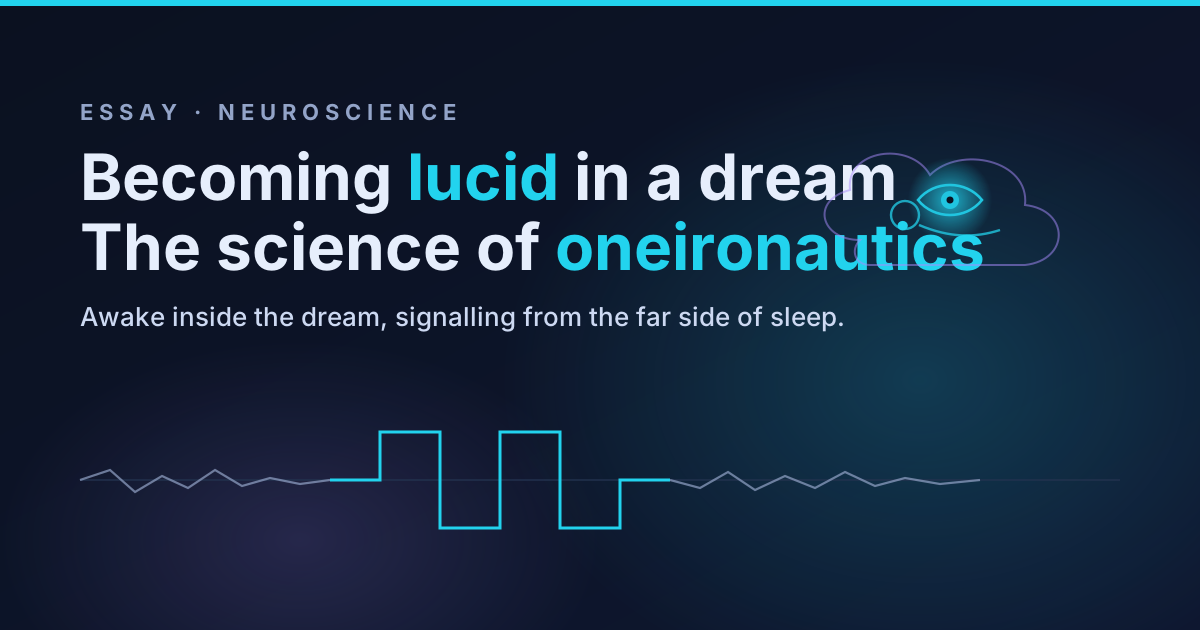
The answer, found by Stephen LaBerge in the early 1980s, has an elegance that commands respect. During REM sleep (the stage where narrative dreams live) the body is paralyzed (this is muscle atonia, a safeguard that prevents one from physically acting out dreams). Everything is cut off, except two things: breathing, and the muscles of the eyes. The eyes still move; it is from this that the name REM, rapid eye movement, derives. LaBerge had the idea of agreeing in advance on a deliberate eye signal (for instance, looking hard left-right-left-right) and asking the lucid sleeper to perform it the moment they realized they were dreaming. Throughout, a sensor recorded the eye movements. The dreamer “signed” from inside the dream, and the trace appeared, clean, in the middle of a deeply sleeping brain. The first letter ever sent from the other side of sleep.
In the middle of the chaotic eye trace typical of REM, four large regular sweeps appear: the lucid dreamer has deliberately looked left-right-left-right. It is a signature impossible to produce by chance, the proof that “someone” is conscious and at the controls, inside the dream.
Forty years later, in 2021, an international team (Konkoly, Paller and colleagues, in Current Biology) pushed the method into a two-way conversation. Of thirty-six sleepers, six succeeded: the experimenters posed questions (by voice, or by light flashes folded into the dream) of the kind “eight minus six?” or “do you speak Spanish?”, and the sleeper answered, with two eye movements for “two,” or with facial contractions, without ever waking. A dialogue, in real time, with a person who was dreaming. Woken afterward, some reported having heard the question “from outside,” others had seen it absorbed into the dream’s scenery. For the first time, the dream stopped being a black box one could only open on waking: one could step inside it while it played.
What the lucid brain is doing: a hybrid state
Why is it so rare and so fragile? Because the lucid dream is a hybrid state, straddling two worlds that are not normally meant to coexist. In ordinary REM sleep, the cortex is nearly as active as in waking (hence the hallucinatory richness of dreams) but one region stays dimmed: the dorsolateral prefrontal cortex, the seat of metacognition, the capacity to watch oneself think. This is precisely why, in an ordinary dream, the absurd seems normal: the part of you that would say “wait, this is incoherent” is asleep. Lucidity is the moment when that frontal lamp switches back on without waking the rest. One keeps the dream’s total immersion, but recovers the critical distance of waking.
The brain signatures bear this out. As early as 2009, Ursula Voss’s team observed a rise in gamma activity (around 40 cycles per second) at the front of the skull at the onset of lucidity, the frequency associated with self-awareness. A 2025 study in the Journal of Neuroscience sharpens the portrait: compared with plain REM, the lucid dream shows a drop in beta activity in the right parietal region and a rise in alpha connectivity. The brain reconfigures into a regime that is neither quite waking nor quite dreaming, but a stable third thing for a few minutes.
The numbers (40 Hz of gamma, beta, alpha) matter less than the picture behind them. The brain broadcasts continuously on several “radio stations” at once, each at its own frequency. An ordinary dream is a party where the “critical-thinking” station has been switched off. Lucidity is someone quietly switching that frontal station back on: loud enough to hear oneself think, soft enough to wake no one. That is the whole of it: lucidity means relighting the lamp of self-awareness at the front, without turning on the light in the bedroom.
How it is caught: the techniques that work
Lucid dreaming is not a rare gift. It is a trainable skill, and research has gradually sorted the methods by effectiveness. A large Australian study by Aspy (published in 2020) tested three cognitive techniques on ordinary participants. The stack runs, roughly, from the foundation upward.
The non-negotiable base is dream recall. Before any lucidity there must be memory: what use is becoming lucid if no trace of it survives the morning? Writing dreams down on waking, even three words, measurably increases how many dreams one remembers within days. It is also what reveals one’s recurring “dream signs” (a place, a person, an oddity), which become future triggers.
Built on top of that are reality tests, the habit that infiltrates sleep. Several times a day, while awake, one seriously asks “am I dreaming?” and checks: reading a line of text twice (in a dream it changes), looking at one’s hands (often distorted), pinching the nose shut and trying to breathe (in a dream the air still passes). With repetition the gesture becomes automatic, and eventually fires inside a dream, where it fails spectacularly, and the realization clicks.
Then comes timing, exploited by Wake Back To Bed (WBTB): waking after roughly five hours of sleep, staying up briefly, then falling asleep again. REM is not spread evenly through the night; it lengthens toward morning. Falling asleep again in the early hours drops one straight into long stretches of REM, the terrain of the lucid dream, with a frontal brain slightly more “relit” by the micro-awakening.
The keystone is MILD (Mnemonic Induction of Lucid Dreams), LaBerge’s central technique. During the nocturnal waking, while drifting back to sleep, one repeats “the next time I dream, I will realize that I am dreaming,” while vividly imagining oneself already lucid in a dream. This is prospective memory: programming one’s future sleeping self to recognize the dream. Combined with WBTB, MILD reached 46 percent success in the study; and among those who fell back asleep within five minutes of practicing it, 54 percent, the highest rate documented in a peer-reviewed study.
The reason timing matters is that REM stretches across the night. The early cycles carry only short bursts of REM; the morning cycles carry long ones. That is why WBTB aims at the five-hour mark: falling asleep again there lands one in the richest dreaming territory, the ground most favorable to lucidity.
A last word, in the spirit of honest science: none of this is guaranteed, and lucidity remains statistically fragile: a few tens of percent, not a hundred. But it is a domain where effort pays off measurably, where each tool stacks its probability on the last. It is the kind of capacity that rewards patient, low-risk experimentation rather than belief.
There is a quieter implication worth sitting with. Most of a life is spent assuming that the sleeping hours are simply lost, a blackout between two stretches of being someone. Lucid dreaming suggests something stranger: that consciousness is not a single switch but a layered thing, and that the layer which watches and judges can, with training, be coaxed back online inside the very state we thought it had abandoned. The dream, long treated as the place where the self dissolves, turns out to be a place where it can also wake up.
Further reading
- Konkoly et al., “Real-time dialogue between experimenters and dreamers during REM sleep,” Current Biology (2021): the original protocol and raw figures of the two-way dream dialogue.
- “The neuroscience of lucid dreaming: past, present, future,” Neuron: the reference review of the brain basis of lucidity.
- Stephen LaBerge’s foundational work on eye-signal verification of lucid dreaming and the MILD technique.