Living Robots and the Code That Is Not in the DNA
Frog skin cells, taken out of the embryo, build a swimming creature that does not exist in nature. What that says about genomes, bodies, and where the instructions for a shape are actually stored.
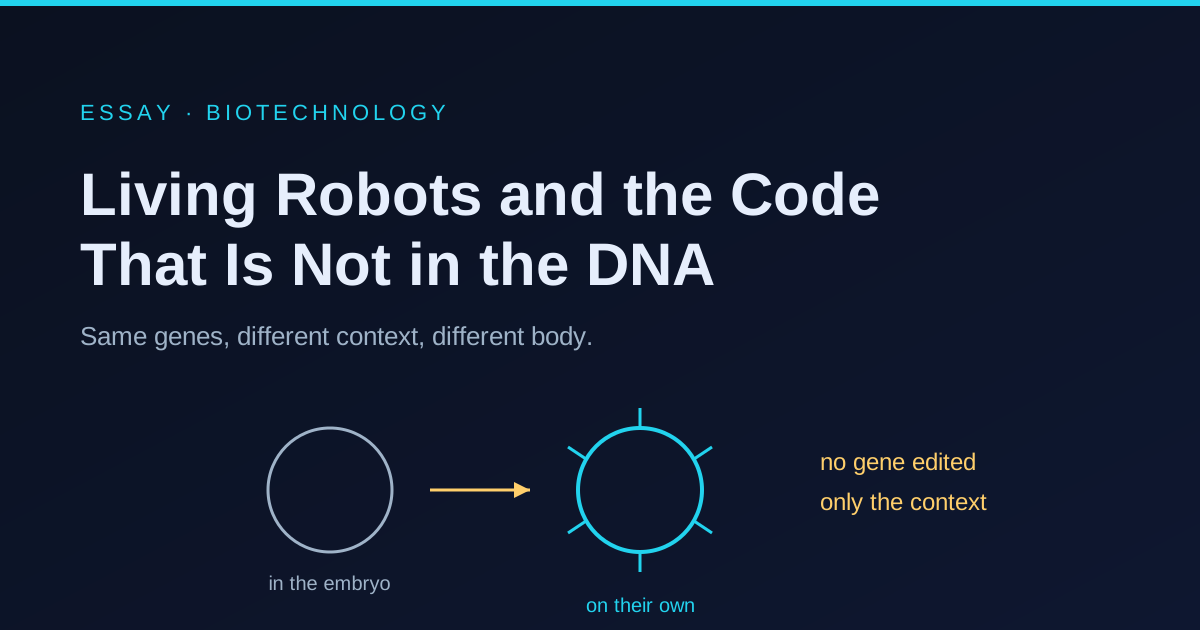
Take skin cells from a frog embryo. Not exotic stem cells: skin, the ordinary tissue whose only known job is to cover a tadpole and beat its cilia to move mucus along. Detach those cells from the embryo, put them together in a drop of water, with no scaffold, no plan, no instructions.
What they do next was not predicted by anyone. They gather into a small sphere about half a millimetre across, turn their cilia outward, and use them as oars. The sphere swims. It turns, it explores, it moves around obstacles, it heals itself when cut, and it lives for one or two weeks on its own yolk reserves. It is not a tadpole. It is not an organ. It is not a machine either. It is a life form that does not exist in nature, made entirely of an intact frog genome, and yet with no counterpart anywhere in frog biology. It was named a xenobot, after Xenopus laevis, the African clawed frog it comes from.
The genome is a parts bin, not a blueprint
This is the real subject, and everything else follows from it. The metaphor most of us were sold is simple: DNA is the blueprint of the body. A construction plan. A flat-pack furniture manual where each step is written down and the outcome is determined.
Xenobots dismantle that image. The genome of the cells forming a xenobot is exactly the genome of a normal frog. No genetic modification, no gene editing, nothing added. Only the context changed: the cells were taken out of the embryo. Same code, different body. So the genome does not encode “frog”. It encodes a set of cellular competencies, and the final form emerges from what those cells collectively decide to do in the situation they find themselves in.
Michael Levin, the Tufts biologist behind much of this work, puts it in a line worth keeping: isolated frog skin does not conclude that it is stuck, it concludes that it will do something else. Every cell is a small agent with local goals, and the body is the result of a negotiation between those agents rather than the execution of a central program.
Designed by an evolutionary algorithm
The second layer is what earned these creatures the word “robot”. The first xenobots, reported in 2020, were not shaped at random. Their form was designed by an evolutionary algorithm running on a supercomputer in Josh Bongard’s group at the University of Vermont. The principle is brutally simple: simulate billions of possible arrangements of two cell types (passive skin and contractile cardiac muscle), keep the ones that travel furthest in simulation, mutate them, repeat. The winner is then sculpted by hand, cell by cell, under a microscope.
A simulated evolution does the designing, and human hands do the building, in living matter. That loop is what makes the word “robot” defensible here: there is an external design intent, even though the material is entirely alive.
Then they started to reproduce
In 2021 the team observed something no biology textbook described at the scale of a whole organism. Placed in a dish containing loose stem cells, xenobots began to push those cells into piles, working like bulldozers. After a few days the piles compacted, grew cilia, and started swimming themselves. Offspring. Which went on to build offspring of their own.
This is not reproduction in the usual sense: no division, no gametes. It is kinematic replication, reproduction by movement. The idea was known in theory from von Neumann and had been observed with molecules, never with whole organisms. The evolutionary algorithm also found the shape that maximises the effect: a Pac-Man, an open half ring, a far better collector than a sphere. The simulation invented a morphology that natural evolution never had a reason to produce.
There is a general lesson buried in that result. Reproduction need not be a mechanism internal to a creature. It can be a consequence of its shape and its motion in a given environment. An object can have offspring simply because its geometry means that, while moving, it piles up the material that builds its double. Function is not always in the genes. Sometimes it lives in the encounter between a form and a world.
A shape memory that lives outside the genome
That leaves the awkward question: if the genome does not specify which shape to build, what does? The answer coming out of Levin’s lab is the most counterintuitive part of the story, and it has a name: bioelectricity.
All cells, not only neurons, maintain a voltage difference across their membranes. They are also connected to each other by junctions that let ions pass. As a result, an entire tissue carries a pattern of voltages, an electrical map distributed across a group of cells. In planarians, the flatworms that are champions of regeneration, that pattern literally encodes where the head goes and where the tail goes.
The demonstration is striking. By briefly perturbing the pattern with a drug acting on ion channels, without touching a single DNA base, researchers made worms regenerate with two heads. That alone is remarkable. The vertigo comes next: cut one of those two-headed worms again, in perfectly ordinary water, with no further treatment, and it regenerates two heads again. And again. The new shape has become the default, indefinitely, with a strictly unchanged genome.
The right word here is target morphology. The cell collective does not build opportunistically as it goes. It aims at a shape and corrects its errors until it gets there. That is a feedback loop applied to anatomy. The body is not an output. It is a goal, maintained by a system that catches itself when you push it off course.
From frog cells to human cells
Two more recent developments bring this uncomfortably close to home.
Anthrobots, first reported in 2023 and expanded through 2024 and 2025, use the same recipe with adult human cells: tracheal epithelial cells taken from donors, which self assemble into small ciliated swimmers. No embryo, no genetic modification. And when a swarm of anthrobots is placed on a layer of human neurons scored with a scratch, they migrate toward the wound, settle in, and the neurons start growing across the gap using the cluster as a physical and chemical bridge. A robot built out of a patient’s own cells, repairing that patient’s tissue, and degrading on its own after a few weeks.
Where this stands in 2026
Three threads are worth tracking.
Neurobots. In early 2026 a team from Tufts University and the Wyss Institute at Harvard published in Advanced Science the first systematic study of biobots containing neurons. Embryonic frog neurons were introduced into a construct that had none. Nobody wired anything. The neurons grew, connected, formed a functional network, extended projections toward the surface of the organism, and the swimming behaviour changed compared to non neural biobots. Gene expression across the construct shifted as well. The creatures are entirely biological, self assembling, self powered, and live for roughly ten days. A primitive nervous system that no one designed, appearing because neurons dropped into an improvised body did what neurons do: look for something to connect to.
That result inverts a common intuition. The usual framing puts a mind first and a body second, with the problem being how to move one into the other. Here a body comes first, and the first bricks of a nervous system show up on their own. Having a nervous system may be less a species privilege than a solution that living matter rediscovers whenever it has to coordinate a body.
Regenerative anthrobots. The neuron repair results remain dish level work. There is no human data, and the gap between a scratch assay and a therapy is enormous. Still, this is one of the more credible routes to regenerative medicine built from a patient’s own material, with no immunosuppression, no foreign hardware, and no genetic editing.
Bioelectric shape memory as a modelling problem. The historic two headed planarian result has been extended by modelling work published in 2025 by Levin’s group, which simulates the evolution of these bioelectric patterns and validates the simulations against planarian regeneration. It is a rare and clean case of biological memory that is neither genetic nor neural: a system storing a goal somewhere other than its source code, and stubbornly returning to it.
What to take away
Five ideas survive the details. The genome is a parts bin rather than a blueprint, since identical genes in a different context produce a different body. Every cell behaves as a small agent with local goals, so an organism is a collective rather than a centrally executed program. Bioelectric patterns store a target shape outside the DNA, and rewriting that pattern once can persist across generations of regeneration. A function can emerge from a form, as kinematic replication shows. And a body appears to invite a mind: neurons released into a biobot organise themselves into a network and change its behaviour with no imposed wiring.
None of this makes the genome unimportant. It makes it a different kind of thing than the blueprint story suggests. The instructions for building you are distributed across the code, the physics, the electrical state of your tissues, and the situation your cells happen to be in. That is a messier picture, and a far more interesting one.
Further reading
- Tufts Now, “Scientists Create Novel Organism With Primitive Nervous System”: the neurobot announcement from the lab itself, with images and video.
- IEEE Spectrum, “Living Neurobot Blurs Line Between Cells and Machines”: the same story from an engineering angle, including the technical limits.
- Michael Levin, “Meet the Anthrobots”: Levin describing anthrobots on his own blog, and the best entry point to his cell as agent philosophy.
- Wyss Institute, “Team builds first living robots that can reproduce”: kinematic replication on video. Watching Pac-Man shapes pile up cells beats any written explanation.
- Phys.org, “Frog-cell neurobots grow self-organized nervous systems and alter gene activity”: a compact summary of the 2026 paper and its gene expression findings.