Into the Zone: The Neuroscience of Flow
Flow, the state athletes call the zone, turns out to rest on a single counter-intuitive mechanism: the brain's supervisor going quiet. A tour of the challenge–skill channel, transient hypofrontality, and what 2026 measurement adds.
You know the state even if you have never named it. The moment when the action does itself: the target, the trigger, the breath, and nothing separates you from the movement. You stop watching yourself perform, you stop tracking the time, you stop hearing your own thoughts entirely, and when you surface you discover that an hour passed like ten minutes. The psychologist Mihály Csíkszentmihályi spent a career chasing this state in climbers, surgeons, chess players and contentedly absorbed factory workers, and gave it a name: flow. Athletes call it the zone. It is the same thing.
Its signs are remarkably constant across domains. Action and awareness merge: you no longer distinguish “you” from “what you are doing”. The commenting self goes silent: no little voice grading the work. Time distorts, stretching or evaporating. Everything feels effortless and under control. And the activity becomes its own reward, what Csíkszentmihályi called autotelic, from the Greek auto (self) and telos (goal): the point is inside the act. Hold on to those five markers, because they are not five separate mysteries. They are, as we will see, a single cause seen from five angles.
The doorway: the flow channel
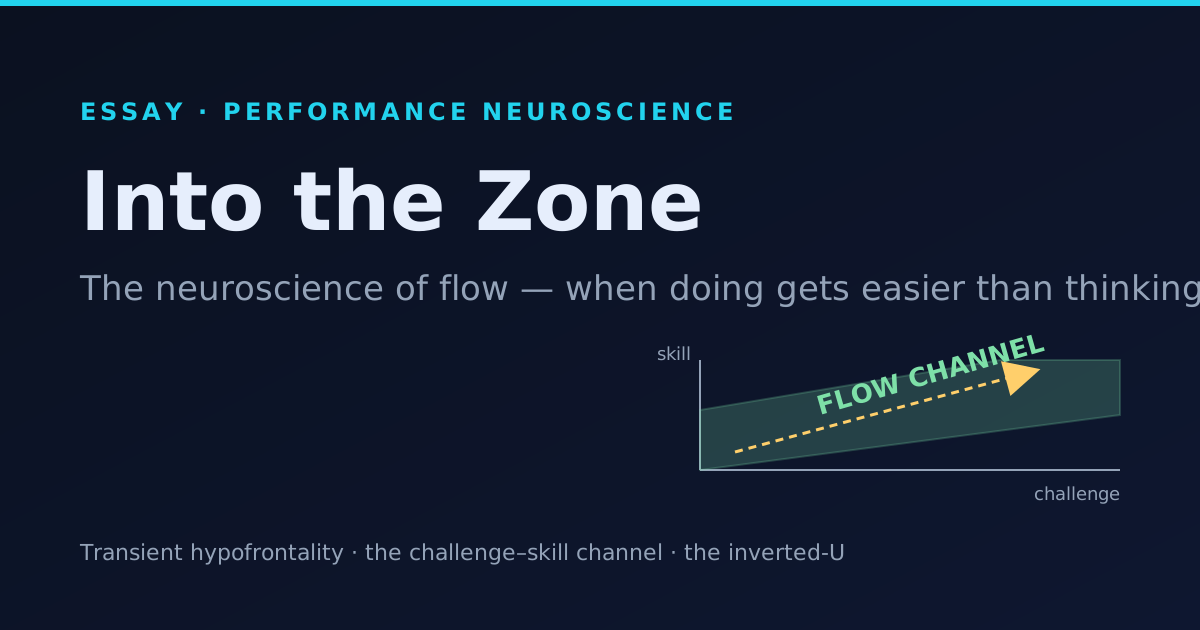
Before the brain, the condition. Flow does not arrive at random; it has a doorway, and the doorway has a very simple shape. It hinges on the balance between how hard the task is and how skilled you are. Too hard for you, and you get anxiety: you tense up, you force it. Too easy, and you get boredom: you check out. Between the two runs a narrow diagonal band where the challenge pulls you just high enough without swamping you: the flow channel.
The channel is a diagonal, not a point. There is a useful cruelty to that: as you get better, the same task slides toward boredom: yesterday’s flow becomes today’s routine. Staying in the zone therefore means raising the bar continuously. To the challenge–skill balance Csíkszentmihályi added two ingredients that close the door: clear goals (you know, at every instant, what “good” means) and immediate feedback (you can tell right away whether you are on it or off). Precision sports check all three at once (difficulty tunes to the millimetre, the goal is unambiguous, and the feedback is the impact itself), which is why they behave almost like machines for producing flow.
What happens in the head: transient hypofrontality
Here is the idea that turns everything around, and it is counter-intuitive. We picture peak performance as a brain running at full throttle, every light on. It is the opposite. The neuroscientist Arne Dietrich proposed in 2004 a hypothesis that remains central: during flow, part of the brain goes quiet: specifically the prefrontal cortex, the seat of explicit thought, deliberate control, and the running commentary about the self. He called it transient hypofrontality (literally, “less front”, temporarily).
Switching the prefrontal cortex down is not becoming stupid; it is cutting interference. The module that watches you, counts the seconds and mutters “careful, don’t miss” is precisely the one that makes you miss. Dimmed, it frees the bandwidth for the fast, implicit system, the one built through thousands of repetitions and stored, quite literally, in the myelin of well-drilled circuits. And now watch the markers fall into place. The prefrontal cortex hosts the narrative self: dim it, and the sense of self dissolves (marker two). It hosts your internal clock: dim it, and time derails (marker three). It hosts explicit control and doubt: dim them, and the action seems to flow without effort (markers one and four). One switch, and the five signs of flow drop together. That is the elegance of the hypothesis: it turns a list of near-mystical sensations into a mechanical consequence.
The inverted-U, and why we choke
There is a classic curve behind all of this (the Yerkes–Dodson law, from 1908), but the thing to keep is not an equation. It is an inverted U. Picture a bell: on the left you are slack, under-stimulated, drowsy; on the right you are over-tense, rigid, forcing it; and at the top, neither too much nor too little, performance peaks. Flow is living at the top of the bell. The whole art is to raise arousal to just the right level, and then not to overshoot it.
The same peak explains choking, failure under pressure. When the stakes rise, arousal climbs past the top, the prefrontal cortex switches back on in a panic, and starts supervising a movement that was supposed to stay automatic. Golfers know it as the yips; the mechanism is the return of explicit control to a circuit that ran better without it.
The interest-based brain is wired for the zone
There is a reason this topic lands harder for some brains than others. The ADHD brain is often described as an interest-based nervous system: its attention does not tune well to the abstract importance of a task, but ignites in the presence of novelty, well-matched challenge, or urgency, precisely the triggers of flow. That is the root of hyperfocus, the capacity to vanish for hours into a subject. But the distinction matters: flow is a chosen absorption, aligned with a goal, that you can exit; hyperfocus is often a captured fixation, hard to leave, and frequently landing on whatever is not the priority. Same neurochemical fuel (a dopamine-hungry system finally meeting the right challenge), two very different uses. The skill worth building is making the state deliberate: pointing the machine at what matters instead of letting it drag you down the nearest rabbit hole.
Where this stands in 2026
For a long time flow was an “ineffable sensation”. It is becoming a metric. A 2025 study in Scientific Reports showed that flow can be detected and tracked with wearables (light EEG plus physiological signals), with alpha and theta bands dominating, consistent with transient hypofrontality; a parallel study on virtual-reality surgical tasks found that high performers show significantly more theta activity, correlated with flow, opening the door to neurofeedback training. Meanwhile the tidy picture of “the prefrontal cortex switches off” has been refined. Recent neuro-imaging describes flow as a high-dimensional, metastable dynamic (the brain does not go dark in blocks, it cycles through tightly coordinated transient configurations), and other work emphasises enhanced connectivity between the default-mode and executive-control networks during flow rather than a simple frontal shutdown. The lesson is one of intellectual hygiene: “the front goes quiet” is a model, illuminating, but coarse. Reality leans toward reorganisation, not silence.
Further reading
- The Flow Model (MindTools): the challenge–skill channel with a clean diagram and practical levers for “entering the channel”.
- A Review on the Role of the Neuroscience of Flow States in the Modern World (Behavioral Sciences, MDPI): the open-access reference synthesis on what we actually know about the brain basis of flow.
- Flow Theory: Csíkszentmihályi’s nine components (Yu-kai Chou): an illustrated breakdown of the nine markers and the triggering conditions.
- Detecting flow with wearables (Scientific Reports, 2025): the physiological-assessment study behind flow-as-a-metric.
- Hyperfocus: the forgotten frontier of attention (review): where hyperfocus overlaps with, and differs from, flow.