Humanoid robots get a market price: what the Unitree IPO reveals
On 19 August the first pure humanoid robot maker listed on a mainland Chinese exchange, and the price the market set was extraordinary. The audited filing that came with it says something more interesting: over seventy percent of those machines are sold to laboratories, not to employers.
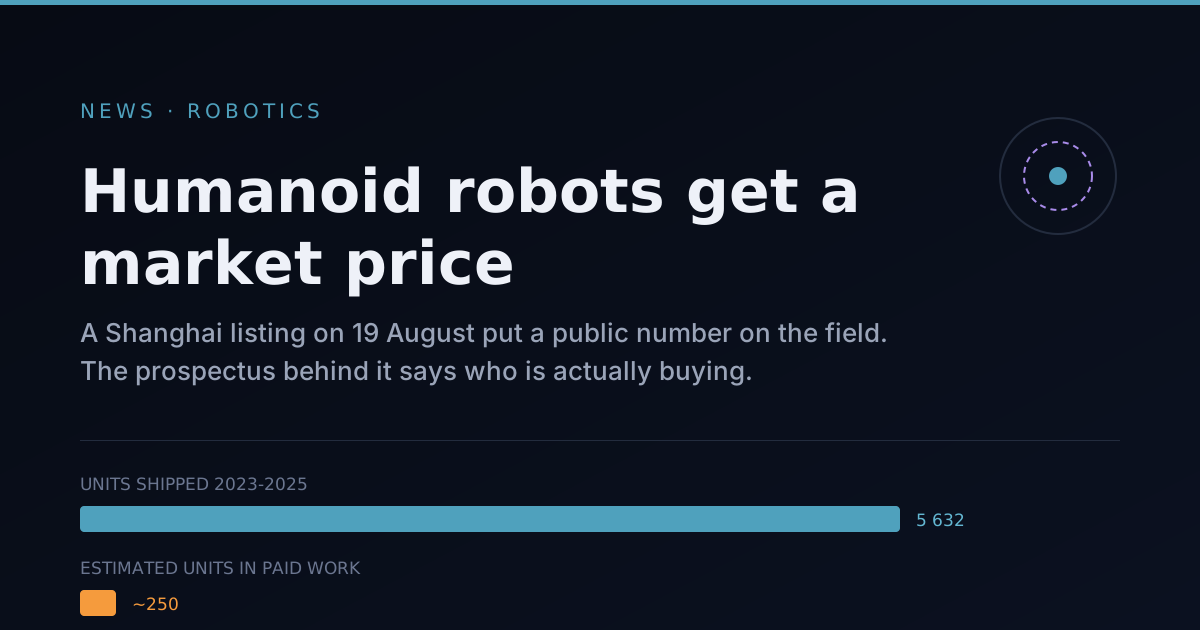
On 19 August, Unitree Robotics began trading on the Shanghai Stock Exchange’s STAR Market. The offering had raised 6.1 billion yuan, about 904 million dollars. The stock opened 629 percent above its offer price, which briefly valued the company at roughly 445 billion yuan, then gave much of that back and closed the day up about 460 percent, at a market capitalisation near 342 billion yuan, or something on the order of 48 billion dollars. Anyone who bought at the opening bell finished the session down by a wide margin.
The number is not the interesting part. Private funding rounds have been putting large numbers on humanoid robotics for three years, and a private round is a negotiation between a handful of people who all want the number to be high. A listing is different in one specific way: it comes with a prospectus. Audited revenue, unit counts, a breakdown of who paid. For the first time, the humanoid robot industry has had to write down what it actually sells.
What the filing says
Unitree’s 2025 revenue was close to 1.7 billion yuan, roughly 252 million dollars, with a net profit of about 278 million yuan. Profitability alone makes it an outlier. Most companies in this field burn capital by design, on the theory that the product is a decade away and the winner takes the market.
The product mix moved fast. Humanoids were 1.9 percent of core revenue in 2023 and 51.5 percent in 2025, with the four-legged robots that made the company’s name, the ones in the viral backflip videos, falling to around 42 percent. Cumulatively, from 2023 through 2025, the filing counts 33,294 quadrupeds and 5,632 humanoids sold. That last figure is enough to make Unitree the largest seller of humanoid robots in the world, which tells you as much about the size of the market as it does about the company.
Then comes the line that reframes everything above it. More than seventy percent of the humanoids sold went to research and education. Universities, national labs, corporate research groups. A further seventeen percent or so went to commercial and consumer uses, which in practice means retail displays, exhibitions and stage performances. Industrial deployment, robots doing paid work in a production process, was under ten percent through the first three quarters of 2025. One third party tally puts the number of Unitree humanoids in active labour applications at roughly 250 as of mid 2026, against 5,500 shipped in 2025 alone.
This is a company that is profitable, and profitable on its own industry’s research budget. The machines are priced and specified as laboratory equipment: a platform you buy so that you can work on the unsolved problem, not a machine that solves it. The revenue is real, and it is not evidence that humanoids work. It is evidence that a lot of people are being paid to find out whether they can.
The same week, in an ice rink
The second World Humanoid Robot Games opened in Beijing on 22 August at the National Speed Skating Oval, the Ice Ribbon built for the 2022 Winter Olympics, and runs to the 26th. The scale is genuinely new: 2,056 robots and 666 teams, up 311 percent and 138 percent on last year, across 1,301 matches. Thirty events are framed as sport, twenty as work scenarios.
Two details in the rulebook are worth more than the medal table.
The first is that 96 percent of the entries are Chinese, from sixteen countries nominally represented. This is not a world championship in any competitive sense. It is a national industrial policy with an audience.
The second is the autonomy line. Flat ground running and football now require full autonomy. Obstacle courses and weightlifting still permit human teleoperation, a human operator driving the machine in real time. That split is the field’s own honest assessment of where the boundary sits, and it lands exactly where the research says it should. Balanced locomotion over known, flat, rigid ground is largely solved, because it is a well posed control problem with a century of theory behind it. Anything that involves making and breaking contact with objects whose shape, weight and friction you did not know in advance is not solved, and the organisers of a showcase event were not willing to pretend otherwise on live television.
So in the space of four days the field produced two documents about itself. One says the market will pay roughly two hundred times revenue on the expectation of autonomous physical labour. The other says that when the task gets slightly hard, a person still has to take the controls.
What the announcement does not settle
The valuation arithmetic is severe. At the closing price, the company trades at something near two hundred times its 2025 revenue and well over a thousand times its earnings. STAR Market first day moves are volatile by construction, with loose price limits on debut, and the collapse from the opening peak is part of the event, not a footnote to it.
There is also a circularity that nobody has a clean answer to. If most revenue comes from research budgets, and those budgets exist because institutions expect humanoids to matter, then the revenue is downstream of the same expectation the share price encodes. That is not fraud and it is not unusual in a young industry, but it means the profit figure is a weaker independent signal than it looks. It would be tested by a downturn in research funding long before it was tested by a robot failing at a task.
Two caveats on the numbers themselves. The revenue mix and unit counts come from the company’s own filing, audited but self reported, and the categories are not perfectly comparable across reporting periods. The estimate of roughly 250 machines in paid work is a third party reconstruction, not a disclosed figure, and should be read as an order of magnitude rather than a count. A stated target of 20,000 humanoid shipments in 2026 is a company forecast and nothing more.
What the week did establish is a reference price and a public disclosure obligation. From here, the claim that humanoids are entering the workforce can be checked against a quarterly filing rather than a demonstration video. That is a real change, and it will probably be uncomfortable for someone.
Further reading
- Unitree Robotics surges 629% to a 66 billion dollar valuation in its Shanghai share debut, South China Morning Post, 19 August 2026
- Unitree IPO draws the spotlight to China’s humanoid robot sector, Shanghai Stock Exchange, on the listing and the sector around it
- The second World Humanoid Robot Games: programme and format, Beijing municipal government, 15 August 2026
- Reading the robot games as a market map, Forbes, 19 August 2026