Humanoid robot safety: what happens when the robot is not bolted down
The framework that makes factory robots certifiable assumes a fixed base, a known reach and a worst case you can compute from the payload. A machine standing on two legs breaks all three assumptions, and the standard written for it is still a working draft while the robots are already shipping.
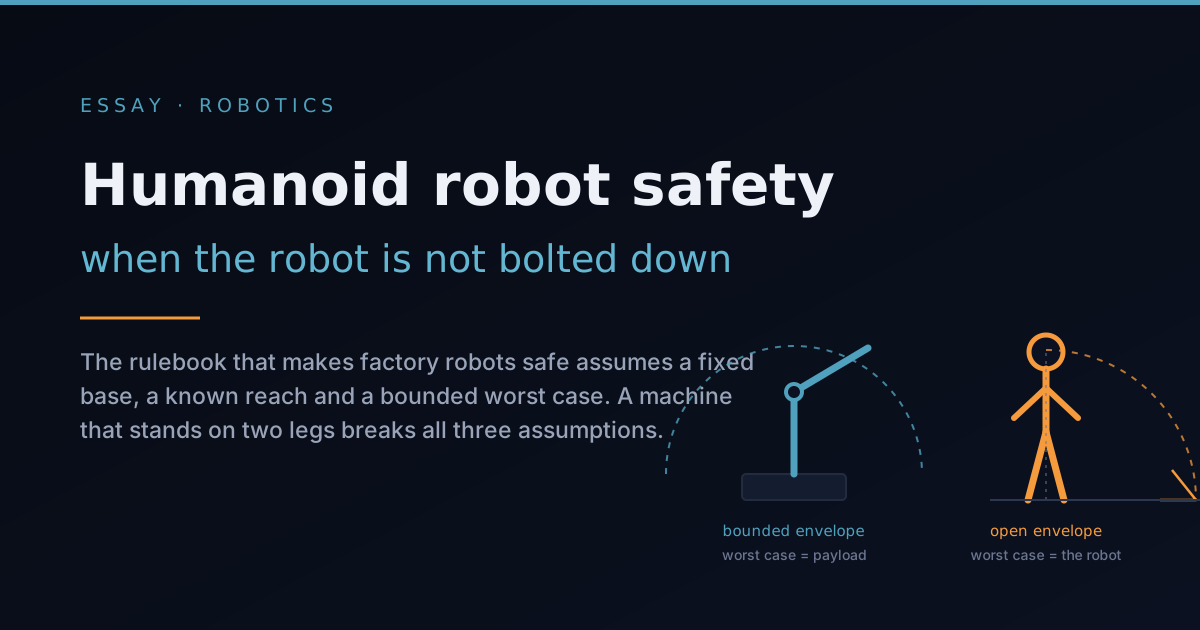
A collaborative robot arm on a factory floor is, on paper, a solved safety problem. It is bolted to a table. Its reach is a known sphere. Its payload is a number in the datasheet. An engineer can work out, for every point inside that sphere, the worst thing the machine is physically capable of doing to a person standing there, then pick motor currents and speed limits so the worst thing lands below a published threshold. The certification that follows is not a promise that nothing will go wrong. It is a narrower and more useful claim: the energy available to go wrong is bounded, and it has been bounded below the level that injures people.
Now take the bolts out. Stand the machine on two legs, give it thirty five kilograms of mass and a centre of gravity around hip height, and let it walk into a kitchen. Every term in that calculation has just become unbounded or unknown. The reach envelope is wherever the robot can walk. The worst case is no longer the payload, it is the entire machine. And the thing holding all of that mass upright is not a bolt. It is a control loop.
This is the gap the humanoid industry is currently shipping into.
The rulebook that already exists
Industrial robot safety has a spine, and it is ISO 10218, the standard that defines what an industrial robot must do to be considered safe. It was rewritten in February 2025, its first serious overhaul in fourteen years, splitting into a part covering the robot itself and a part covering the cell it works in.
Sitting underneath it is the document that does the interesting work: ISO/TS 15066, a technical specification for collaborative operation, meaning any arrangement where a robot and a person share a workspace without a fence between them. Its central mechanism is called power and force limiting. Rather than keeping the human away from the machine, you cap what the machine can deliver on contact, so that a collision is permitted and merely unpleasant.
To cap it you need a number, and the way the number was obtained is worth sitting with. Researchers built a body model of twenty nine specific body areas grouped into twelve regions, then pressed on volunteers, gradually increasing force at each location until they reported the onset of pain. A hundred subjects. The resulting table gives, per body area, a maximum permissible force and a maximum permissible pressure, split between quasi-static contact, where a person is pinned and the load persists, and transient contact, where the robot strikes and rebounds. Safety, in this framework, is defined empirically as staying below the point where a human being says ouch.
Pressure matters as much as force, which is why the table carries both. The same twenty newtons through a padded surface and through a bolt head are different events. This is also the reason the standard specifies contact area, and the reason a well designed gripper has rounded edges.
None of this is hand waving. It is one of the more honest pieces of engineering standardisation in circulation: a measured biomechanical threshold, a design rule that follows from it, and a test procedure that verifies compliance.
It also does not transfer to a walking robot, for two separate reasons.
Reason one: the energy budget
The first is arithmetic. A robot that topples has converted its height into kinetic energy, and the conversion is the one line of physics this article needs:
energy = mass x gravity x height of the fall
Mass times gravity times the height its centre of mass falls through. For a thirty five kilogram humanoid of the Unitree G1 class, roughly 1.3 metres tall, the centre of mass sits somewhere near 0.7 metres, and the sum comes to about 240 joules. Roughly twice the kinetic energy of a professional fastball, arriving over a larger contact area and more slowly, but arriving from a machine that a moment earlier was standing politely still.
Compare that with what the collaborative framework permits. Its transferred energy limits are specified per body region and they live below a joule.
Energy is not the whole story. Spread the same 240 joules over a broad padded surface and across a longer contact time and the injury picture changes considerably, which is exactly why the framework specifies pressure alongside force. But there is no contact geometry clever enough to close two or three orders of magnitude. Either the fall does not happen, or it happens in a shape somebody designed.
Reason two: the standard says it does not apply
The second reason is scope, and it is stated plainly in the documents.
The 2011 version of ISO 10218 excluded mobile platforms outright. The 2025 revision relaxed that: humanoids can now be covered, but the mobility aspects are carved out. The standard assumes a statically stable machine, one that stays where it is when you cut the power. Robots that need active balance control to remain upright are explicitly routed elsewhere, to ISO 25785-1, which as of early 2026 is still a working draft.
That distinction is the conceptual heart of the problem, and it is worth stating in full. A bolted arm is statically stable. Its safe state is stop: kill the power and the machine becomes furniture. Every safety architecture in industrial robotics is built on that fact, because it means the emergency response is always available and always correct.
A biped is dynamically stable. It remains upright only because a controller is continuously correcting, shifting its weight so that the projection of its centre of mass stays inside the small patch of floor bounded by its feet. Cut the power and it does not become furniture. It becomes a falling object. The safe state of a walking robot is not stopping, because stopping is the failure mode.
This is why the existing rulebook cannot simply be widened to cover humanoids. It is not that the numbers are too low. It is that the mechanism the numbers rest on, a guaranteed safe stop, does not exist on a machine that has to keep working to stay upright.
What engineers are actually doing about it
Three lines of work, in increasing order of maturity and decreasing order of ambition.
The first is teaching robots how to fall. Since a biped will eventually go down, the question becomes what it does on the way. SafeFall is a representative example: a lightweight predictor watches the robot’s state and tries to recognise the moment a fall has become unavoidable, at which point a reinforcement learning policy takes over from the normal controller and executes a protective manoeuvre. Tested on a full scale Unitree G1, the authors report peak contact forces down 68.3 per cent, peak joint torques down 78.4 per cent, and 99.3 per cent of collisions with vulnerable components eliminated. A cluster of related papers pursues the same idea through soft and stylised falling and self protective falling policies.
Read the objective function, though. The reward is damage aware in a specific sense: it encodes the robot’s own structural vulnerabilities, shielding its head and hands while absorbing energy through sturdier parts of its body. That is a sensible engineering goal and it is not a human safety goal. A policy that spares the robot’s sensor head by throwing its torso sideways has just made an unmodelled decision about where 240 joules go. Nothing in the objective knows a person is standing there.
The second line is passive: compliant covers and soft skins that increase contact area and lengthen the collision. This works, and it is the most directly transferable idea from the collaborative arm world, where protective skins measurably cut collision forces. It also trades peak force for contact duration, and the framework treats those as different hazards for good reason.
The third is the standards work itself, which has finally started moving. An IEEE study group published a pathway document for future humanoid standards that names the missing pieces directly: quantifiable stability metrics, test methods for actively balancing machines, and benchmarks for fall response behaviour. In the domestic direction, ISO 13482 for personal care robots is moving toward final approval, and UL 3300 already covers consumer and service robots, with a dedicated service robot testing laboratory behind it.
Where this stands in 2026
The honest summary is that the commercial timeline and the standards timeline have come apart.
Humanoids are being sold into warehouses and, increasingly, promoted for homes. The standard that would govern their defining physical characteristic, the fact that they balance, is a working draft. In the meantime the operative guidance is to follow manufacturer specifications and apply the principles of a standard that states it does not cover this case.
There is also a quieter problem with who writes the rules. An IEEE Spectrum analysis of domestic humanoid standards makes an argument worth taking seriously: the people most exposed to these machines, older adults in particular, are not systematically represented in the working groups drafting the requirements. The same piece makes a sharper technical point. Physical human robot interaction is bidirectional. The robot changes what the person does, and the person changes what the robot perceives and does next. Safety is therefore not a fixed property of the machine that can be measured once in a test cell. It is a property of a relationship.
What breaks
Five things, in ascending order of seriousness.
The pain threshold table came from a hundred adult volunteers under controlled, deliberate contact. Children and frail older adults are not that distribution, and in a domestic setting they are precisely the likely bystanders.
The falling numbers come from one robot, in one laboratory, on laboratory surfaces. They are improvements relative to an unprotected fall, not absolute safety margins, and they have not been reproduced across hardware.
Falls are the dramatic hazard, not the frequent one. The frequent one is a hand or an arm moving at speed during ordinary operation, which the collaborative framework does already cover. There is a real risk of certifying against the photogenic failure and under-weighting the boring one.
There is no public incident database. Aviation has mandatory reporting and a shared denominator. Domestic and industrial robotics has vendor press releases. Any claim about how safe these machines are in practice currently rests on data nobody outside the manufacturers can see.
And certification happens in a test cell, while deployment happens in a house that contains stairs, rugs, a dog, and at least one child who will eventually push the robot on purpose to see what it does.
The deepest change is the one that is easiest to miss. For sixty years, robot safety has been fundamentally mechanical. You could point at the bolt, the fence, the torque limit, the physical thing that made the guarantee true. Take the bolt away and the guarantee migrates into software: the robot is safe because a control policy keeps it upright, and because a second policy decides how it goes down when the first one fails. Nobody has yet worked out how to write that claim in a form a certifier can test. That is the actual reason the standard is still a draft, and the robots are already walking.
Further reading
- ISO 10218 industrial robot safety standard receives major overhaul, on what the 2025 revision changed and what it still leaves out.
- Domestic Humanoid Robot Safety Standards Are Shifting, IEEE Spectrum on standards for robots in homes and who is absent from the drafting table.
- SafeFall: Learning Protective Control for Humanoid Robots, the preprint behind the protective falling results quoted above.
- IEEE study group publishes framework for humanoid standards, a map of which standards exist, which are in development, and what is still missing.