How sleep engraves memory
A memory is not saved at the moment you form it. It is replayed, sorted and fixed while you sleep, by three brain rhythms that must interlock at exactly the right instant. How the night does the editing, and why forgetting is a feature.
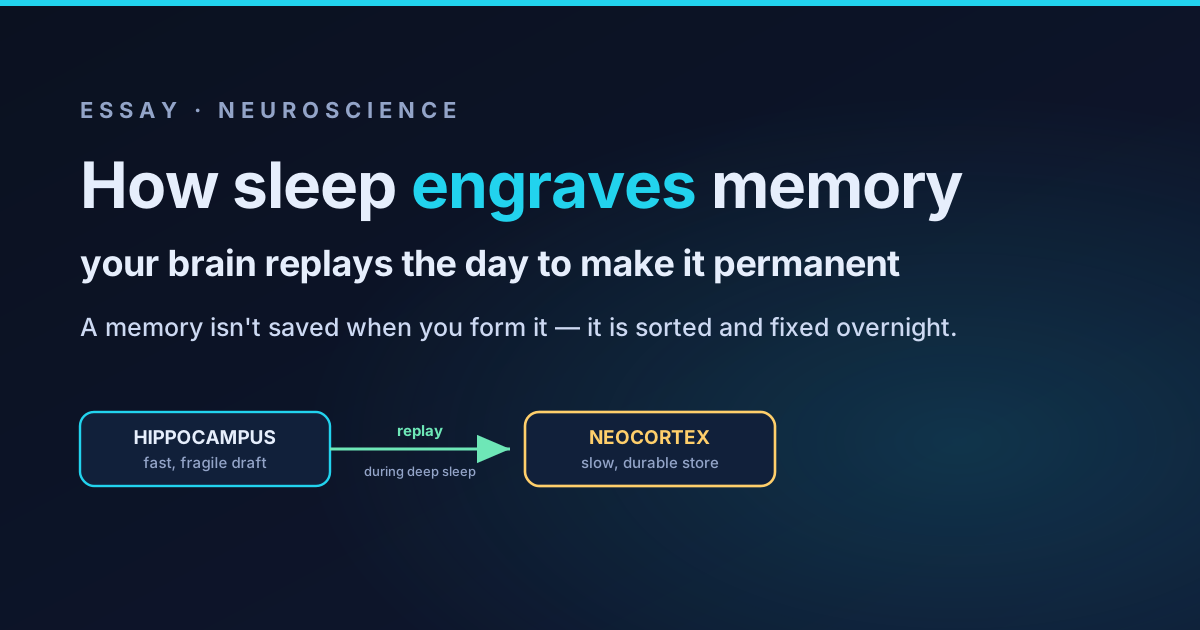
Start with something you have lived without naming it. You struggle in the evening with a piece of code, a movement, an idea you can’t quite phrase. You give up and go to sleep. The next morning, without having touched it, it is clearer: the move flows, the solution is there, the useless detail has dropped away. This is not an illusion. It is the heart of the matter: a memory is not recorded at the moment you form it. It is reworked, sorted and engraved while you sleep. By day you encode fast and dirty. At night your brain does the edit.
Two stores and a nightly dialogue
To see how, you need two players and a conversation. The first is the hippocampus, a pair of small seahorse-shaped structures deep in the brain. It is your fast scratchpad: it captures a new experience in a single shot, instantly, but in a fragile, temporary way: limited capacity, easily overwritten. The second is the neocortex, the great folded sheet on top. It is your slow hard drive: it learns gradually, through repetition, but what it finally inscribes is durable and woven into the rest of your knowledge.
The whole problem of long-term memory is therefore: how do you move a trace from the fragile draft to the durable store? The answer is the single idea worth carrying away: during deep sleep, the hippocampus replays the day to the neocortex, over and over, until the cortex has learned it on its own. This is the two-stage model of consolidation: the night is the transfer.
Replay: the brain rehearses, sped up
The key word is replay. In the 1990s, electrodes placed in the hippocampus of rats running a maze revealed that specific neurons, place cells, fired in sequence as the animal moved: place A, then B, then C, like a string of beads. The surprise came at night. During deep sleep, the same A-B-C sequence spontaneously replayed, but compressed, roughly twenty times faster. The rat was “re-running” the maze in its head, in fast-forward, dozens of times. This replay is not a passive memory playing back; it is the physical act of consolidation. Each replay strengthens the right cortical connections a little more. You repeat to engrave.
And the replay is not haphazard. It is orchestrated by three electrical rhythms of slow-wave sleep (the deep non-REM sleep of early night) that must interlock at the right moment, like three gears:
Keep the image, not the technical detail: the slow oscillation is the conductor beating time; the spindle and the ripple are the musicians who play only on its downbeat. This synchrony (the “slow-oscillation/spindle coupling”) is so central that its quality predicts, from one person to the next, how much they will remember on waking. The better the gears mesh, the more the night engraves.
The night does not keep everything, and that is a feature
Here is the most counter-intuitive point. Your brain does not consolidate everything you experienced: it sorts. What is tagged important (emotionally charged, tied to a reward, or simply flagged “you will be tested on this”) is replayed first. The rest fades. And that fading is not a fault; it is active and necessary.
The synaptic homeostasis hypothesis (Tononi & Cirelli) puts it bluntly: during the day you strengthen thousands of connections in every direction, the signal-to-noise ratio degrades, the brain “saturates.” At night, slow-wave sleep globally turns down the volume of all synapses (a down-scaling) except the strongest, the ones that were replayed. By morning, the important signal stands out clean and the noise has melted away. Forgetting the trivial is the dedicated nightly work that protects what matters. Information is not free to keep; pruning is what keeps the pattern legible.
There is one number worth meeting, and nothing to memorize about it. People say that “cutting 20% of your night can cost you far more than 20% of your dreaming sleep.” The picture, not the formula: your night is not a uniform slab. Deep slow-wave sleep (which engraves facts and skills) is concentrated early; REM dreaming sleep (which links and makes sense of things) lengthens with each cycle toward morning. So shaving off the last two hours is not removing a random slice: it amputates mostly the REM portion, the latest. Not a proportional cost, a targeted one, aimed precisely at what you think you can sacrifice.
And REM does not do the same job as deep sleep. If slow-wave sleep fixes (it engraves the raw trace), REM links: it networks the new trace with everything you already know, extracts the general rule behind the examples, and favours distant associations, hence the creative flashes and insights on waking. Two phases, two trades: engrave, then integrate. This is why a full night beats ten re-readings: no waking re-read triggers the coupled replay of deep sleep or the weaving of REM.
Why spacing beats cramming
The practical consequence falls out directly. Why does spaced repetition (reviewing at intervals rather than in one block) work so well? Because every time you actively reactivate a trace (by asking yourself for it, without re-reading), you re-tag it as “important” for the next night’s sort: you put it back at the top of the replay pile. Reviewing is programming what your sleep will engrave. Three levers follow: learn then sleep (the window right after learning is when replay bites hardest; even a nap with some deep sleep already consolidates); don’t shave the end of the night on learning or training days, or you lose the integrative REM; and space rather than mass, because the night is the unit of engraving, not the hour of cramming.
Where this stands in 2026
This is no longer only a story about rats and electrodes; it has become an engineering target, with a healthy dose of caution.
In January 2026, a team at Cornell publishing in Neuron isolated a sub-type of large hippocampal ripples tied to replay and amplified them in closed loop with optogenetics during sleep. Mice that should not have remembered a displaced object did remember it after the boost; the intervention even restored memory in animals with impaired brains. It is the first causal demonstration that the nightly engraving can be dialled up: a direct lead toward memory augmentation, and a hope on the dementia side. The caveat is large: this is invasive optogenetics in animals, not (yet) in humans.
The honest counterweight arrived the same year. Closed-loop auditory stimulation (soft clicks timed to the slow oscillation) works in the lab, gently boosting slow-wave activity. But a 2026 ecological study (34 participants, one night, at home) found that while the stimulation did increase slow-oscillation amplitude, it produced no measurable benefit to memory. The lesson for every consumer sleep gadget: amplifying the physiological signal is not the same as improving performance. Meanwhile, human intracranial recordings reported in a 2026 preprint show ripples driving the reactivation of individual neurons during consolidation, closing the gap between the animal evidence and the human brain, one cell at a time.
The picture that emerges is consistent across scales: memory is not stored the way a file is written to disk. It is rehearsed, triaged and rebuilt every night, and what the sleeping brain chooses to forget is as much a part of you as what it keeps.
Further reading
- Boosting sleep ripples helps preserve memories normally forgotten, a clear walk-through of the 2026 ripple-boosting study: what ripples are, how they are amplified, and what it implies. (light)
- Systems memory consolidation during sleep: oscillations, neuromodulators, and synaptic remodeling, a review with the figures: how slow oscillations, spindles and ripples interlock, and the role of synaptic pruning. (medium)
- Sleep: a brain-state serving systems memory consolidation, the conceptual case for why a whole brain-state is needed to move the draft into the durable store. (harder)