How humanoid robots learn to balance: the art of controlled falling
A biped is an inverted pendulum, so standing still is active work and walking is controlled falling. Inside the control stack that keeps humanoid robots upright, and the shift from programming balance to learning it in simulation.
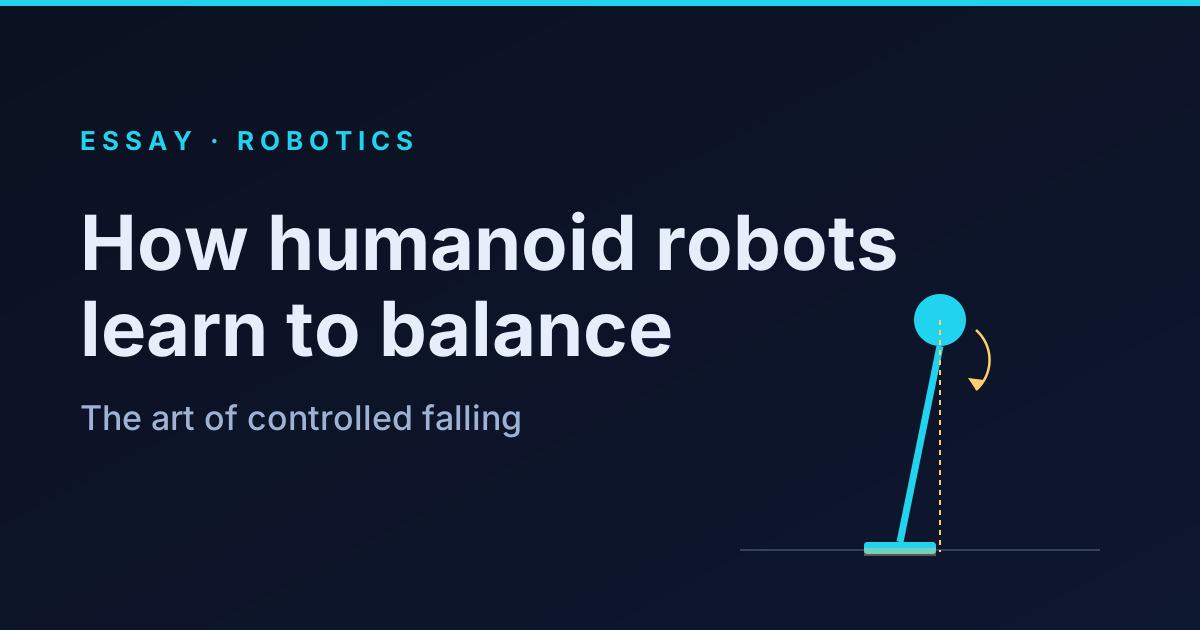
Standing still looks like nothing. It is, in fact, one of the hardest control problems your body quietly solves, and reproducing it in a machine took engineers the better part of two decades. A chair does nothing to stay up; a statue does nothing. You, right now, do a great deal: dozens of muscles around your ankles, knees and hips are correcting tiny imbalances without ever reaching your awareness. Cut that control (fall asleep on your feet) and you drop. A human, like a humanoid robot, is not a stable structure. It is an inverted pendulum kept from falling by catching it, over and over.
Standing still is active work
The difference from a stable object is fundamental. A four-legged table, a tripod, a quadruped at rest: their center of mass falls comfortably inside their support polygon (the area bounded by their contact points on the ground) and it stays there by itself. That is static stability: give them a nudge and they return on their own. A standing biped has a tiny polygon (two soles) and a center of mass perched high, around navel height. The smallest deviation and the projection of the center of mass slips out from under the feet; gravity takes over and tips you. Staying upright means continuously keeping that projection inside a small zone through micro-corrections.
Walking is controlled falling
If standing is already active, walking is more radical still: it is a controlled fall. With each step you let yourself topple forward (your center of mass leaves the top of the support foot) and you swing the other leg out just in time to catch yourself before you crash. Then you do it again, in rhythm. A roboticist’s phrase captures it: walking is “falling forward and catching yourself, indefinitely.” Stability is no longer static (holding in place) but dynamic (holding within motion).
To steer that mastered fall, engineers use a clever point: the zero-moment point (ZMP). Forget the name; keep the idea. When your foot is on the ground, your whole weight and all your accelerations reduce to a single point under the sole. As long as that point stays inside the footprint, the foot does not tip: it stays flat. If the point tries to cross the edge of the sole, the foot starts to pivot on its rim: you fall. The entire walking strategy therefore consists of moving the body so as to keep that point under the contact at every instant.
Here is the image to keep, and the only one you need: the ZMP is “the point under your foot that isn’t tipping over.” Picture carrying a loaded tray on your palm: as long as the weight reduces to the middle of your hand the tray stays level; the moment it slides toward your fingertips everything spills. Your foot on the ground is that palm. Walking without falling means constantly shifting your body so that “the weight on the palm” stays centered, never at the edge.
And when you are shoved by surprise? The controller computes another useful point almost instantly: the capture point, the exact spot where a foot must land to bring you to a dead stop. Too short and you keep toppling; too far and you are off-balance the other way. A human does it without thinking: jostled on a train, you plant a foot precisely where it needs to go. A modern robot does the same: it computes the capture point and throws its recovery step there. That is exactly what separates, in the videos, a robot you push that collapses from a robot you push that takes two dancing steps and settles.
The toy model that makes it tractable
A real humanoid has thirty to sixty joints, arms, a torso, a head, a system of formidable complexity. Computing the balance of all of that in real time would be impossible. The engineers’ trick is to crush the whole robot into a ridiculously simple model to reason with, then descend back to the real body. That toy model is the linear inverted pendulum: replace the entire robot with a single point mass (the center of mass) at the end of a weightless rod resting on the foot. A ball on a stick. On that caricature, the balance equations become simple enough to solve hundreds of times per second. It is the same game as balancing a broom on your palm: you do not model the bristles, only “a mass on top, a pivot at the bottom,” and you move your hand to stay under it.
Two motor brains: a slow planner and a fast reflex
How do you connect the “broom” to the real body? Through a two-tier control stack that has earned a telling nickname: the “brain” and the “cerebellum.” The first tier plans: on the toy model, it predicts the trajectory the center of mass should follow over the next second or two, anticipating the coming footfalls. This is the job of model predictive control (MPC): like a chess player calculating several moves ahead, it simulates the near future, picks the best trajectory, and repeats continuously as the world shifts.
The second tier executes: it takes that plan and distributes it, in real time, across all the joints at once: whole-body control. An ultra-fast loop, often around a thousand times per second: the sensors (the inertial unit that feels tilt, the force sensors under the feet, vision) measure the true state, and the controller instantly recomputes the torque to send to each motor to track the plan. The “brain” thinks slowly about where to go; the “cerebellum” works very fast to not fall.
The real turn: balance is learned, not written
Everything so far describes “classical” robotics: engineers hand-writing the physical models and tuning the controllers. That is what kept robots walking for fifteen years. But since 2023–2024 a shift has happened, and this is the live news. Instead of programming balance, we now let the machine learn it, in simulation, with reinforcement learning, the same family of methods that learned to play Go.
The principle is dizzying. You launch a physics simulator where thousands of virtual robots run in parallel on a single graphics card (the emblematic tool is NVIDIA’s Isaac Gym). Each one tries, falls, gets up, repeats: the machine accumulates years of falling experience in a few hours of compute. It learns a policy (a function that maps what the sensors feel directly to motor commands), not because a human dictated it, but because, over countless trials, falling was “punished” and moving forward “rewarded.”
One trap remains, the reality gap: simulation always lies a little (friction, mechanical play, sensor delays, real masses never exact). A policy that is perfect in sim often collapses in the real world. The countermeasure is domain randomization: during training you deliberately shake the simulation: changing the floor friction, the limb masses, the delays on every trial, adding gusts and shoves. The virtual robot learns to succeed despite that chaos. The result: a policy that has seen “a thousand slightly wrong worlds” copes with the single true world, treating it as one more case. This is sim-to-real transfer, and it is what unlocked, in two years, the humanoids that trot over gravel, absorb a kick, and pick themselves up after a fall.
There is a general lesson worth stating plainly: a robust controller is not the one that memorized one perfect situation, it is the one that met enough variety to stop being surprised. Domain randomization is that lesson in machine form, and it echoes how skilled movement is trained in animals, where varied practice, more frustrating in the moment, engraves a skill that transfers.
One last link, a hardware one: why now? Because the actuators have matured. For a long time only hydraulics delivered enough power (the old Atlas spat pressurized oil). Recent humanoids are electric, with “proprioceptive” motors: finely controllable in torque (force), able to sense the effort they undergo, and backdrivable: you can move them by hand, they yield instead of resisting like a rigid hydraulic arm. This lineage, inherited from MIT’s work on the Cheetah, is what makes a robot body both strong enough and sensitive enough to apply, a thousand times a second, the subtle torques balance demands. The electric Atlas now carries 56 degrees of freedom, lifts 50 kg, and moves through postures no human could hold.
Where this stands in 2026
Boston Dynamics unveiled the “product” version of its electric Atlas at CES in January 2026, with a control architecture explicitly split into System 1 / System 2: a high-frequency “cerebellum” for balance and motor torques, and a “brain” that processes vision and plans tasks. The 2026 units are already fully spoken for (a Hyundai plant, Google DeepMind). In May 2026 the company demonstrated whole-body control to lift heavy loads by bracing with the entire body, not just the hands.
The deployment story has moved past the demo. Figure AI reports crossing more than 10,000 deployments across partner warehouses, a company figure, to be read as such, but the signal is clear: the field is leaving viral clips for repeated use. Unitree sells its G1 (reinforcement-learned locomotion policies) at roughly a tenth of the price of Western rivals and ships more units than all of them combined. A useful counterpoint: Tesla’s Optimus production had still not begun by mid-July 2026 (targeted for late July or August), a reminder that “announced” and “shipped” are different verbs. On the research side, work such as ASAP (aligning simulation physics with the real world to learn agile whole-body skills) and perceptive locomotion over rough terrain shows the same trajectory: train in massively parallel simulation, randomize the domain, transfer with no tuning (“zero-shot”) to the real robot.
Further reading
- Boston Dynamics Unveils New Atlas Robot: the move to electric, told by the source, with videos of dynamic balance and impossible postures.
- Humanoid Robots in 2026: What Is Actually Deployed: a sober survey of what is really in the field this year, beyond the hype.
- ASAP: Aligning Simulation and Real-World Physics for Agile Humanoid Whole-Body Skills: the heart of modern sim-to-real for whole-body control.
- Humanoid-Gym: RL with Zero-Shot Sim-to-Real Transfer: an open-source base for training a walking policy in simulation and transferring it, untuned, to a real humanoid.