How a gesture becomes a reflex: motor learning and the ceiling that isn't there
An expert movement is not a thought performed faster: it is a movement that has left thought entirely. On the power law, myelin, sleep, and why the plateau is mostly an illusion.
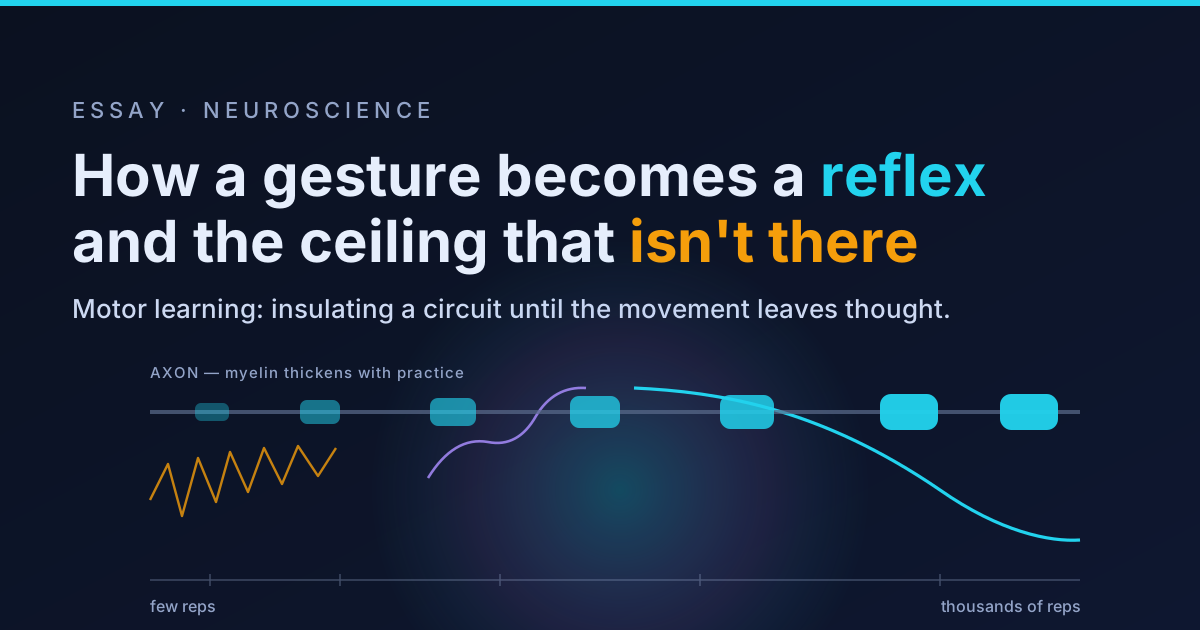
Start with the fact that turns the intuition inside out: an expert movement is not a thought performed faster: it is a movement that has left thought entirely. A beginner’s brain steers every step consciously: the stance, the grip, the alignment, the breathing, the release. It is slow, costly, fragile under stress. The expert is not doing “the same thing, better.” The expert is doing something else: the movement executes on its own, beneath the radar of awareness, while attention is freed for the things that actually decide the outcome: the wind, the rhythm, the chosen instant. Learning a gesture is not learning to perform it better. It is learning to perform it without having to think about it. Everything else follows from there.
Hold the founding image before a single detail: motor skill is attention given back. Each automatism that gets built frees working memory for something else. The beginner is saturated; the expert has room to spare. What follows is, in essence, the story of how the body physically manufactures that room.
The law of practice
The first pillar is one of the sturdiest regularities in all of psychology: the learning curve follows a power law of practice. In plain terms, progress is enormous at the start, and then each further slice of improvement demands more and more repetition. The time it takes to perform a task drops steeply, then flattens.
The mathematical form, for intuition only, is T(n) = a · n^(−b), where T is the time (or error) on the n-th attempt and n is the number of attempts. Forget the exponent and keep one sentence: to win the same increment of progress, the total practice has to double each time. Going from 10 to 20 hours buys as much improvement as going from 100 to 200. What matters is not “+10 hours,” it is “×2.”
This reframes the plateau entirely. The “plateau” is not a wall where progress stops. It is the moment when a brain that expects linear returns can no longer see a progress that, on a logarithmic scale, is still happening. The real curve never touches the floor: it keeps descending, indefinitely, just more and more slowly. The naive expectation imagines a straight line of constant gain; the gap between that imagined line and the true curve is the felt frustration of the plateau. The ceiling is in perception, not in the nervous tissue.
The physical substrate: myelin
Now the part few people know, and the part that changes everything. “Muscle memory” is a misnomer: the muscle remembers nothing. A learned movement is engraved in the white matter of the brain and spinal cord: specifically in myelin, the fatty sheath that wraps the axons, the cables between neurons. The more myelinated a circuit, the faster the signal travels along it and the less it leaks. A bare axon conducts at a few metres per second; a well-myelinated one, up to about a hundred. Skill is a wiring that has been insulated.
This is not a decorative metaphor. A study that has become a landmark showed in mice that blocking the production of myelin prevents the learning of a new movement, without touching gestures already acquired. Myelination is not a side effect of motor learning; it is a necessary condition of it. To learn a movement is, literally, to re-wire the electrical plumbing of the nervous system. And in humans, MRI is beginning to see these white-matter changes after only a few weeks of practising a skill.
The mechanism is worth picturing concretely. By repeatedly sending current through the same circuit, support cells (the oligodendrocytes) come and wrap it in tighter and tighter sheaths. The movement does not become “stronger.” Its cable becomes faster and more reliable. That is the real physical meaning of “it has become a reflex.”
Two engines, one of which runs at night
Here is a subtlety that recent research has sharpened, and it is precious for anyone trying to improve at anything: learning a movement and consolidating it are two different physiological processes. During the session, the brain adjusts on the fly. But it is afterward, and above all during sleep, that the trace stabilises and gets engraved into myelin. One often leaves a session worse than expected and returns the next day better than the day before. That “offline” gain is not magic; it is overnight consolidation.
This connects directly to the architecture of sleep. The motor pattern is replayed and fixed during sleep, in large part via sleep spindles, those rhythmic 12–14 Hz bursts of stage-2 sleep. The more spindles after learning, the better the gesture is retained the next day. REM, for its part, seems to help generalise and to invent variants. The operational consequence is blunt: sleep is not passive recovery, it is the second half of the training. Sacrificing the night to practise more is sawing off the branch the practice grows on.
Breaking the plateau
Now to what most people actually want: how not to plateau. The classic trap has a name, blocked practice: repeating the same gesture, in the same conditions, over and over. It gives a heady sensation; one improves quickly, session after session. But it is a mirage. What rises fast in a block falls fast, and transfers poorly outside the training context.
The opposite is varied practice with high “contextual interference”: mixing distances, positions, conditions, alternating tasks instead of blocking them. In the moment it feels worse (more errors, less fluency), and that discomfort is precisely the sign that it is working. Forcing the brain to reconstruct the gesture on each attempt, rather than pulling it out still warm, is what engraves it deeply. The reference meta-analysis confirms the pattern: high interference means a more painful acquisition but superior retention and transfer. (One honest caveat: the effect is clean in the lab and more debatable, more context-dependent, on the real sporting field.) The cruel and useful fact is that the sensation of progress and the reality of progress point in opposite directions.
Above all this hovers the idea of deliberate practice. The experts who never seem to plateau do not repeat what they already know how to do: they work obstinately at what they cannot yet do, at the edge of their competence, with precise feedback on error. Comfortable repetition myelinates a frozen gesture; chosen difficulty opens a new circuit. That is the mechanical answer to “how not to plateau”: the plateau is the comfort zone closing in; the leap is the difficulty one goes looking for on purpose.
The thing that does not download
There is a philosophical residue here worth naming. We increasingly imagine capturing a person as data, exporting what someone knows. But the myelin of an expert gesture is not declarative information. It is a wiring built by thousands of repetitions and nights of sleep, and no export captures it. A system might one day archive what a person knows; it is far less clear how it would archive what a body knows how to do without knowing that it knows. The competence is the thing that does not download.
And the arithmetic of the power law has a sting that reframes how we read talent itself. If three levels of skill cost roughly 700 hours to climb (say, from 100 to 800 hours of practice), the next three levels run from 800 to 6,400 hours: about eight times more, for a gain that, viewed from outside, looks modest. The gap between someone good and someone great is not “a bit more work.” It is an order of magnitude of practice for an improvement the eye barely registers. Visible talent hides a logarithmic mountain of repetition. The ceiling that looks so solid is not a wall in the tissue; it is the slope of a curve that simply asks for ever more, and keeps paying, for anyone willing to climb the next doubling.
Further reading
- McKenzie et al., Motor skill learning requires active central myelination (Science, 2014), the key experiment: blocking myelination prevents the learning of a new gesture.
- Gray & Lindstedt, Plateaus, Dips, and Leaps (Cognitive Science): why dips in performance often signal that a learner is in the middle of inventing a new method.