Grid inertia: what happens when a power grid loses its spinning mass
For a century, the first second after a power system fault was handled by the kinetic energy of spinning turbines, at no cost and with no decision to make. That mass is being replaced by control software, and the Iberian blackout showed how easily the substitution is misread.
On 28 April 2025, at 12:33 CET, the Iberian power system lost roughly 15 gigawatts of generation in a handful of seconds. Spain and Portugal went dark, along with part of southwest France, and more than 50 million people spent the afternoon without electricity. Within a day, the explanation circulating in public had collapsed into a single word: inertia. Spain runs a great deal of solar, solar has no inertia, therefore the grid fell over.
A year later the official account says something else. The final root cause report, published on 20 March 2026 by ENTSO-E, the association of European transmission system operators, runs to 440 pages, was produced by a 49 member expert panel, and names voltage control, reactive power management and the regulatory framework around them as the root causes. Red Electrica, the Spanish operator, has argued that extra inertia would not have saved the system, only postponed the collapse.
Both statements can hold at once, and that is exactly why the subject is worth taking apart. Inertia is a real quantity, it is genuinely shrinking, and it was not what broke Iberia. The interesting question is not who was right in the argument. It is what kind of thing inertia is, and what it means that engineers are now building it out of software.
A stabiliser nobody had to buy
Start with what a conventional power station physically is. A turbine, driven by steam, gas or falling water, spins a generator at a fixed speed, locked to the frequency of the network. In Europe that frequency is 50 hertz, and every large synchronous machine on the continent turns in step with every other one. The grid is not a collection of independent sources. It is one enormous rotating system, mechanically distributed across thousands of kilometres and held together electrically.
That arrangement has a consequence that was never designed in and never had to be paid for. All those rotors store kinetic energy. When demand suddenly exceeds supply, the extra energy has to come from somewhere in the first instants, before any control system has noticed anything, and it comes out of the rotation. The machines slow down fractionally. Frequency dips. The energy that arrives at the load in that first moment is drawn directly from the momentum of steel.
Engineers quantify this as the inertia constant, written H and measured in seconds: roughly, how long a machine could keep supplying its full rated power from stored rotation alone. Large thermal units sit around two to nine seconds. It sounds tiny, and it is, but it is not supposed to solve the problem. It is supposed to buy time.
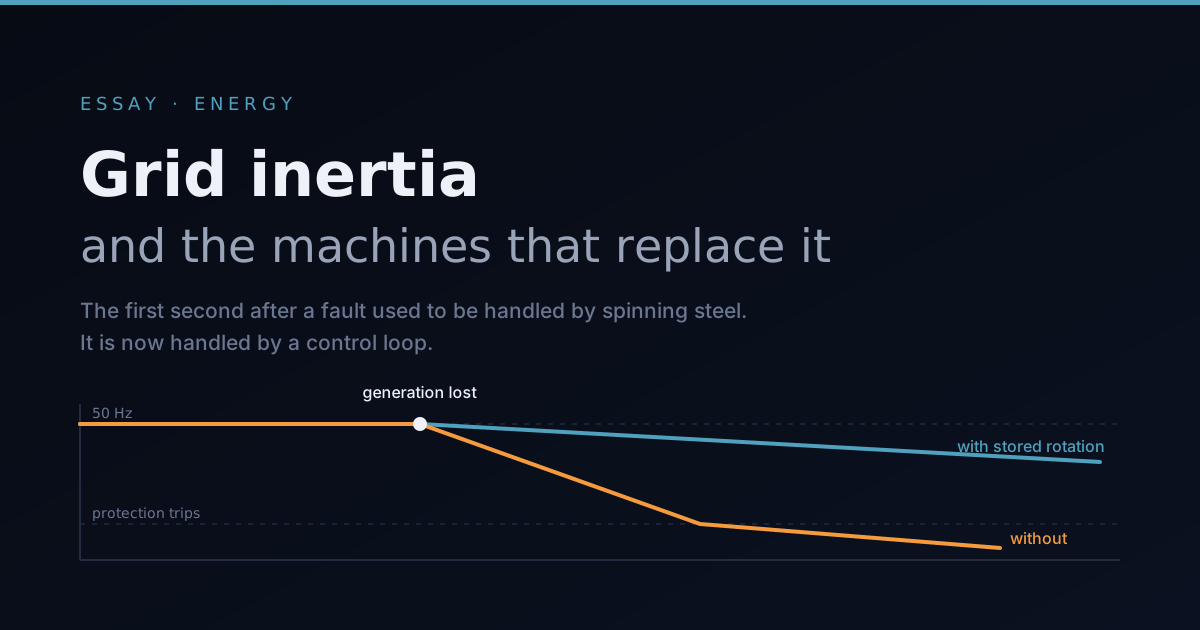
What it buys time against is the rate of change of frequency, the speed at which the grid drifts away from 50 hertz after a disturbance. Protection relays across the network are set to disconnect equipment if frequency moves too far or too fast, because a generator forced badly out of step tears itself apart. A high inertia system responds to a lost gigawatt with a gentle slope, leaving seconds for governors to open valves and for reserves to arrive. A low inertia system responds with a cliff, and the relays start tripping before anything slower can act. That is the cascade mechanism: each trip makes the imbalance worse, which makes the next trip arrive sooner.
None of this was ever a market. Inertia came attached to generation, in proportion to how much fossil and hydro plant happened to be running. Nobody procured it. Nobody metered it.
Why it is vanishing
Solar panels have no moving parts. Batteries have none. Modern wind turbines do spin, but their rotation is deliberately decoupled from grid frequency by a power converter, so that the blades can turn at whatever speed the wind favours. In all three cases the connection to the network is an inverter: an assembly of fast semiconductor switches that synthesises an alternating waveform out of direct current, thousands of times per second.
An inverter has no momentum to contribute, and, in its conventional form, no opinion about frequency either. A grid following inverter measures the voltage waveform already present on the network, locks onto it, and pushes current into it. It is a follower by construction. It needs someone else to be setting the frequency, and it will happily ride a collapsing grid down until its own protection disconnects it.
So a system dominated by inverters has two related problems, and they are not the same problem. It has less stored energy to cushion the first second after a fault. It also has less of what operators call system strength, the tendency of the network to hold its voltage steady when something goes wrong nearby, a service that synchronous machines provide by dumping large fault currents into a short circuit. Inertia gets the attention. Strength and voltage control are where Iberia actually failed.
Three ways to put it back
The first answer is the least imaginative and the most reliable: keep the spinning mass and throw away the fuel. A synchronous condenser is a large electrical machine connected to the grid and spun up, with nothing attached to its shaft. It burns no fuel and generates no net power. It exists purely to add rotating mass, short circuit current and voltage support, and bolting a flywheel to it pushes its inertia constant to seven or eight seconds, occasionally beyond. It works because it is not a simulation of the physics. It is the physics.
The second answer accepts the loss of mass and compensates with speed. Fast frequency response uses batteries that watch the frequency and inject power when it starts to fall. The mechanism is fundamentally different from inertia: a rotor gives up energy because Newton says so, with no sensing and no decision in the loop, while a battery must detect the deviation, run it through a controller and act. That chain takes time, typically a few hundred milliseconds. Useful, but arriving after the steepest part of the fall.
The third answer is the one reshaping the field. A grid-forming inverter inverts the relationship: instead of following an existing waveform, its control loop imposes a voltage of its own, at a frequency it chooses, and lets the current be whatever the network demands. This is what a synchronous generator does, and doing it in software means the response can be faster than mechanical inertia rather than slower. The British system operator’s grid code now asks grid-forming plant to react to a rate of change of frequency of 2 hertz per second within 5 milliseconds, which no turbine could meet. The same machine can also hold an islanded network alive with no synchronous generation present at all, and can black start it.
Where this stands in 2026
The technology has moved out of the pilot stage on two continents. In the United Kingdom, a battery installation at Blackhillock in Scotland went live in March 2025 as the first at that scale contracted to supply synthetic inertia to a national operator, under a procurement programme that pays specifically for stability rather than energy. NESO is targeting 15 gigavolt ampere seconds of inertia procured nationally for the 2027 to 2028 delivery year, which is the concrete form the shift takes: a physical by-product has become a line item with an auction attached.
Australia has gone furthest. The market operator now specifies grid-forming capability for new batteries above 100 megawatts, following a set of projects, Hornsdale, Wallgrove, Broken Hill and Darlington Point among them, that were built to test whether the control strategies actually delivered under fault conditions. Tesla has stated it expects 4.5 gigawatts of grid-forming storage operating in Australia by the end of 2026, a manufacturer figure rather than an audited one, and that it will not sell a non grid-forming battery into that market.
The strongest recent evidence is smaller and more careful. In January 2026, the National Renewable Energy Laboratory published results from a collaboration with the utility cooperative on Kauai, where the island grid was deliberately perturbed with test pulses issued through a battery plant. The finding was that inverter based resources under grid-forming control delivered system strength comparable to the synchronous machines they displaced. An island grid is a small and forgiving laboratory, but it is a real one, measured rather than simulated.
What is still unsolved
The hardest limitation is not a control problem, it is a silicon problem. A synchronous generator faced with a short circuit will deliver five or six times its rated current for several seconds, because a lump of copper and iron has no way to refuse. Semiconductor switches do not survive that. They have to limit their current, and the moment they hit that limit the machine stops behaving as a voltage source and the careful grid-forming behaviour breaks down. The literature on fault current limiting, including several preprints this year on predicting voltage collapse in current limited grid-forming inverters, is essentially about managing the transition into the limit and the recovery out of it. It is an open problem, not a solved one.
The economics have a matching awkwardness. Synthetic inertia costs headroom: a battery reserving capacity to respond to a fault is capacity it is not trading into the energy market. Real inertia was free because it was a side effect. Simulated inertia is a product, and someone has to pay for it. That is not an objection, but it does mean the quantity procured will be the quantity somebody decided to buy, rather than whatever happened to be spinning.
And then there is the Iberian lesson, which is about the risk of solving the wrong problem well. The report describes manual connection and disconnection of voltage control equipment, slowing response at the worst moment, and operators without real time visibility of the reactive power the system needed. Reactive power is the component of the flow that does no useful work but sets voltage; the collapse came from that quantity going unmanaged, not from a shortage of stored rotation. Replacing one service that synchronous machines used to supply for free says nothing about the others they also supplied for free.
The deeper change is easy to miss because it is invisible in the grid’s behaviour when everything is working. A rotor is stable because of what it is. An inverter is stable because a control loop decided how to behave, in a design office, under assumptions that may not include the situation actually arriving. The physical guarantee is being traded for a designed one, and designed guarantees have a different failure mode: they are faster, more flexible, better tuned, and they have edges. The engineering question for the next decade is not whether software can imitate spinning steel. Kauai suggests it can. It is whether the imitation stays trustworthy in the conditions nobody wrote down.
Further reading
- 28 April 2025 Iberian blackout, the ENTSO-E page collecting the investigation and the final root cause report.
- ENTSO-E report finds systemic failures behind 2025 Iberian blackout, a summary of the March 2026 findings and recommendations.
- With inverters, an island adapts to the changing physics of power grids, the NREL account of the Kauai grid-forming experiment.
- Current limiting strategies for grid forming inverters under low voltage ride through, a technical review of the fault current limit and why it is hard.