Grey Walter's robot tortoises: how much brain does a body need?
In 1949 a neurophysiologist built two small robots whose entire brain was a pair of vacuum tubes, and they wandered, avoided obstacles, went home to recharge and danced in front of a mirror. Seventy-seven years later, robotics is again asking how much of intelligent behaviour lives in the controller and how much in the loop between body and world.
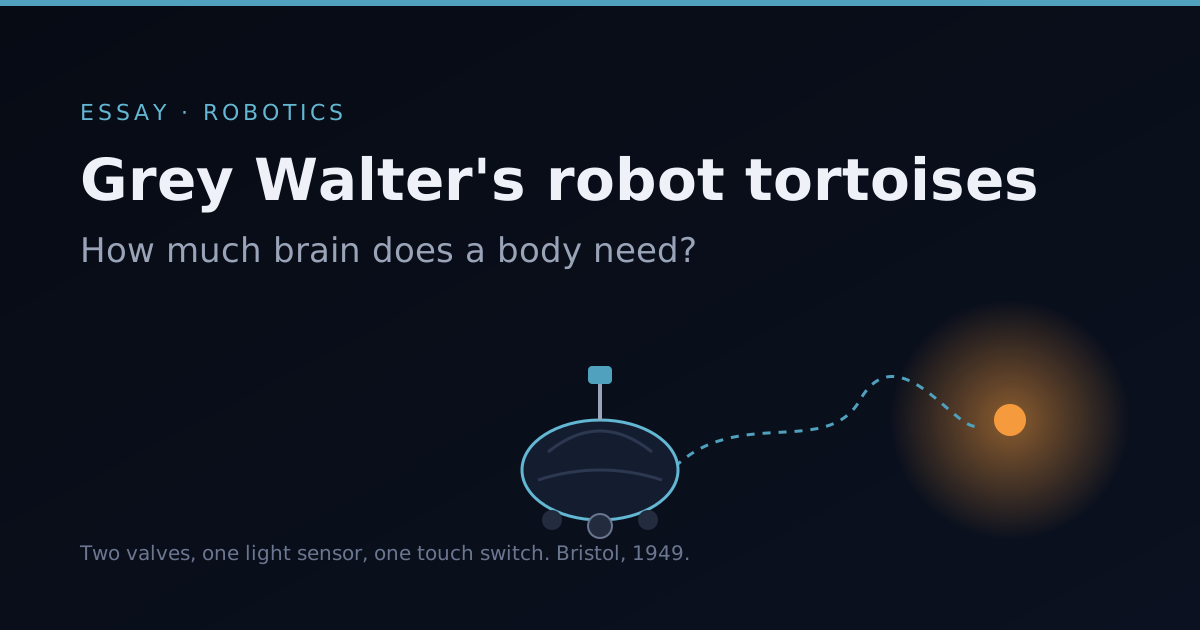
Picture a darkened room in Bristol at the end of 1949. A domed shell about the size of a large dinner plate rolls slowly across the floor, a small tube on its neck turning round and round like a periscope. It drifts toward a lamp, veers away when it gets too close, bumps a chair leg, wobbles, shoves, frees itself, and carries on. Later, as its battery runs down, it stops avoiding the brightest light in the room and heads straight into it, into a little hutch where it plugs itself in to recharge.
Journalists watching it reached for animal words: curious, hesitant, hungry. The machine’s entire brain was two electronic valves, the vacuum tubes that preceded transistors. That gap, between how rich the behaviour looked and how little was producing it, is the reason the robot tortoises of William Grey Walter still matter. It is also, in a new form, one of the open questions of robotics in 2026.
Two cells and a lot of world
Grey Walter was a neurophysiologist at the Burden Neurological Institute, best known for his work on electroencephalography, the recording of the brain’s electrical rhythms. He was not an engineer by trade, and his robots were not built to do a job. They were built to make an argument. Walter wanted to show that rich connections between a very small number of brain cells could give rise to very complex behaviour.
He began in 1948. By December 1949 the first two machines, Elmer and Elsie, were being demonstrated to the press. He gave them a mock Latin species name, Machina speculatrix, the machine that explores, and filed them with the tortoises because of their shell and neck. The names were an acronym: ELectro MEchanical Robots, Light Sensitive, with Internal and External stability.
Each tortoise had three wheels, two motors, a rotating photocell for an eye, a battery, and a shell mounted so that any push against it closed a contact. That was the whole sensory world: a single direction of light, and the fact of being touched.
What made the design clever was not any one part but how the parts were coupled. The photocell was mounted on the same rotating column as the steering wheel. When it saw nothing interesting, the column kept turning and the robot traced looping, scanning paths across the floor. When the photocell caught a moderate light, the turning stopped and the robot drove toward it. When the light grew too bright, the circuit flipped and the robot turned away. Touching an obstacle overrode everything else and threw the machine into a rhythmic push and turn that, more often than not, worked it free.
None of these behaviours was programmed in the modern sense. There was no list of instructions, no stored map, no representation of a lamp or a chair. There were thresholds, and the world did the rest.
The behaviour that was not in the circuit
The most striking behaviour came from a single extra coupling. As the battery voltage dropped, the circuit’s response to light shifted, so that bright light, previously repellent, became attractive. Walter put a strong lamp over a recharging hutch. A well-fed tortoise avoided it. A hungry one drove into it, made contact with the charging terminals, and, once topped up, found the light unpleasant again and wandered off.
Walter did not design a “go home” routine. He designed a dependency between an internal state and a sensory preference, and homing fell out of it. That is the core lesson of the tortoises, and it has been relearned many times since: a behaviour an observer would describe as a goal does not need a goal written anywhere inside the machine.
The second famous behaviour was stranger. Each tortoise carried a small pilot lamp that switched off whenever the photocell registered enough light. Placed in front of a mirror, the robot saw its own lamp, approached, turned the lamp off by the very act of seeing it, lost the stimulus, turned the lamp back on, and saw it again. The result was a flickering, jittering hover in front of its reflection. In his 1950 Scientific American article, “An Imitation of Life”, Walter compared it to Narcissus and suggested that in an animal this pattern might be taken as evidence of some degree of self-awareness.
He meant it partly as provocation. The mirror dance is a perfect demonstration of how easily observers read an inner life into a feedback loop. It is also a fair warning about the evidence: the best-known photograph of Elsie at a mirror may show her responding to a candle placed nearby rather than to her own light.
The line from the tortoise to the floor cleaner
The tortoises were exhibited at the Festival of Britain in 1951, and an original went on display at the Science Museum in London in 2000. For several decades, though, the idea they embodied lost the argument. Artificial intelligence from the 1960s onward was built around a different recipe, sometimes summarised as sense, plan, act: build an internal model of the world, reason about it symbolically, then execute a plan. Robots built that way could be impressive in a tidy laboratory and helpless in a cluttered one, because the world kept changing faster than the model.
The revival came in 1986, when Rodney Brooks at MIT published “A Robust Layered Control System for a Mobile Robot”. Brooks proposed what he called a subsumption architecture: stack simple behaviours in layers, each coupling sensors almost directly to motors, and let higher layers suppress lower ones when they need to. Avoid obstacles at the bottom, wander above it, explore above that. No central world model. If a higher layer fails, the lower ones keep the robot out of trouble. It is the tortoise’s touch override, generalised into an engineering method.
Brooks co-founded iRobot in 1990, and its Roomba became the clearest commercial descendant of the idea: a cheap machine that cleans a room by layering a few robust reflexes, bump, turn, follow the wall, spiral, head for the dock, rather than by understanding the room. Well over ten million have been sold. IEEE Spectrum has called Walter’s tortoise the Roomba’s ancestor, and the family resemblance, a small domed machine that wanders and finds its own charger, is hard to miss.
Where this stands in 2026
Today the mainstream of robot learning sits about as far from the tortoise as it is possible to get. The dominant models for manipulation are vision-language-action models, networks that take camera images and a written instruction and output motor commands. A representative example, the π0 model released by Physical Intelligence in late 2024, pairs a three-billion-parameter vision-language backbone with an action module of roughly three hundred million parameters, trained on more than ten thousand hours of robot demonstrations across seven different robot bodies. That is several billion adjustable numbers where Walter had two valves.
The comparison is not fair, and it is not meant to be: a tortoise could not fold a shirt or take an instruction. But a counter-current in research keeps returning to the tortoise’s question, which is not “how big must the brain be?” but “how much of the job can structure do?”
One line comes from Ramin Hasani and colleagues, whose liquid neural networks are small recurrent networks with neuron dynamics inspired by the nematode worm C. elegans. In a 2023 Science Robotics study, drones controlled by these compact networks kept performing fly-to-target tasks under drastic changes of environment, changes that degraded larger conventional networks. A closed-form version published in Nature Machine Intelligence removed the need to solve differential equations step by step and, by the authors’ account, runs one to five orders of magnitude faster.
A second line goes further and borrows the wiring of a real brain. The complete connectome of the adult fruit fly, the map of every neuron and synapse, is now public, and a 2025 Nature paper by Vaxenburg and colleagues produced a physically realistic simulated fly body that can walk and fly under reinforcement learning, a training method in which a controller improves by trial, error and reward. Two groups have since used the connectome itself as the controller’s skeleton. A NeurIPS 2025 paper reported that a network wired like the fly’s brain reproduces gait initiation, straight walking and turning in that simulated body. A February 2026 preprint from Tsinghua, FlyGM, extended this to walking, turning and flight, and reported that the connectome-wired controller learned faster and performed better than the same network randomly rewired, a random graph, or a standard dense network.
That last comparison is the modern version of Walter’s bet. If the specific pattern of connections beats a rewired copy with the same number of links per neuron, then the wiring itself carries information about how to drive a body, before any training starts.
What the tortoises do not prove
It would be easy to turn this into a fable in which small and clever beats big and brute. The evidence does not support that.
The tortoises had no memory worth the name and could not learn from experience; their richness was entirely borrowed from the environment, which is precisely why it impressed. Brooks’s own architecture ran into the same wall. Without stored maps, symbolic representations or central control, subsumption systems struggle with anything that requires remembering where things are, planning several steps ahead, or understanding language. Modern robot vacuums mostly added mapping on top of their reflexes for exactly this reason.
The 2026 results carry their own caveats. The connectome controllers run in simulation, not on a physical robot, and FlyGM is a preprint that has not been through peer review. Its advantage over rewired graphs is a claim by its authors, on tasks they chose. The liquid-network robustness results come from specific flight tasks, and robustness on those tasks does not transfer automatically to manipulation, where the large models currently dominate. And the vision-language-action models solve problems no compact controller has come close to: following an open-ended instruction in an unfamiliar kitchen.
Finally, there is Walter’s own trap. Every one of these systems invites the observer to project intention onto it. The tortoise looked hungry. The mirror dance looked like self-recognition. A drone that holds its course in a storm looks determined. The lesson of 1949 is not that two valves can think. It is that much of what we call behaviour lives in the loop between a body, its sensors and the world, and that any honest account of a machine’s intelligence has to separate what the controller contributes from what the environment hands it for free.
Seventy-seven years on, robotics is still running that experiment, just with more valves.
Further reading
- Meet Roomba’s ancestor: the cybernetic tortoise, IEEE Spectrum’s history of how Walter’s tortoises were built and shown.
- Self-recognition and the mirror dance, an archive page on the mirror experiment, with Walter’s own description and the doubts about the famous photograph.
- Subsumption architecture, an overview of Brooks’s layered approach and its known limitations.
- FlyGM: whole-brain connectome as a controller for a simulated fly, the 2026 preprint testing whether a real brain’s wiring helps a body learn to move.