Enhanced geothermal: building a radiator inside hot rock
A few kilometres down, almost every continent is hot enough to boil water. Enhanced geothermal is the attempt to reach that heat anywhere, and its real constraint is not temperature but how slowly stone gives heat up, and how much rock you dare to crack to get it.
On 24 September 2026, a power plant in Beaver County, Utah, synchronised its first 33 megawatt unit with the grid. Nothing about the turbine was new. What was new was the reservoir underneath it. The hot water feeding the plant did not come from a natural hot spring, a volcanic field or a known aquifer. It came from granite that was dry and nearly watertight until engineers drilled into it, cracked it open and started pumping water through it. Fervo Energy, the company behind Cape Station, calls it the first utility scale enhanced geothermal plant to export power.
The phrase sounds like marketing. It describes something precise: geothermal power that does not depend on finding a rare geological accident. And the interesting part is not the heat, which is abundant. It is the plumbing, which is very hard.
Heat is not the scarce resource
The Earth gets warmer as you go down, by roughly 25 to 30 degrees Celsius per kilometre in ordinary continental crust, and faster in some regions. At four or five kilometres, under most of the inhabited world, the rock sits well above the boiling point of water at the surface. That is enough to run a turbine. The energy in that rock, summed over a continent, dwarfs anything humanity could use.
Conventional geothermal power exists in very few places because it needs three things to coincide: high temperature, water already present underground, and rock permeable enough for that water to flow to a well. Iceland, parts of Indonesia, New Zealand, California and Kenya have all three. Most places have only the first. Below a few kilometres, granite and similar basement rock is hot but tight: it holds little water and lets almost none through.
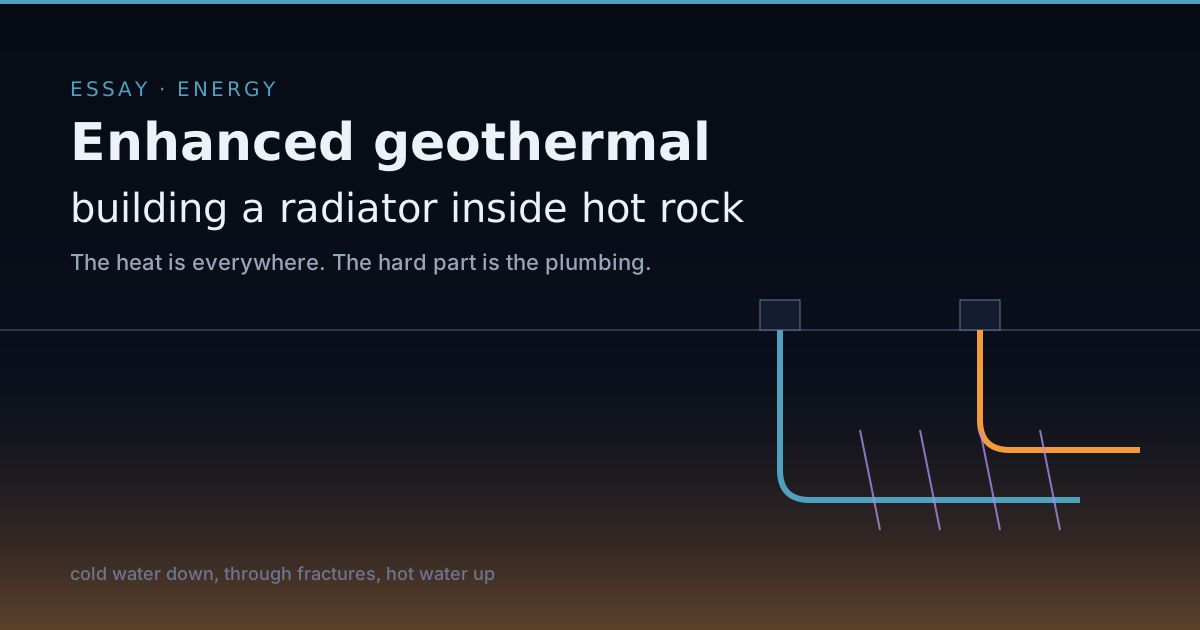
An enhanced geothermal system (EGS) manufactures the missing two ingredients. You drill an injection well and a production well, then pump water down at high pressure to open or widen existing cracks in the rock between them, a step called stimulation. Cold water goes down one well, threads through the fracture network, picks up heat from the surrounding stone and comes up the other well hot. At the surface it passes through a heat exchanger or turbine and goes back down. The rock is the boiler; the fractures are the radiator fins.
Why rock is a stubborn heat source
Here is the counterintuitive part. Hot rock is not a furnace that you tap; it is a slab that gives up its heat reluctantly. Stone is a poor conductor. Once the water has cooled the rock right next to a fracture, the next layer of heat has to crawl in from further away, and it crawls slowly.
Physicists capture that crawl with one relation: the time for heat to diffuse across a distance L is roughly t ≈ L² / κ, where κ (kappa) is the rock’s thermal diffusivity, a measure of how quickly temperature spreads through a material. For granite, κ is about one millionth of a square metre per second. In plain terms, the squared distance makes everything brutal. Heat travels one metre through granite in about two weeks. Ten metres takes around three years. Thirty metres takes about thirty years, the lifetime of a power plant.
The consequence shapes the whole engineering problem. Over a plant’s life, each fracture can only drain a few tens of metres of rock on either side of it. To produce tens of megawatts for decades, you need an enormous wetted surface: many fractures, spread across a large volume of stone, with water flowing evenly through all of them. If the water finds one easy channel and races through it, that channel cools quickly while the rest of the rock stays hot and useless. Engineers call this short circuiting, and it has quietly ended several earlier EGS projects.
This is why the recent progress has come from the oil and gas industry rather than from geology. Shale drilling spent two decades learning to drill long horizontal wells and to stimulate them in many separate stages, each one opening its own set of fractures. Turn the wells sideways and you can lay two parallel horizontal laterals through hot rock, a few hundred metres apart, and stimulate dozens of zones between them. The radiator gets more fins.
Where this stands in 2026
Fervo’s Cape Station is the clearest test of that recipe at commercial size. The company says Phase I is about 100 megawatts in three 33 megawatt blocks, the first due to enter commercial operation on 1 October 2026 and the other two by 1 January 2027, with a further 400 megawatts under construction for 2028 and roughly 900 megawatts of output already contracted to buyers. Its drilling numbers are striking, and they are company figures: an appraisal well reaching 4,805 metres of vertical depth with a projected bottom temperature of 260 °C in 16 drilling days, and a production well with a total length of 5,927 metres, including a horizontal section of about 2.3 kilometres, drilled in 21 days. Fervo reports its drilling rate has risen by 143 percent since its first well at the site.
In parallel, the public research site run for the US Department of Energy a few kilometres away, Utah FORGE, is working on the questions a company has less incentive to publish. In August 2024 it circulated water between two wells for nearly a month, recovering more than 90 percent of the injected fluid at around 188 °C. In August 2026 it began a circulation test planned to run up to four months, specifically to measure how fast the reservoir cools, how much water vanishes into the rock and what treatment the produced water needs. The data is due to go into a public repository, which matters: the long-term behaviour of these reservoirs is exactly what nobody has yet measured at scale.
A different school avoids fractures entirely. In Geretsried, Bavaria, Eavor began delivering electricity to the grid in December 2025 from a closed loop: a sealed network of multilateral wells through which a working fluid circulates without ever touching the rock directly, like a coolant pipe in an engine block. No stimulation, no lost water, no fluid pushed into faults. The price is the diffusion problem in its purest form. Heat only reaches the fluid through the borehole wall, so output per kilometre drilled is low, and the project targets 8.2 megawatts of electricity from a substantial drilling campaign.
The policy backdrop explains the investment. The US Department of Energy’s 2024 commercial liftoff report estimated that next generation geothermal could supply around 90 gigawatts in the United States by 2050, provided some 20 to 25 billion dollars went into the first 2 to 5 gigawatts this decade. The appeal is that geothermal is firm: it runs day and night at constant output, which is what grid planners and data centre operators value most once a lot of wind and solar is already in place.
What still breaks
Cracking rock with pressurised water means moving stress along faults, and some faults are already close to slipping. In Basel, in December 2006, a deep heat mining project injected water into a five kilometre well. After six days of stimulation, a magnitude 3.4 earthquake shook the city, insurance eventually paid around seven million Swiss francs in damage claims, and the project was abandoned. In Pohang, South Korea, on 15 November 2017, a magnitude 5.5 earthquake struck the city, among the strongest recorded in the country; a government commission concluded in 2019 that injections at the nearby EGS site had triggered it by reactivating a fault that had not been mapped. Some seismologists still argue that the main shock was largely tectonic, with the injection only pushing an already loaded fault over the edge. That distinction matters to geophysicists. It matters much less to a city.
Modern projects use traffic light protocols, rules that slow or stop injection when monitored microseismicity crosses preset thresholds, and they site wells away from known large faults. Those tools reduce the risk; they do not abolish it, because the fault that matters may be the one nobody has found yet.
The second open question is decline. A reservoir that runs for a month at full temperature says little about year fifteen. Short circuiting, mineral scaling in the fractures and slow water loss all appear on timescales that the industry has barely observed in engineered rock. That is precisely what the FORGE test is designed to measure, and it will cover four months, not thirty years.
The third is cost. First power is not commercial operation, and 33 megawatts is one block of a three block phase. One analysis published three days after the announcement put Phase I near 7,000 dollars per kilowatt of capacity, several times a new gas plant, with lower targets for the next phase that have not yet been demonstrated. Drilling speed is falling fast, but each well is still a multi-million dollar bet on rock that cannot be inspected before you drill.
None of these objections are arguments that the approach fails. They are the specific places where it has not yet been proven. The physics is clear: the heat is there almost everywhere, and stone gives it up slowly. Enhanced geothermal is the wager that drilling engineering can build radiators big enough, and gentle enough, to make that slowness irrelevant over the life of a plant. The next few years of reservoir data will settle more than any announcement.
Further reading
- Fervo Energy achieves first power at Cape Station, the company announcement with the phase schedule and contracted capacity.
- Utah FORGE concludes successful extended circulation test, results from the public research reservoir.
- Triggering of the Pohang, Korea, earthquake by enhanced geothermal system stimulation, the forensic analysis behind the Korean commission’s conclusion.
- Eavor’s closed-loop geothermal project produces grid power in Germany, the sealed pipe alternative to fracturing.