Wiring a brain to a machine: how a thought becomes a command
A brain-machine interface does not read minds. It taps the motor output line and reroutes it. A walk through the four stages, the decoder, and the mutual learning that makes the coupling work.
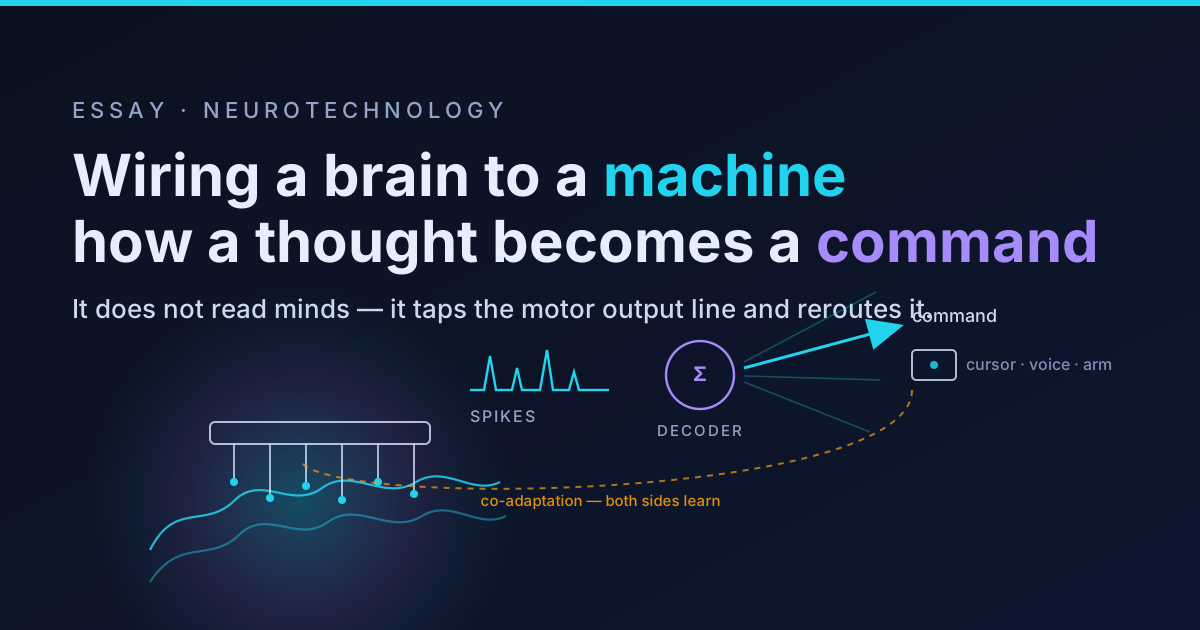
Start with the fact that tips the whole intuition over: a fully paralysed person can move a cursor, type, and even “speak”, without moving a single muscle. Not by magic, but because paralysis breaks the cable between cortex and muscles while leaving the cortex intact. When the person forms the intention to move a hand, the motor cortex lights up exactly as it did before. The command signal is still being emitted; it is simply no longer delivered. A brain-machine interface (BMI, or BCI) does one thing, and that one thing is vertiginous: it goes and fetches the signal at the source and plugs it in somewhere else: into a cursor, a speech synthesiser, a robotic arm.
Hold the founding image before any detail: a BCI is not “reading thoughts.” It is putting a tap on the motor output line and rerouting it. Everything else (electrodes, models, surgery) is engineering around that idea.
Four stages and a loop
Every BCI, from the crudest to the most advanced, is the same chain in four steps, closed back on itself.
Stage one is the cortex. When an intention to move is formed, populations of neurons in the motor cortex fire, not a single “right-hand neuron,” but thousands voting together, each slightly more active for some directions than others. Stage two is the electrodes: a sensor turns those electrical discharges into a digital signal. Stage three is the decoder: a mathematical model that translates the raw signal into a useful command. Stage four is the effector: whatever the command drives: cursor, voice, arm.
And then the loop closes. Because the person sees the cursor move, the brain adjusts its discharges to drive it better, while the decoder, in turn, re-tunes itself to the brain. The secret is not in any single box. It is in the feedback edge, two learners meeting in the middle. We will come back to why that matters more than the silicon.
The decoder, or the art of reading a crowd
The interesting part is stage three. How does one get from “thousands of neurons crackling” to “the cursor goes left”? The founding idea is called the population vector, and it is surprisingly intuitive. Each neuron in the motor cortex has a preferred direction: it fires a little for many movements, but flat out for “its” direction. Taken alone, a single neuron is a talkative, unreliable witness. Taken by the thousand, it is a poll.
The simplest decoder fits on one line:
command = Σ  weight_i × activity_i
             (summed over all the neurons read)
Do not keep the sigma; keep the image of the vote. Picture a crowd in which each person points toward a preferred direction but shouts louder or softer depending on their enthusiasm of the moment. To know where the crowd wants to go, take the average of the fingers, weighted by the volume of the shouts. One individual can be wrong; a thousand are not. The decoder is that weighted-average taker, and the modern versions (deep neural networks) only do a far craftier version of the same gesture: weighting votes to extract an intention.
There is a quiet echo here of the attention mechanism that powers modern language models. A modern decoder does not treat every neural channel the same way; it learns which ones to listen to at each moment, much as a Transformer learns which words to attend to. “Which neurons deserve my attention to decode this movement?” is, almost word for word, the precision-weighting problem the brain itself is thought to solve. We end up building machines that listen to the brain using the same principles the brain uses to listen to itself.
The trade-off that governs the field
There is one engineering tension no company can route around, and understanding it hands over the map of the entire sector. To read the brain more finely, one must get closer to the neurons, and therefore become more invasive, more risky. To stay safe, the reading is taken from a distance, and is therefore more blurred. Every approach lines up along that diagonal.
At one extreme, EEG, the cap of electrodes on the scalp, reads through the bone of the skull: zero risk, but it is like listening to a stadium from the car park: the mood comes through, not the words. At the other extreme, the intracortical electrode (the “Utah” array of needles, or the ultra-fine threads of newer devices) is planted in the tissue and listens to neurons one by one: maximal resolution, but open-skull surgery and everything that implies. Between the two sit two clever bets: laying a thin film on the surface of the cortex without penetrating it, or threading a sensor through a blood vessel up to the edge of the motor cortex via the jugular, with no opening of the skull at all.
There is no best point in the abstract. There is a best compromise given the patient, the use, and the regulatory profile aimed for, which is exactly why the field does not converge on a single design but spreads itself along the curve.
The current frontier: restoring speech
The cursor is the baseline. The 2025–2026 frontier is speech. When someone who can no longer speak tries to speak, the speech-motor cortex activates: the regions that command lips, tongue, larynx. A device places electrodes there, and a deep model translates that “silent rehearsal” into text, or directly into synthesised voice. The recent technical leap is less about accuracy than about latency: the field has moved from sentence-by-sentence decoding with several seconds of delay to streaming synthesis, near real time: the voice emerges while the person is trying to speak, not ten seconds later. That is the difference between dictating a telegram and holding a conversation.
The chain in one sentence: intention to speak → discharges in the speech-motor cortex → electrodes → deep model → audible voice in tens of milliseconds. The thought is never read; it is the motor command for speech that is caught, the same principle as the cursor, applied to the muscles of language.
Why it works: the brain adopts the machine
Here is the part worth staying awake for. A BCI does not work because the decoder is perfect. It never is. It works because the brain adapts to the machine. Return to the predictive frame: the cortex is a prediction engine that minimises error. Give it a cursor to steer and a visual feedback channel, and it will treat that cursor like a new limb. It predicts where the cursor should go, sees the gap, corrects its discharges to shrink the gap. Within a few sessions the steering becomes fluid, almost reflexive: the cortex has folded the prosthesis into its body schema.
Meanwhile the decoder travels the opposite road: it recalibrates onto the brain’s activity. Two learners converging on each other: this is co-adaptation, and it is co-adaptation, not the silicon, that makes the human-machine coupling possible. The fusion is not a plug; it is mutual learning. It is also a vivid instance of Engelbart’s old idea of augmentation: it is neither the machine alone nor the bare brain that acts, but the coupled system.
The walls that have not fallen
Honesty demands the counterweight. Three walls still stand. The first is stability over time: the brain is soft, mobile, alive, and a rigid electrode is a foreign body. The tissue reacts (scarring, micro-gliosis), threads can migrate, and the neuron captured cleanly today may fade in a few months. The promise of “for life” is an open problem. The second is decoder drift: the neural activity for the same gesture is not identical from one day to the next, so many systems require regular recalibration, a few minutes each morning to re-tune the machine to the day’s brain. The third is the bandwidth ceiling: reading a thousand neurons out of the brain’s roughly eighty-six billion is like listening to a thousand people across an entire city. Enough for a cursor or a voice; very far indeed from the fantasy of “uploading a mind.”
That last point is the one I keep returning to. The popular imagination treats a BCI as a step toward dissolving the boundary between person and machine, as though enough bandwidth would let a self leak out through a cable. The reality is both more modest and more interesting. The boundary does not dissolve; it moves, by habit rather than by matter. A cursor, a synthetic voice, perhaps one day an avatar: at some level of co-adaptation each stops being a tool one uses and becomes part of what one is. The frontier of the technology is not the implant. It is the question of where, exactly, a person ends.
Further reading
- Brain-to-voice neuroprosthesis restores naturalistic speech (UC Berkeley / UCSF): a clear, illustrated account of streaming voice synthesis from the team itself.
- NIH Research Matters, Brain-computer interface restores natural speech after paralysis: the sober institutional version of the same technical leap, good for the figures without the marketing.