Augmenting human intellect: the idea Engelbart had 60 years too early
In 1968 Douglas Engelbart demoed the mouse, hypertext and live collaboration, but those were only the shavings. The real idea was to raise human intelligence, and the industry kept the tools while throwing away the philosophy.
December 9th, 1968, San Francisco. A conference hall, a thousand engineers, the lights dimmed. On stage, a calm 43-year-old with a headset and an odd wooden box under his right hand. For ninety minutes, almost without raising his voice, Douglas Engelbart walks a stunned audience through: the mouse, on-screen windows, hypertext (clickable words that jump elsewhere), real-time text editing, and (the climax) two people at a distance editing the same document while seeing each other over video link. In 1968. While the rest of the computing world was still punching holes in cardboard cards.
It came to be called, in retrospect, the Mother of All Demos. In ninety minutes, Engelbart showed, working, almost everything we use to do knowledge work today. But here is the real subject: the mouse and the hypertext were not the point. They were only the shavings of a far larger idea. And it is that idea, not the gadgets, that still deserves attention.
The idea: not to replace the human, but to amplify them
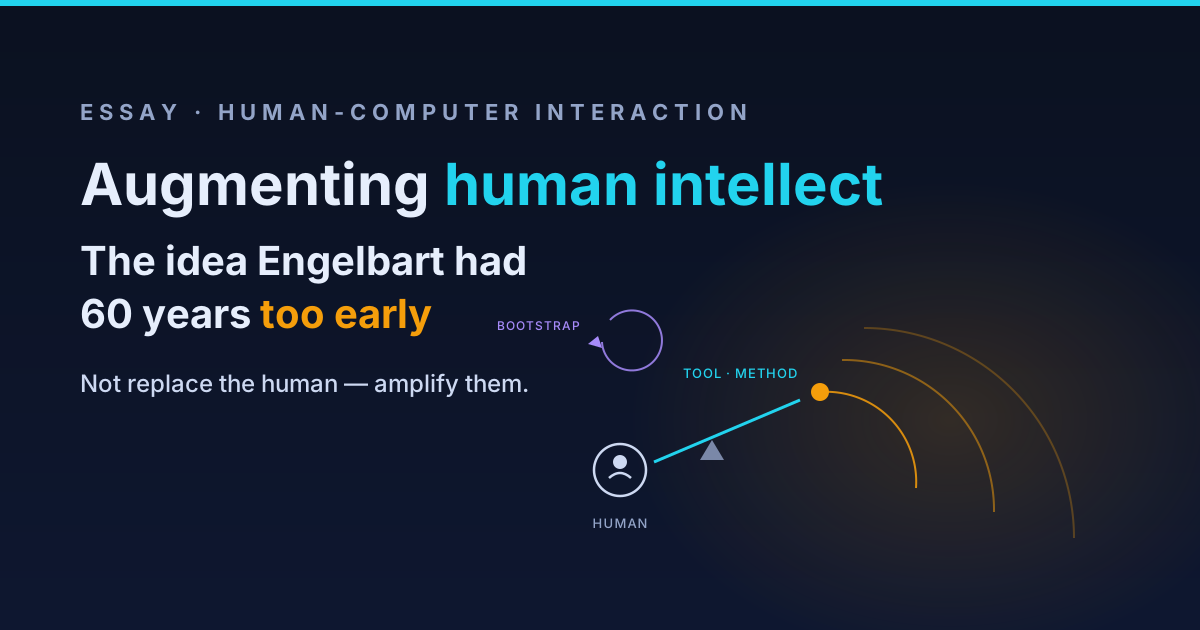
Six years earlier, in 1962, Engelbart wrote a report with a transparent title: Augmenting Human Intellect: A Conceptual Framework. His question was not “how do we build an intelligent machine?” That was everyone else’s question, the question of the newborn field of artificial intelligence. His question was the exact inverse: how do we make humans, together, radically more capable, by giving them the right tools? Not a machine that thinks in your place. A machine that lets you think higher.
His motivation was almost moral. Engelbart observed that humanity’s problems (their complexity, their urgency, their scale) were growing faster than our collective capacity to solve them. The bet: if we could raise collective intelligence even one notch (our ability to understand complex situations and find solutions together), we might catch up with the curve. The computer was not an end; it was a lever for the brain.
The dividing line: to automate is to do the work in the human’s place: the human steps back. To augment is to let the human do work they could not do alone: the human steps up. Two opposed philosophies of the machine. Engelbart planted his flag, almost alone, on the side of augmentation.
The unit that thinks is the system, not the bare brain
Engelbart refused to look at the isolated human. For him, what solves a problem is not a bare brain but a whole system, which he labelled, with an engineer’s taste for acronyms, the H-LAM/T system: a Human using Language, Artefacts (tools, paper, screen) and a Methodology (ways of proceeding), all of which they have been Trained to use. Intellectual capability is a property of the whole, not of the part called “brain.”
The shape is familiar to anyone who has met the systems reply to the Chinese Room: capability emerges from the whole system, not from the isolated component. Where one argument says “the man in the room does not understand; look at the whole system,” Engelbart, twenty years earlier, says “look at the human plus their tools plus their method: that is the unit that thinks.” A person with pencil and paper can multiply two ten-digit numbers; the same person with nothing cannot. It is not that they have become cleverer: the system of person-plus-pencil-plus-method has.
The secret engine: getting better at getting better
Here is Engelbart’s most powerful concept, and his most neglected. He did not just want better tools. He wanted tools that help build better tools, a loop that bites its own tail in the right direction. He called it bootstrapping, and organised it as three levels best pictured as a staircase: activity A is doing the work (designing, producing); activity B is improving how you do A (the tools, the methods); activity C is improving the way you improve: B improving B.
Most teams live in A: they do the work. Good ones do a little B: they sharpen their tools. Almost nobody does C: working to get better at getting better. Engelbart bet that C is where the real gains hide, because they compound: each improvement makes the next one easier, which makes the one after that easier still.
Forget the equation behind the word “exponential” and keep the picture. Two woodcutters. The first swings at the tree all day, hard, without pause: that is linear effort: you add blows one at a time. The second stops regularly to sharpen the axe: he looks slower at first, even lazy. But his axe cuts better and better, so sharpening itself gets faster, so he sharpens more often. By midday the first is exhausted and the second has felled three times as much. “Exponential” just means this: the improvement applies to itself. You are not climbing a staircase step by step; you are building an escalator that builds the next one.
That is Engelbart’s real legacy, far more than the mouse: the idea that a team (or a person) should spend a share of their energy not on the work itself, but on reducing the future cost of all their work. Sharpening the axe is honest work.
The tragedy: why almost nobody knows his name
If all this was so visionary, why is Engelbart not as famous as the founders of the personal-computer industry? Because the world took the other branch of the fork. Engelbart wanted to augment, and he accepted that this demanded learning. His system used a chorded keyboard (five keys pressed in combinations, like piano chords), tremendously powerful once mastered, but forbidding at first contact. His conviction was that, like the bicycle or the violin, you accept a learning curve because the capability at the end is immense.
The industry took the opposite branch: ease. “User-friendly,” zero learning, usable in three minutes. That is what won the market, and arguably what had to win to democratise the computer. But Engelbart experienced it as a betrayal of the idea. The tools had been taken and the philosophy thrown away. The design optimised for the beginner (make it easy), not for the augmented expert (make it powerful). The mouse survived; the dream of raising collective intelligence, much less so.
Engelbart’s dilemma, intact today: should a tool be made easy (the user stays as they are) or augmenting (the user has to grow to use it, and genuinely grows)? A great deal of the current argument about AI fits under that single question.
Why it is exploding now
That old fork, augment versus automate, is exactly the current argument about AI, only sharper, because for the first time the machine reaches past the hands (mouse, screen) and into reasoning itself. An AI can augment: prompt better questions, open more avenues, help you understand faster: the Engelbart spirit. Or it can automate: do the thinking for you while your own mind disengages. And here is the twist: cognitive science has begun to measure the difference. Early studies comparing writing with and without a language model report weaker engagement and poorer recall of one’s own output when the tool does the work rather than supporting it. (Small samples, artificial tasks: not to be oversold, but suggestive.) Engelbart laid down, in 1962, the exact reading lens we need to think about these tools in 2026. He was simply sixty years ahead of the tools capable of realising his vision.
The practical lesson survives the man. When you build something (a dashboard, an assistant, a workflow) there is always a choice hiding in the design. You can make it decide for the person, so they stop looking and stop learning. Or you can make it help the person see what they would have missed and grow more capable for using it. Both are defensible. But it is a choice, not a default, and Engelbart’s whole life was an argument for noticing that it is one.
Further reading
- Douglas Engelbart, “Augmenting Human Intellect: A Conceptual Framework” (1962): the founding manifesto, more readable than its reputation suggests.
- The “Mother of All Demos” (1968): the original video; five minutes of watching a man wield a mouse and hypertext in 1968 is a shock no summary replaces.
- The Stanford / Doug Engelbart Institute retrospectives: for why the vision was decapitated, its tools kept and its philosophy discarded.