Adaptive deep brain stimulation: the implant that listens before it stimulates
For thirty years, brain implants for Parkinson's disease pulsed at the same setting day and night. The new generation reads a signal from the brain and adjusts itself, which turns a stimulator into a small control system, and shows how hard it is to find a signal that actually means what the patient feels.
A person with Parkinson’s disease who has a deep brain stimulator lives with a device that does not know what time it is. At nine in the morning, before the first dose of medication has kicked in, their movements are slow and stiff and the brain needs a lot of help. At eleven, with the drug at its peak, the same help is too much: limbs start to writhe in involuntary movements called dyskinesias. At night, asleep, the brain needs something else again. The implant, for most of its history, delivered one setting through all of it, chosen by a neurologist in a clinic visit that might happen every few months.
That is the problem adaptive deep brain stimulation sets out to solve. Instead of pulsing at a fixed level, the implant listens to the brain through the same wires it stimulates through, and turns itself up or down according to what it hears. In early 2025 the US Food and Drug Administration approved the first commercial system to do this. In 2026, research groups started pointing the same idea at walking, the symptom conventional stimulation handles worst. The interesting part is not that the implant can adapt. It is how much depends on choosing what it adapts to.
What the old implant does
Deep brain stimulation, or DBS, places a thin electrode deep in the brain, most often in the subthalamic nucleus, a lens-shaped cluster of neurons a few millimetres across that sits in the circuit linking the cortex to the basal ganglia, the structures that help select and smooth movement. A battery pack under the collarbone sends a steady train of electrical pulses, typically more than a hundred per second, down the wire.
Nobody fully agrees on why this works. The leading picture is that in Parkinson’s disease the motor circuit falls into an overly synchronised rhythm, many neurons firing together in lockstep, and that high-frequency pulses break up that lockstep so the circuit can carry ordinary movement commands again. What is not disputed is that it works well enough to have been implanted in many tens of thousands of people since the late 1990s.
What it does not do is react. Conventional DBS, often called continuous DBS, is an open-loop system: the output is set by a person and does not depend on the state of the brain it is driving. Every adjustment between clinic visits is either a compromise setting that is a little wrong most of the time, or a handheld controller that the patient uses to nudge it manually.
The signal the implant listens for
To close the loop, the implant needs a measurement that rises and falls with the symptoms. For Parkinson’s disease, the main candidate is the beta rhythm, an oscillation between roughly 13 and 30 cycles per second in the local field potential, which is the summed electrical activity of thousands of neurons near the electrode. Beta power in the subthalamic nucleus tends to be high when a patient is stiff and slow, and drops when medication or stimulation brings movement back.
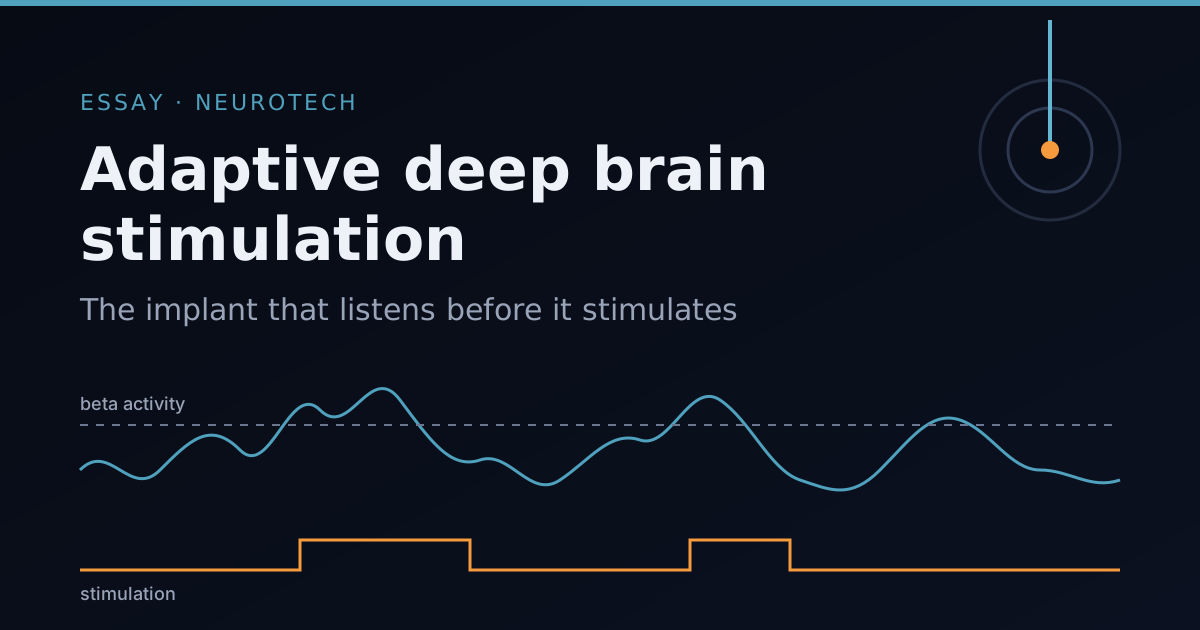
That gives the controller a rule of thumb. When beta climbs, the brain is probably sliding toward its stiff state, so stimulation goes up. When beta falls, the brain is probably being helped enough, or too much, so stimulation goes down. The commercial system offers two versions of this rule. A single-threshold mode raises or lowers stimulation when beta crosses one line. A dual-threshold mode defines a band: stimulation steps up only when beta rises above the upper line, steps down only when it falls below the lower line, and holds steady in between.
The band matters more than it looks. Beta power is noisy, and a controller that reacted to every wobble would spend its time flipping between settings, which patients can feel as tingling or sudden changes in symptoms. The gap between the two lines is a deliberate dead zone, the same trick a household thermostat uses so the boiler does not switch on and off every few seconds.
Where this stands in 2026
The commercial system is Medtronic’s BrainSense Adaptive DBS, which runs on the company’s Percept stimulators. The pivotal trial behind it, ADAPT-PD, was published in JAMA Neurology in 2025. It enrolled 68 people already stable on continuous stimulation and medication; those who tolerated both adaptive modes spent 30 blinded days in each, and then could keep their preferred mode for roughly ten months of follow-up. The main question was modest by design: would patients keep at least as much “on” time, meaning hours with good movement and without troublesome dyskinesia, as they had under continuous stimulation? Both modes met that goal. According to the trial’s conference abstract, dual-threshold mode added an average of about 1.4 hours of good “on” time per day, and single-threshold mode cut the total electrical energy delivered by about 15 percent. The trial was sponsored by the manufacturer, and the company’s own announcement of the publication frames it as the largest commercial launch of brain-computer interface technology, a description that is marketing rather than a measured result.
Read soberly, ADAPT-PD shows that a closed loop is safe and at least as good as a well-tuned open loop for people who were already doing well. It was not designed to show that adaptive stimulation is dramatically better.
The more striking results come from small academic studies that personalise the loop. In 2024 a team at the University of California, San Francisco ran a blinded feasibility trial in four patients, each of whom named the residual symptom that bothered them most. Algorithms tuned to each person cut the waking time spent with that symptom by about half compared with their optimised continuous stimulation, as Physics World reported. Four people is a demonstration, not a verdict, but the design points at the real lever: the gain comes less from adapting in general than from adapting to the right thing for each brain.
In 2026 that lever moved to walking. Gait problems, shuffling steps, irregular rhythm and freezing in doorways, respond poorly to conventional DBS and are a major cause of falls. In June, two papers in Nature Medicine tested stimulation that changes with movement itself rather than with slow shifts in symptom state. One, a randomized crossover feasibility trial in five patients, used extra electrodes over motor areas of the cortex to detect the brain signals tied to each step and adjusted stimulation within fractions of a second, in time with the gait cycle. In the clinic it reduced the variability of step length and step timing and improved symmetry between legs; in a blinded phase at home, falls were less frequent with the adaptive mode switched on. The other, from a separate group, used activity-dependent stimulation in four people with walking problems that had resisted standard treatment, and reported improvements in real-world settings.
The shift is conceptual as well as technical. The ADAPT-PD controller tracks the slow tide of medication across a day, with adjustments over minutes. The gait controllers track the fast cycle of a single step, with adjustments over a fraction of a second. Both are called adaptive DBS. They are solving different problems on timescales a thousand times apart.
What still breaks
The weakest link is the signal. Beta power is a population-level average, and it does not show up equally in everyone. In some recordings there is no clear beta peak to track at all; in others, beta drops with medication but not reliably enough to catch every bad hour. One small series on the commercial device found that the beta signal often failed to flag when patients had slipped into their stiff state, which is exactly the moment the loop exists to catch. Without a clean biomarker, a measurable signal that tracks the symptom, the controller is steering on a blurred instrument.
The signal is also tiny. Neural activity near the electrode is measured in microvolts, while the stimulation pulses and the heartbeat are thousands of times larger. Electrical interference from the heart contaminates a large share of recordings from implants placed on the left side of the chest, an artifact that signal-processing studies have had to develop dedicated filters for. An implant cannot ship a laboratory’s offline cleaning pipeline inside a battery-powered can.
Then there is the question of what the loop is optimising. Beta is a proxy for slowness and stiffness. It says little about tremor, mood, speech or sleep, and the gait studies needed a second set of electrodes on the cortex precisely because the deep signal did not capture walking. In one of the 2026 gait studies, a participant who was satisfied with beta-based adaptive stimulation overall still struggled during long walks and ended up returning to manually raised settings for those periods. A loop that serves one symptom can underserve another.
Finally, scale and independence. The most impressive results come from groups of four or five people. The only large trial was industry-sponsored and set out to show equivalence, not superiority. Nobody yet knows how well adaptive settings hold up over years as the disease progresses, or how much clinician time the extra tuning consumes, which matters because programming effort is already one of the bottlenecks of DBS care.
A thermostat inside the brain
It is tempting to describe adaptive DBS as the first mass-market brain-computer interface, and in a narrow sense it is: a device reads neural activity and acts on it without a human in the loop. But the more useful comparison is a thermostat. A thermostat does not understand comfort; it measures temperature and trusts that temperature stands in for comfort. Adaptive DBS measures an oscillation and trusts that the oscillation stands in for how the patient feels. When the proxy is good, the loop quietly does better than any fixed setting could. When the proxy drifts from the experience, the loop optimises the wrong quantity with perfect consistency.
That is the real frontier here, and it is shared with every machine that acts on a body. Building the loop turned out to be the easy part. Deciding what the loop should listen to, and accepting that the answer may be different for each brain, each symptom and each hour of the day, is where the work now is.
Further reading
- ADAPT-PD trial in JAMA Neurology: the pivotal study of chronic adaptive DBS in daily life.
- Gait-synchronized adaptive DBS, Nature Medicine 2026: the randomized feasibility trial that linked stimulation to individual steps.
- Activity-dependent adaptive DBS improves gait, Nature Medicine 2026: a second, independent approach to walking.
- Removing heartbeat artifacts from implant recordings: why listening to the brain from inside the body is harder than it sounds.