A history of artificial humans: what every automaton reveals about its age
The dream of building a person runs from Greek myth to the humanoids of 2026. Each era's artificial human is a mirror of what that era believed life and mind to be: a breath, a mechanism, a spark, and now information.
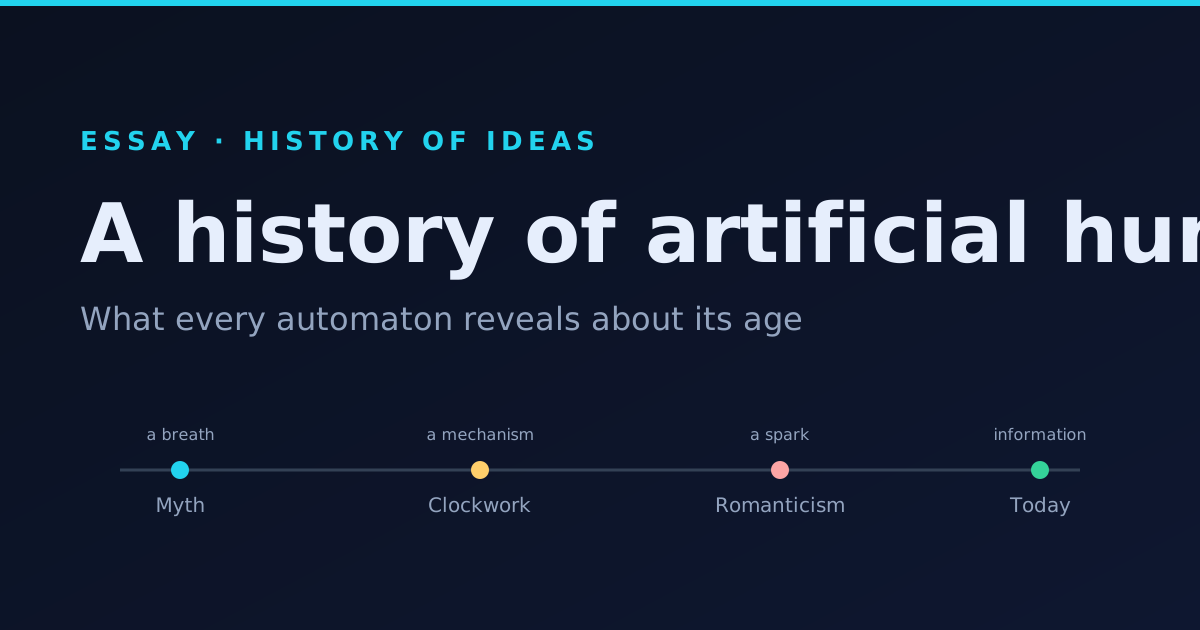
There is a single thread that runs through the whole of human history: the urge to build a person. Not a tool, not a statue: a person, something that moves on its own, that seems to want, perhaps that thinks. The dream returns in every century, but it never keeps the same face. And that is the fascinating part: the shape a culture gives its artificial human tells you almost everything about how that culture understood life and mind. Follow the thread, and you are reading, in negative, the history of the idea of the self.
Act I · The mythic dream: life is a breath you blow in
Before any technique, there is myth, and myth is already a blueprint. The Greeks told of Talos, the bronze giant who guarded Crete by circling the island three times a day: the first “sentinel robot” in literature, forged by a god. They told of Pygmalion, the sculptor who falls in love with his statue and whom Venus brings to flesh: desire animating dead matter. Hephaestus, the smith-god, is even helped by golden servants “endowed with reason.”
Elsewhere, Jewish tradition gives us the Golem: in the legend of sixteenth-century Prague, a rabbi shapes a giant from clay and animates it by inscribing a word on it: the name of God, or the word “truth” (emet). Erase one letter and it returns to mud. Hold on to that detail: here, what gives life is not a mechanism but language: a breath, a name, a word. It is a deep intuition that will come back to haunt computing centuries later: what if life were information?
Myth was not only fable. In parallel, real engineers were building real automata. Hero of Alexandria (first century) made animated theatres, temple doors that opened “by themselves” with steam, birds that sang on air pressure. In the thirteenth century the Arab engineer Al-Jazari described programmable automata: a mechanical band on a boat whose tune you changed by moving pegs on a camshaft. The technical brick of the “program” was already there, seven centuries before the computer. Yet in the mind of the age these marvels stayed imitations: real life came from elsewhere, from a divine breath no cogwheel could counterfeit.
Act II · The age of the clock: what if the living thing were ONLY mechanism?
A decisive turn arrives in the seventeenth and eighteenth centuries. Europe fills with clocks; the watch becomes the metaphor for the world. And a philosopher dares to turn it against the living. Descartes declares that animals are beast-machines: a yelping dog is hydraulics and springs, not a soul. He rescues the human by reserving for us a separate “thinking thing” (the famous mind–body dualism). But the door is open, and someone will walk through it.
That someone is La Mettrie, who in 1747 publishes a pamphlet with a title like a bomb: Man a Machine. His scandalous thesis: no human exception. Man too is a machine: a more intricate, more finely assembled one, but a mechanism. Thought, emotion, soul: all of it emerges from organised matter. The book is burned, the author exiled. But the idea is loose, and it is exactly the question AI engineers still ask: if mind is only arranged matter, then in principle it can be re-built.
And the century matched word with deed. Clockmakers built astonishing androids. In 1738 Vaucanson unveiled his Digesting Duck: it flapped, pecked at grain, swallowed and “digested” it (a fraud, a hidden compartment, but the public believed). Then, between 1768 and 1774, the Swiss Jaquet-Droz family built three automata still alive today in the museum of Neuchâtel. The most unsettling, The Writer: 6,000 parts, a doll that dips a real quill in ink and writes any sentence of up to 40 characters, because you can reprogram it by changing cams. Its eyes follow its hand. Many historians see in it a legitimate ancestor of the computer: a state machine, reprogrammable, executing a “memory” engraved in metal.
The illusion, already: the Mechanical Turk
In 1770, von Kempelen unveiled the Mechanical Turk: an automaton that played chess, and won, against Napoleon and Benjamin Franklin alike. It was a sensation across Europe for decades. It was a hoax: a human chess player was hidden inside the cabinet. The lesson is worth its weight in gold: the human brain is desperately eager to believe that a machine thinks. We project an inner life onto the smallest scrap of clever behaviour. (This is why, two centuries later, Amazon named its human micro-labour platform “Mechanical Turk”, a wink at the fake robot stuffed with people.) Keep that critical reflex: “it looks like it’s thinking” has never proved “it thinks.”
Act III · The Romantic recoil: and what if we shouldn’t have?
Until then, the artificial human amazed. Then, in 1818, a twenty-year-old woman flipped the table. Mary Shelley published Frankenstein, subtitled The Modern Prometheus. For the first time the story no longer asked “can it be done?” but “what happens next?” The creature is not a toy: it suffers, it learns, it begs for love, and it is the rejection by its maker that turns it monstrous. The horror stops being mechanical and becomes moral. The artificial human becomes a mirror of our fears: the creator’s hubris, our responsibility toward what we make, the creature that might deserve better than us.
A century later, the dread found a word. In 1920 the Czech playwright Karel Čapek wrote R.U.R. (Rossum’s Universal Robots) and coined the term “robot”, proposed, he said, by his brother Josef. It comes from the Czech robota: drudgery, the forced labour of serfs, from the root rab, “slave.” That is no accident: from birth, the word “robot” says a servant made to toil. And in the play? The robots revolt and wipe out humanity. In a single work, Čapek engraved the narrative template that still rules science fiction a century on: we build artificial slaves, they rise up. Terminator, Blade Runner, The Matrix: all children of robota.
Against that fear, one response: govern the creature. In 1942 Isaac Asimov set out his Three Laws of Robotics (do not harm a human, obey, protect yourself, in that order). It was the first great attempt to turn panic into ethics, the direct ancestor of today’s debates on aligning AI. The dream of the artificial human now has its twin poles: wonder (we can create!) and dread (at what price, and who is in command?).
The thread, gathered
Put the pieces back together and the picture becomes clear. In every era the artificial human changes its material (bronze, clay, cogs, stitched flesh, silicon) because the material tracks the era’s theory of life: a divine breath, then clockwork, then the electricity and chemistry of the living, then information and computation. Our humanoids of 2026 are the endpoint of that shift: for us, to “give life” is to run the right program on the right body. The Golem’s intuition (life as word, as information) has won.
But the old question has not moved an inch: this being that acts like a person, is it truly someone, or a perfect mime? The Mechanical Turk reminds us how easily we are fooled; Frankenstein reminds us that if it really is someone, we owe it duties. Three thousand years on, we hold better dolls; we still have not settled the question that matters.
Where this stands in 2026
For the first time, the descendants of the mythic servant are doing actual work in the real world. Figure AI’s humanoid (Figure 03) is deployed as a fleet of around 40 units at BMW’s largest plant, billed, by the company, at roughly 25 dollars per robot-hour, after an earlier generation that reportedly helped assemble tens of thousands of vehicles; BMW is now extending the trial to a second site. The dream of robota is being realised to the letter.
The gap between announcement and use, though, is the Mechanical Turk in corporate dress. Tesla says it started its Optimus (V3) line in early 2026 and deployed a few hundred units inside its own factories, still under supervision, yet as of mid-2026 there are no public sales and no consumer pre-orders, with availability pushed to “late 2027 at the earliest.” Always separate the demo from the deployment. Meanwhile the Norwegian start-up 1X has opened pre-orders for NEO, pitched as the first humanoid for the home: around 20,000 dollars (or a monthly subscription), 30 kilograms, driven by tendon-like actuators to stay soft and safe near people. (These figures are vendor claims; treat them as such.) That last one is the moment the artificial human walks into the house rather than the factory, and Shelley’s question (what do we owe it?) and Čapek’s (whom does it obey?) become questions for the living room.
Further reading
- The Czech Play That Gave Us the Word “Robot” (MIT Press Reader), the best way in to Čapek, robota and R.U.R.: vivid, clear, well told.
- The Jaquet-Droz automata · the Writer, the Draughtsman, the Musician (Watch Explorer), to actually see the 6,000-part Writer of Neuchâtel: photographs, video, mechanism. The closest thing to an eighteenth-century computer.
- Pierre Jaquet-Droz (Linda Hall Library), the historical file: who built these programmable androids, when and how.
- R.U.R. (Encyclopædia Britannica), the reliable synthesis of the play, its reach and its legacy, to anchor the dates.